
Heliciel searches, on the angles actually tabulated in your polars, the twist giving the best glide ratio without losing lift.
Optimal 3D wing twist, at conserved lift
A wing of finite span does not work at the same angle everywhere: the circulation decreases towards the tips, and the induced angle varies along the span. Twist — giving each section its own setting angle — is the classical answer. What remains is to know which twist.
1: Starting from a computed wing
Open a wing or foil project, compute it, and note two figures at the current operating point: the lift and the glide ratio. These are the two terms of the bargain you are about to strike.
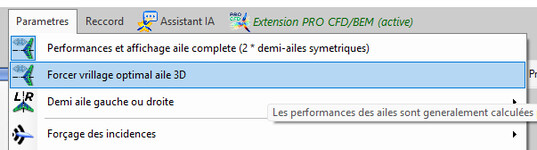
The menu entry
2: The constraint, and why it matters
Heliciel's search obeys two explicit rules:
- the lift of the current operating point is conserved. Without that constraint, improving the glide ratio would be trivial: it would be enough to lift less;
- the search is made on the tabulated angles of your polars. Heliciel does not invent an operating point between two computed values: it chooses among what the database actually contains. If your database is coarse, make it denser — see the numerical wind tunnel.
3: Reading the new distribution
After the search, the distribution of angles of attack along the span has changed. That is the useful result: it is read, it is discussed, and it is manufactured — it is a spar twist, not an abstract setting.
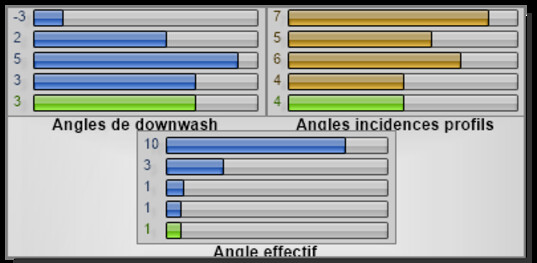
Before
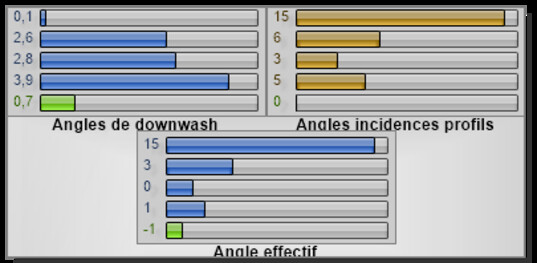
After
4: Checking the gain — and the lift
Compare the glide ratio before and after, then check the lift: it must be conserved. That is the check that validates the exercise.
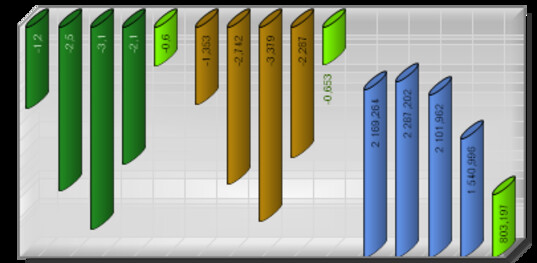
The balance sheet
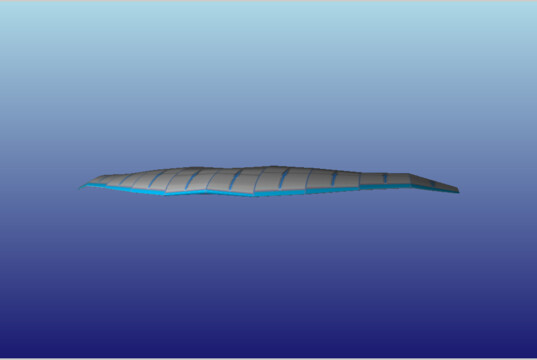
The twisted wing
One reminder about reading the figures: the model loaded for a wing is a half wing, and the full wing display option doubles the performance displayed — see the conventions.
 Global site map
 Mecaflux
 Tutorials Mecaflux Pro3D
 Tutorials Heliciel
 Tutorials Heliciel PRO CFD
 Mecaflux Store
 Compare software functions
 Quotes, Orders, Payment Methods
 project technical studies