
Propeller operating point and blade twist: input, apparent speed, off-design
The operating point of a propeller is the pair formed by the fluid speed and the rotation speed. The two speeds combine into an apparent speed and an apparent angle on every blade profile, and these set the blade twist (the pitch angle of each section) that suits the propeller. In Heliciel, you enter them in the 1.3: Operating point tab, and the software then computes the geometry and the performance that go with them.
On this page:
- 1: Entering the operating point in Heliciel
- 2: Apparent speed and apparent angle along the blade
- 3: Tangential speed and blade sections
- 4: From the operating point to the blade twist
- 5: When the operating point changes: off-design mode
1: Entering the operating point in Heliciel
Here you enter the fluid velocity upstream of the blade, which is the speed of the aircraft, the boat or the wind, and the rotational speed of the propeller if you know it. If you do not, you can let Heliciel find it: that is the job of the optimisation tools described on the page about the optimal rotation speed and number of blades.
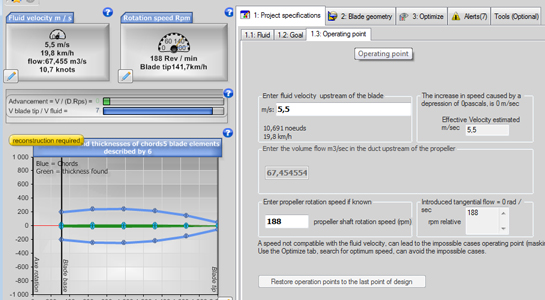
The operating point entry tab: the upstream fluid speed (here in m/s, with its conversion to km/h and knots), the volume flow rate for a ducted propeller, and the rotation speed in revolutions per minute.
The Restore operation points to the last point of design button puts the operating point back to the one the blade was last designed for. It is handy after some off-design trials.
2: Apparent speed and apparent angle along the blade
The fluid speed and the rotation speed each have their own direction: the fluid arrives along the axis, and the blade turns around that axis. They therefore add up to an apparent speed and an apparent angle, which is what the profile "sees" coming. They change with the place on the blade you look at.
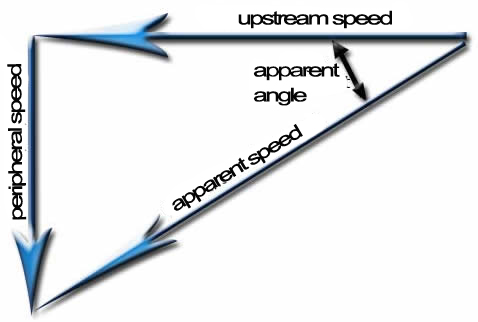
The velocity triangle: the upstream fluid speed and the tangential speed make up the two sides, the resultant is the apparent speed, and the apparent angle is the one it makes with the fluid direction.
This angle thus varies with the rotation speed as well as with the fluid speed. This pair of speeds is the operating point of our propeller.
3: Tangential speed and blade sections
The tangential speed, in m/s, of a point on the blade is the perimeter of the circle it describes multiplied by the number of revolutions per second: v = 2 π r n, with r the radius in metres and n the rotation speed in revolutions per second. If you cut the blade into slices, you find that, for the same rotation speed, a slice at the blade tip moves much faster than a slice close to the axis.
A hypothetical example, to fix ideas: at 10 revolutions per second (600 rpm), a profile 0.10 m from the axis moves at about 6.3 m/s, and a profile 0.50 m from the axis at about 31.4 m/s. If the fluid arrives at 5 m/s, the apparent angle, measured as in the previous figure, is then about 52° near the axis and 81° at the blade tip.
Blade sections are usually airfoils. The part of the blade between two profiles is a blade element: on each of these elements, the BEM (Blade Element Momentum) method draws up its force balance.
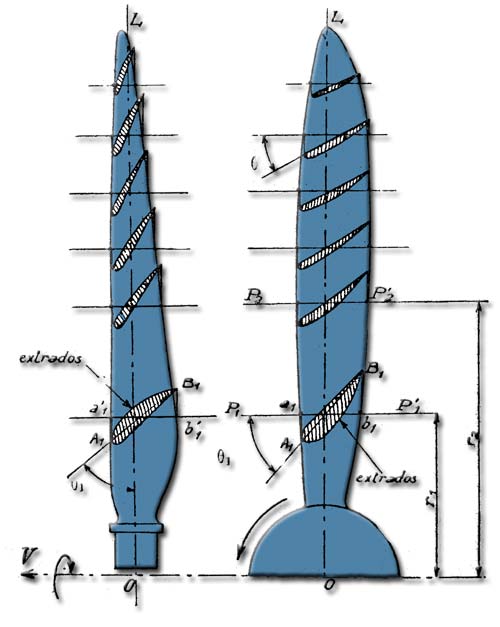
A blade seen from the front and from the side: the inclination of the profiles changes from one radius to the next, which is the twist.
4: From the operating point to the blade twist
Since the speed of a profile at the blade tip differs from that of a profile close to the axis, the relative flow varies in angle and in speed with the distance from the propeller axis. For the angle of attack of every profile to stay at its optimum, the pitch angle (the angle between the plane of rotation and the chord of the profile) must therefore vary with the direction of the relative flow. This is the twist of the blade.
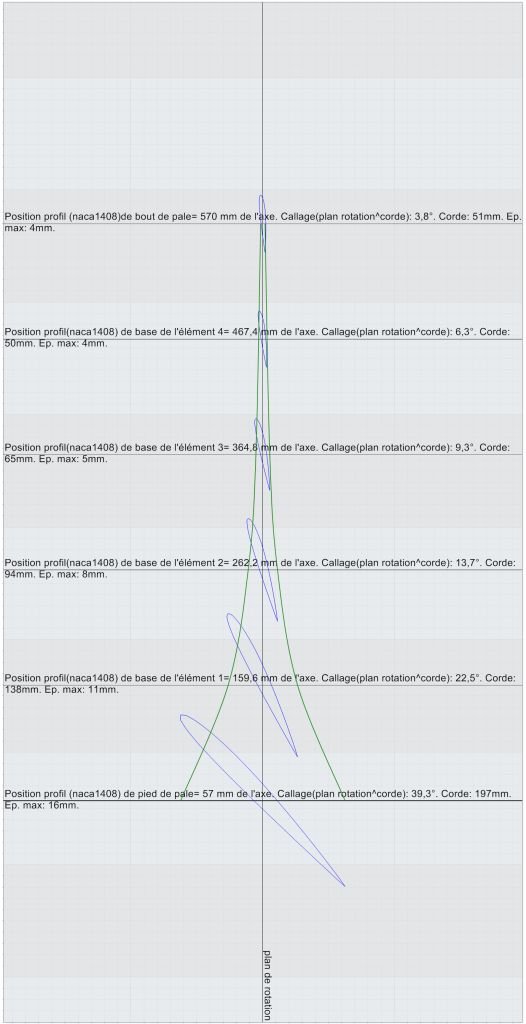
The blade twist drawing computed by Heliciel: from 39.3° at the blade root to 3.8° at the tip, according to the values written on the drawing.
The operating point therefore also determines the twist. A blade is twisted so that its angles are optimal at one precise operating point.
5: When the operating point changes: off-design mode
If the rotation speed or the fluid speed varies, the twist of the blade is no longer optimum. The propeller then works outside its design point: this is the off-design mode. Its profiles no longer work at their best angle of attack, and its efficiency drops accordingly. Heliciel handles both situations:
- rebuild the optimum twist for the new operating point

- calculate the off-design performance of the existing blade

To go further, we can compare several operating points in one go with the multiple operating point analysis, or see how to change the pitch angle and pitch of the blade to suit a given point.
 Global site map
 Mecaflux
 Tutorials Mecaflux Pro3D
 Tutorials Heliciel
 Tutorials Heliciel PRO CFD
 Mecaflux Store
 Compare software functions
 Quotes, Orders, Payment Methods
 project technical studies