
Coefficients measured on existing turbines, plotted against the specific speed, give plausible starting dimensions.
Similitude statistics of Kaplan, Francis and Pelton turbines
The statistics tabs plot, against the specific speed Ns, coefficients measured on built machines, and derive starting dimensions from them. These are plausible orders of magnitude, not guarantees. Only the Kaplan values feed the sizing; Francis and Pelton are given for information.
Turbine similitude tab, Propeller-Kaplan statistics, Francis statistics, Pelton statistics, Ref. A. Tenot, Ref. ESHA and Ref. Layman sub-tabs. Each block explained here carries a ? help icon in the window: clicking the icon opens the matching section of this page directly.
Contents:
- Propeller-Kaplan statistics: extrapolation and similitude
- Francis statistics (information)
- Pelton: runner and jet diameter from statistics
- Pelton: runner and jet diameter from the jet velocity
- Pelton: bucket dimensions
- The references: A. Tenot, ESHA, Layman
Propeller-Kaplan statistics: extrapolation and similitude
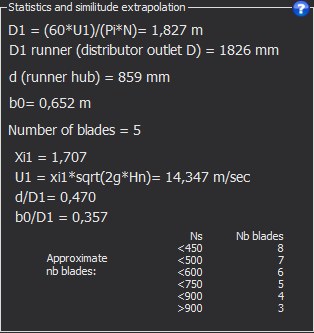
- Open the Propeller-Kaplan statistics tab after setting the test rpm.
- Read the coefficients at the current specific speed and the derived dimensions.
The chart plots the coefficients against Ns; the block reads the value at your Ns and derives the dimensions:
- U1 = ξ1·√(2·g·Hn) and D1 = 60·U1 / (π·N): the runner diameter, equal to the distributor outlet;
- d/D1, which gives the hub d, and b0/D1, which gives the guide vane height b0;
- an approximate blade number.
These are the values applied by the "Kaplan statistics" choices of the runner diameter, the height b0, the hub and the blade number.
Example
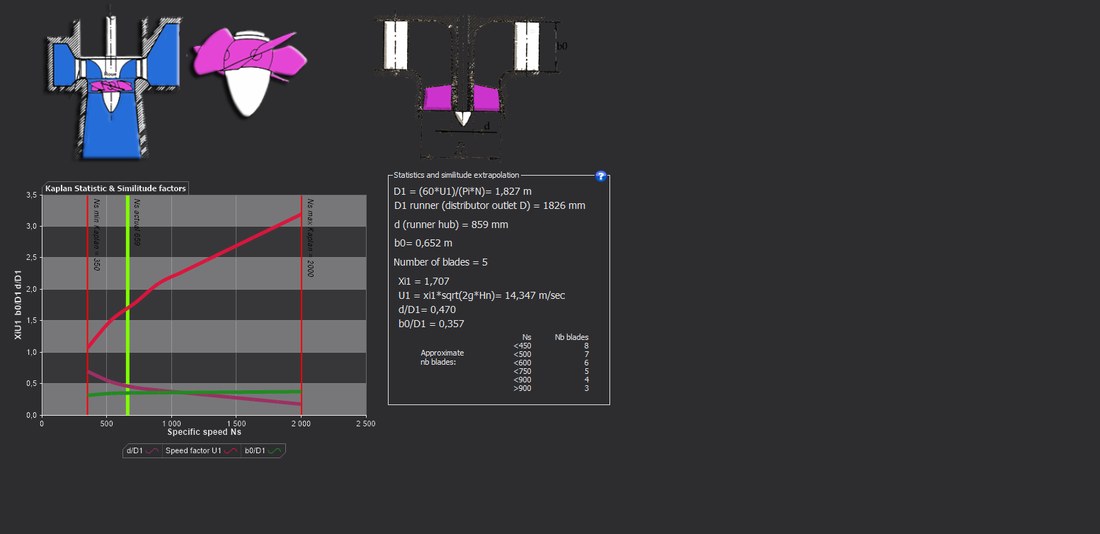
The Propeller-Kaplan statistics tab: similitude curves against Ns and extrapolated dimensions.
Francis statistics (information)
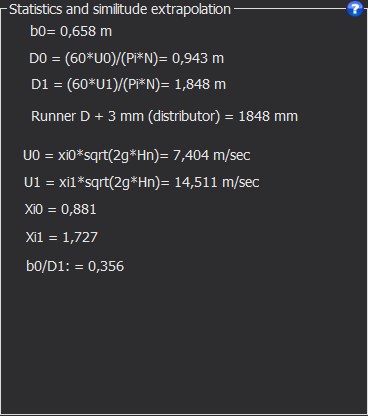
U0 = ξ0·√(2·g·Hn), D0 = 60·U0 / (π·N); U1 = ξ1·√(2·g·Hn), D1 = 60·U1 / (π·N); b0 from the ratio b0/D1; distributor diameter = runner D + 3 mm.
These values are for comparison: the window neither draws nor computes a Francis runner.
Example
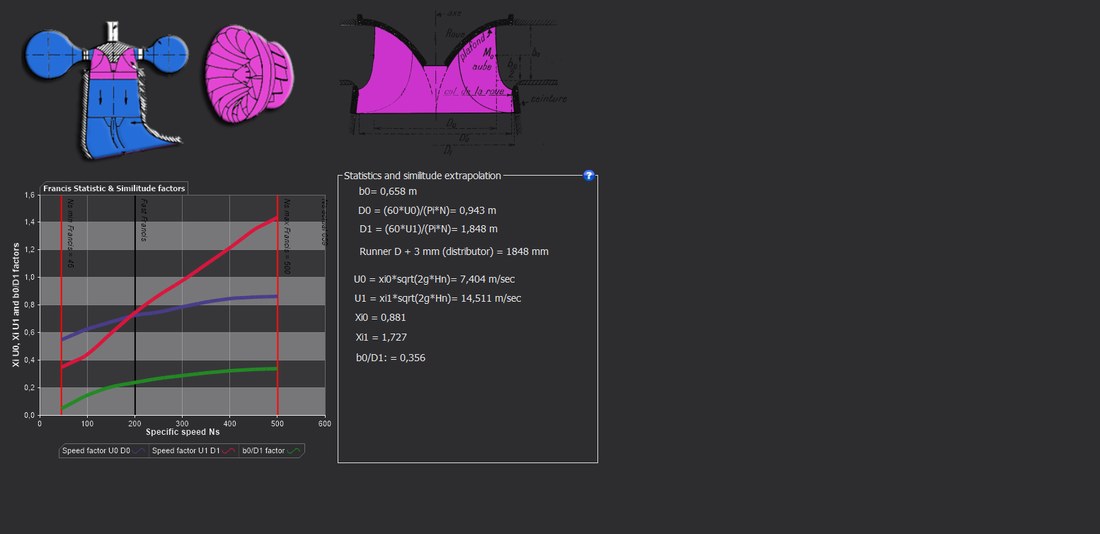
The Francis statistics tab (information).
Pelton: runner and jet diameter from statistics
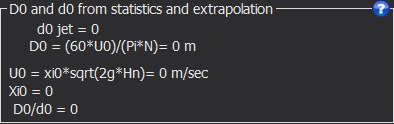
U0 = ξ0·√(2·g·Hn), D0 = 60·U0 / (π·N); the ratio D0/d0 read on the statistics gives the jet diameter d0. Information only.
Example
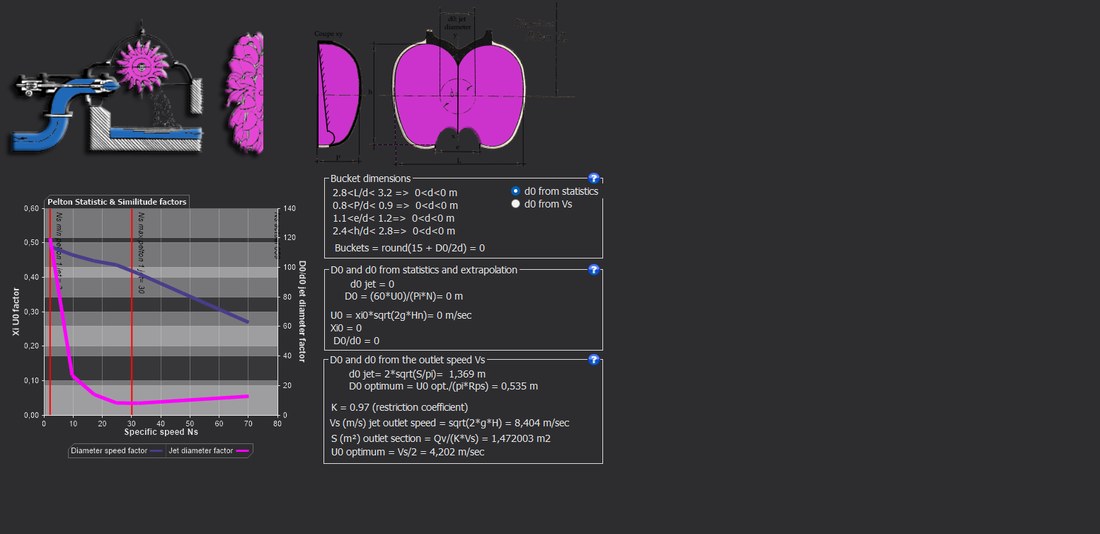
The Pelton statistics tab (information).
Pelton: runner and jet diameter from the jet velocity
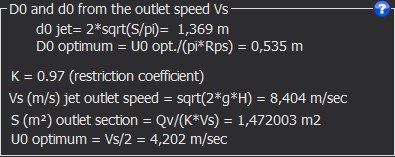
Vs = √(2·g·Hn); outlet section S = Qv / (K·Vs), with K = 0.97 (restriction coefficient); d0 = 2·√(S/π).
The optimum bucket speed is half the jet speed: U0 = Vs/2, hence D0 = U0 / (π·N), N being here in rev/s. Information only.
Pelton: bucket dimensions
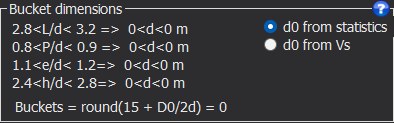
Number of buckets = round(15 + D0 / 2d0). Proportions relative to the jet diameter d0: 2.8 < L/d0 < 3.2; 2.4 < h/d0 < 2.8; 0.8 < P/d0 < 0.9; 1.1 < e/d0 < 1.2.
The reference jet is chosen: "d0 from Vs" (jet velocity) or "d0 from statistics" (statistics). Information only.
The references: A. Tenot, ESHA, Layman
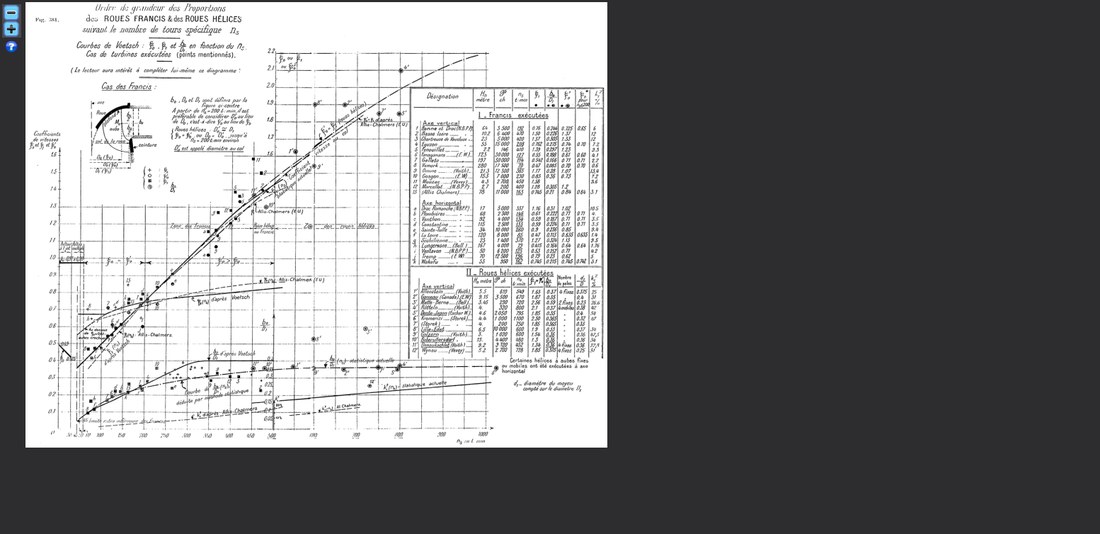
- Open the Ref. A. Tenot tab.
- Zoom with the + and − buttons to read the chart.
Three tabs show the documents the statistics and formulas come from: the A. Tenot statistical chart, zoomable with the + and − buttons, the ESHA small hydropower guide, and the Layman guide. The curves of the statistics tabs are taken from them, and the ESHA runner diameter and hub formulas come from the second one.
Going further
The Hydro Turbine design reference page presents the complete method and a worked case. The other help pages of the window:
 Global site map
 Mecaflux
 Tutorials Mecaflux Pro3D
 Tutorials Heliciel
 Tutorials Heliciel PRO CFD
 Mecaflux Store
 Compare software functions
 Quotes, Orders, Payment Methods
 project technical studies