
Wind turbine rotor, the wind engine of the turbine: tip speed ratio and number of blades
The wind turbine rotor is the wind engine of the turbine: an energy-harvesting propeller whose blades turn the speed of the wind into torque on the shaft. Its performance depends on two linked choices, rotation speed and number of blades, which a single ratio sums up: the tip speed ratio. This page shows how to make them, from the operating point to the number of blades.
To place this page: the components of the wind turbine carry out the transformation of wind energy into power, and the notions of efficiency and limits are defined in the article on energy-harvesting propellers. To go hands-on, the wind turbine propeller design tutorial walks through the full calculation.
In this page:
- Wind turbine diameter calculation and operating point
- Blade twist and variable pitch
- Choosing the nominal wind speed
- Rotation speed, generator and gearbox
- Rotation speed, torque and wind turbine rotor efficiency
- Tip speed ratio: advantages and disadvantages
- How many blades for a wind turbine?
1: Wind turbine diameter calculation and operating point
The geometric definition of a wind turbine starts with choosing its diameter, according to the wind at the site and the power we want to produce. Once we know the average wind speed, we quickly estimate the propeller diameter needed to produce the desired energy (see energy-harvesting propellers and the relation between power and wind speed).
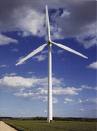
A three-bladed wind turbine, the most common configuration.
To build a wind turbine and choose the shape and number of its blades, we first have to establish its operating point. It consists of the wind speed, which we cannot change, and the rotation speed of the rotor. Choosing the operating point therefore means choosing the optimum rotation speed. The following sections review the parameters that determine it; the page on optimizing rotation speed and number of blades goes deeper.
2: Blade twist and variable pitch
The operating point determines the twist of the blades. A fixed-pitch propeller is designed and twisted for one operating point. A variable-pitch propeller is too: variable pitch does not change the twist. It is often used to adapt the pitch or to regulate speed, but the twist stays designed for a single operating point, the one where the wind turbine will reach its best efficiency. Once the blade is built, we can no longer change it.
3: Choosing the nominal wind speed
Our wind turbine will therefore have a rotation speed matched to a nominal wind speed, the one where its efficiency is highest. We choose it by analysing the meteorological and statistical data of the site. These statistics must be read in terms of power, not speed, because power grows with the cube of the speed. Two hours of wind at 10 km/h bring 2 × 10³ = 2,000 units of energy, whereas a single hour at 20 km/h brings 1 × 20³ = 8,000, four times more (the calculation is detailed on the page about the operating speed of the wind turbine).
4: Rotation speed, generator and gearbox
On a small wind turbine, the centrifugal force at the blade tip allows rotation speeds high enough to drive a generator directly. The largest wind turbines are often fitted with a gearbox, to keep a reasonable rotation speed. Yet some large wind turbines have slow generators without a gearbox, and some small ones have a gearbox.
There are endless combinations of "rotation speed / gearbox / generator". The choice is usually driven by manufacturing cost (the copper in the generator) and maintenance cost (high rotation speed means fast wear).
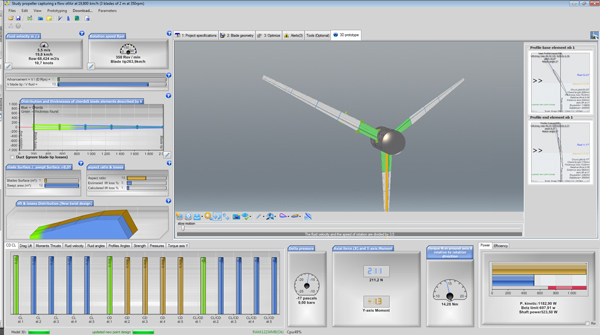
Study of a three-bladed wind turbine in Heliciel: the 3D view of the rotor, the performance curves and the results at the chosen operating point.
5: Rotation speed, torque and wind turbine rotor efficiency
The operating point is therefore tied to a manufacturing strategy: the rotation speed you choose sets the operating point. Efficiency must be assessed too. The power of our propeller is the shaft torque (N·m) multiplied by the rotation speed (rad/s). The torque results from the force that the wind applies to the blades. Here is how rotation speed plays on this torque:
- When the rotation speed is low, the apparent wind and the angles of attack of the sections give lift forces better aligned with the plane of rotation, and drag slows the rotation less.
- But as the rotor slows down, the apparent gap between the blades grows. To avoid losing the energy of the air passing between them, we must add blades, but not too many, as they could disturb each other. There is therefore an ideal rotation speed for each number of blades.
- For the best efficiency / manufacturing cost ratio, we look for a minimum number of blades.
- But to use all the air with few blades, we must turn faster so that the "apparent gap" between blades shrinks to its ideal size.
- However, high rotation speeds give less favourable projections of lift and drag, which hurts efficiency.
- These drawbacks are offset by two facts: sections perform better at high speeds, and for the same power, a high rotation speed produces less reaction torque. The flow is then spun less, and losses are lower.
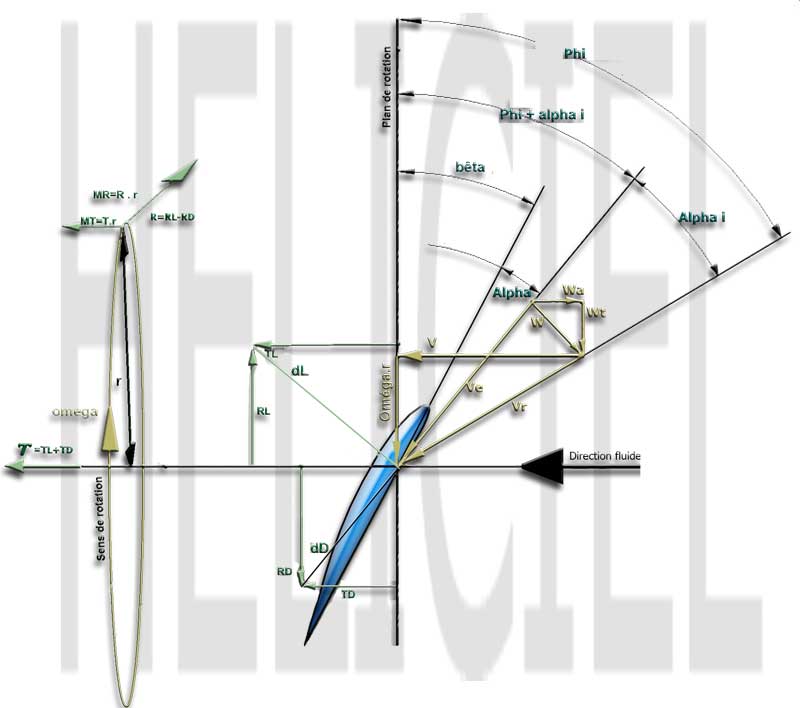
Velocities, angles and forces on a wind turbine blade section: the induced velocity (W) changes the angle of attack seen by the section. The rotor's performance is that of its sections.
Aerodynamic or hydrodynamic sections are a bit like people: there are tall ones, small ones, sturdy ones, slim ones, and each has the flaws of its qualities. Give them the right conditions and the best comes out. Enough philosophy, back to our sections. The performance of our wind turbine rotor is that of the sections making up the blades. It is expressed by the Cl/Cd ratio, called the lift-to-drag ratio of the airfoil. This ratio varies with the speed of the fluid: some airfoils, cambered ones, have a good ratio at low speed and become less good at higher speeds.
6: Tip speed ratio: advantages and disadvantages of high and low values
To sum up, we assess rotation speed through the tip speed ratio (specific speed): the speed at the blade tip divided by the wind speed. The two tables below compare a high and a low tip speed ratio.
High tip speed ratio
| Advantages | Disadvantages |
| It captures the energy with few blades, thus bringing the advantages of a light rotor: low manufacturing cost. | The projection of drag and lift is less favourable, which demands good-quality airfoils, sometimes difficult to make. |
| The tangential rotation of the flow downstream of the propeller reveals the energy lost by the system. At equal power (P = torque in N·m × rotation speed in rad/s), a high rotation speed uses less torque and therefore generates fewer losses. | Starting torque is often insufficient to start at low wind speeds, so starting assistance is sometimes needed. |
| Rotation speeds are closer to those of generators (the generator and gearbox cost less). | Rotation speed and torque are unsuited to pumping. |
| Exposure to violent winds is low, thanks to feathering. |
Low tip speed ratio
| Advantages | Disadvantages |
| It allows simple blade shapes, cheap to manufacture. | To get good efficiency, many blades are needed (more expensive, heavier, more wind load in storms). |
| It starts even at low wind speeds. | The tangential rotation of the flow downstream of the propeller reveals the energy lost by the system. At equal power (P = torque in N·m × rotation speed in rad/s), a low rotation speed uses more torque and therefore generates more losses. |
| Rotation speed and torque are well suited to pumping. | Rotation speeds are unsuited to generators (the generator and gearbox cost more). |
This list is far from complete, because each wind turbine is a compromise dictated by the constraints of the project. In our tutorial, we chose a small number of blades producing electricity. We take three blades, because two blades or one cause problems of vibration and mechanical endurance. The optimum tip speed ratio (blade tip speed / wind speed) of a three-bladed wind turbine is generally close to 7.
7: How many blades for a wind turbine?
The number of blades depends on the use. If you want to run a machine at low speed with little wind, like wind pumps, and be sure to start even in light wind, you will fit many blades.
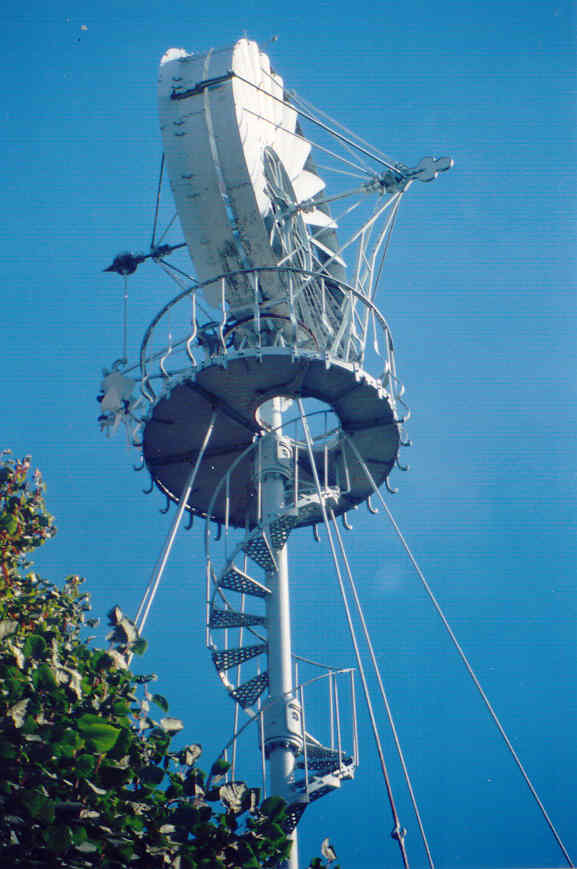
A multi-blade wind turbine: many blades for starting at low wind speed.
If you want to sell the electricity produced with a minimum of material, the manufacturing cost of the blades being a profitability factor, you will on the contrary look for the minimum number of blades.
Why are single-blade wind turbines not more common? The reason is purely mechanical. The imbalance around the axis of rotation and the alternating wind forces around the propeller pivot generate vibrations and destructive effects, which must be balanced with counterweights. Some manufacturers have nevertheless explored this route.
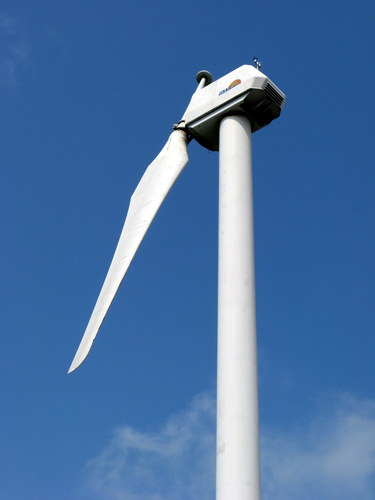
A single-blade wind turbine, balanced by a counterweight.
The two-bladed propeller also has balancing and vibration problems. The inertia of the rotor about the nacelle's yaw axis varies during the revolution: it is maximum when the blades are horizontal and minimum when they are vertical. Three-bladed propellers offer a stability that manufacturers seem to have preferred.
Optimizing a project must therefore take into account efficiency, but also manufacturing cost, service life, noise, appearance and ease of manufacture.
To go further, we can study the design of a wind turbine blade together, from the choice of airfoils to the twist, in the wind turbine blade design tutorial. We can also quantify the energy of a site with the page on wind turbine power and wind speed, or read the article on wind energy.
 Global site map
 Mecaflux
 Tutorials Mecaflux Pro3D
 Tutorials Heliciel
 Tutorials Heliciel PRO CFD
 Mecaflux Store
 Compare software functions
 Quotes, Orders, Payment Methods
 project technical studies