
Ship propeller and boat propeller: operation, types and design
Thrust, speed and diameter give the pitch, the slip and the Wageningen B-series propeller that delivers them: boat propeller pitch calculator
A boat propeller turns shaft rotation into thrust: its blades, small wings in rotation, accelerate the water backwards, and the water pushes the hull forwards in return. Its efficiency depends on the diameter, the pitch, the number of blades and the operating point of the boat. Here we review the devices that improve the efficiency of a marine propeller, then the different sailboat propellers (fixed, folding, feathering, automatic variable pitch), and we finish with the calculation of the propeller that suits your boat.
In this page:
- How a boat propeller works
- Improving the efficiency of a ship propeller: the three zones
- Sailboat propeller: fixed, folding or automatic variable pitch
- Calculating and designing your boat propeller
1: How a boat propeller works
As we saw in the brief summary of the evolution of boat propeller shapes over the past centuries, the shapes and systems that promise to improve the performance of the marine propeller have multiplied. The stakes are both economic and ecological: improving the efficiency of ship propellers saves energy, and therefore fuel.
Three quantities govern this efficiency: the size of the propeller (the larger it is, the more gently it accelerates a large mass of water, with fewer leaks), its pitch, and the operating point, that is the match between shaft speed and boat speed. A heavily loaded propeller also runs into cavitation, the vapour bubbles that form where the pressure on the blade drops too low. The devices below all try to gain on one of these points.
2: Improving the efficiency of a ship propeller: the three zones
The systems that increase the efficiency of a ship propeller fall into three categories according to their location relative to the propeller (after Carlton, see the bibliographic reference): zone 1 is upstream of the propeller, zone 2 is the propeller itself, zone 3 is downstream.
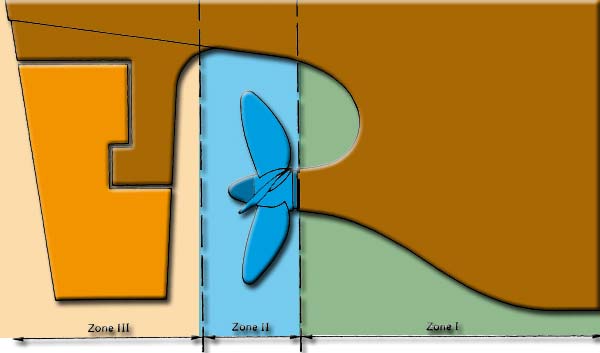
The stern cut into three zones: zone I ahead of the propeller, zone II at the blades, zone III behind, towards the rudder.
Zone 1: guiding the water entering the propeller
The water reaches the propeller after flowing along the hull, which slows it down unevenly. The zone 1 systems guide or even out this flow before it meets the blades.
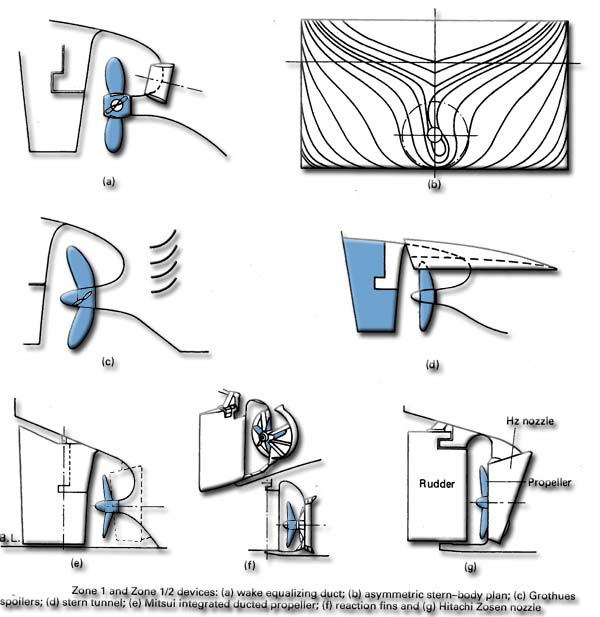
Zone 1 and zone 1/2 devices: (a) wake equalizing duct, (b) asymmetric stern-body plan, (c) Grothues spoilers, (d) stern tunnel, (e) Mitsui integrated ducted propeller, (f) reaction fins, (g) Hitachi Zosen nozzle.
Zone 2: the systems attached to the propeller
The first is the variable pitch propeller. Since 1960, the share of variable pitch propellers fitted to large naval units has risen from about 5 to 35%. Other systems to improve marine propulsion by propellers have also been developed.
The Grim Vane wheel uses an additional propeller placed in the slipstream of the first one. Its inner part works as a turbine, recovering the rotation energy left by the first propeller; its outer part, at the blade tip, uses the torque thus recovered to produce extra thrust. This second propeller is therefore both a receiver and a propulsor.
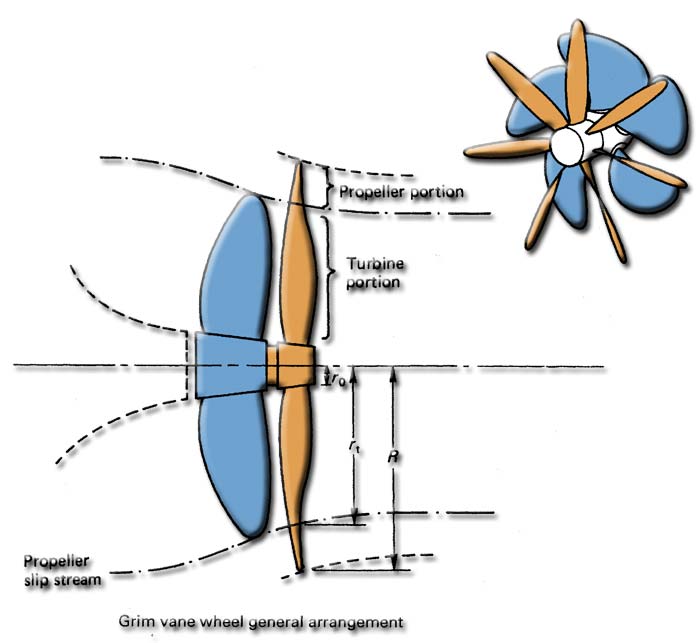
The Grim Vane wheel (orange) in the slipstream of the propeller (blue): the inner part acts as a turbine, the outer part as a propeller.
Blade tip plates. The marine propeller can also be fitted with plates at the blade tips, which act like the winglets of aircraft wings. This device reduces tip losses.
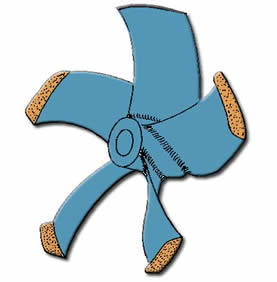
A boat propeller with a plate at the tip of each blade, which limits the water flowing around the blade.
The duct. For the same reason, ducting the propeller increases the thrust of a heavily loaded propeller. Tip losses come from the pressure difference between the two faces of the blade, so they weigh heavily when the thrust-to-area ratio is high. The efficiency gain is real only for slow boats, because the duct creates a drag that grows with the square of the boat speed.
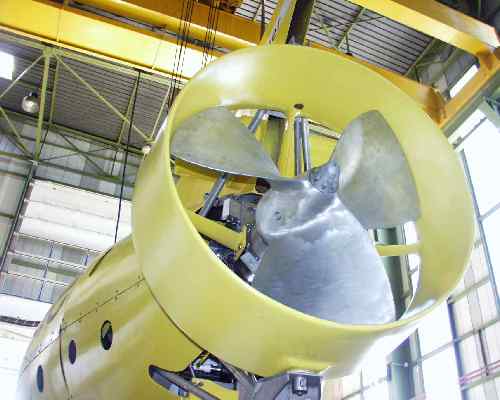
A ducted propeller in its yellow nozzle: the nozzle stops leaks at the blade tips, which suits high thrust at low speed.
Zone 3: straightening and recovering the rotation of the flow
The propeller does not only push the water backwards: it also sets it in rotation, and this rotation carries energy that does not help the boat advance. The zone 3 systems, placed behind the propeller, straighten this flow and recover part of that energy.
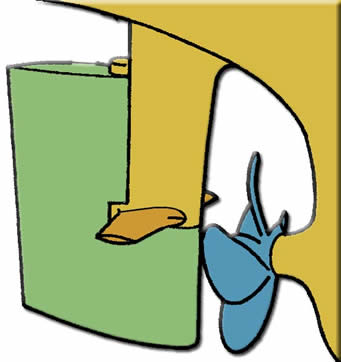
Sketch of a rudder and a fin placed behind the propeller: they straighten the flow set in rotation by the blades.
Whether for small boats such as sailboats or for the largest ships, builders and propeller makers compete in ingenuity to improve marine thrusters, taking their operating conditions into account.
3: Sailboat propeller: fixed, folding or automatic variable pitch
A sailboat propeller is essential for harbour manoeuvres and for days without wind, but it becomes a brake when the boat sails. Propeller makers have therefore looked for solutions to this problem. Arriving and leaving under sail remains proof that the captain masters the art of sailing, but many harbours now forbid it, unless you claim an engine failure… Here are some sailboat propeller systems, with their approximate price for information (indicative prices, to be checked with the makers).
The fixed propeller
If the fixed pitch propeller has been properly chosen and its performance matches the operating point of the boat, it remains very efficient for a boat that often runs on its engine (in the Mediterranean, for example, either there is no wind or there is a storm… no, I'm joking). It is efficient only if the boat speed and the engine speed match the optimum operating point of the propeller. Few sailors know the operating point of their propeller: for them the engine remains a safety and breakdown device, and propeller efficiency a low-priority detail. Setting drag aside, it is the best propeller for the money (about €400 new, €120 second-hand on an auction site).

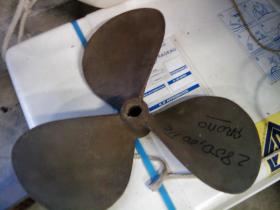
On the left a new three-blade bronze propeller, on the right a second-hand propeller of the same type.
Caution: if you fit a propeller without knowing whether its operating point matches your boat, you risk very poor efficiency. Even if it is given to you, it may cost you a fortune… in energy: a full tank of diesel on a sailboat costs the price of a propeller.
Folding and feathering propellers
The folding or feathering propeller derives from the research of Griffith that we saw in the evolution of boat propeller shapes. When the vessel is under sail and the shaft does not turn, the blades feather.
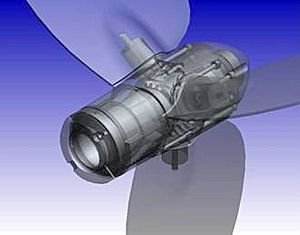
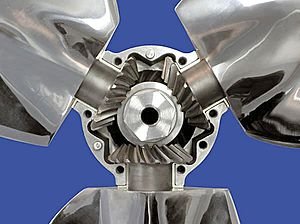
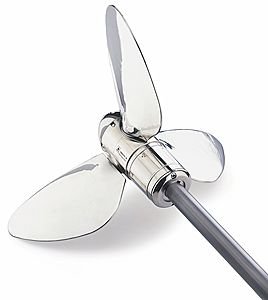
The EWOL feathering propeller (about €2,990): the blades pivot thanks to bevel gears housed in the hub.
Another example, the SPW Variprofil (about €2,000):
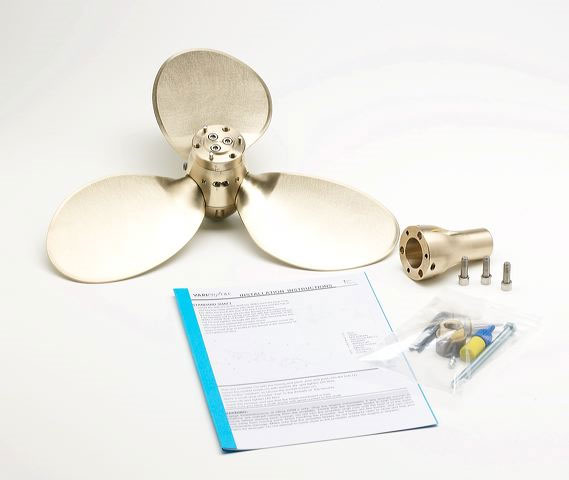
A three-blade bronze feathering propeller, with its instructions and fitting kit.
And the Kiwiprop, with composite blades, a cheaper option (about €1,400):
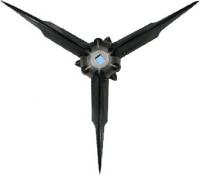
The Kiwiprop propeller, blades open then blades folded in line with the current.
Other blades fold along the current thanks to an axis built into the blade. Here are the Flexofold (about €1,700) and France Hélice Racing (about €1,115).
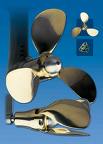
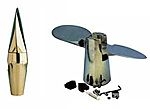
Two folding propellers: the Flexofold on the left, France Hélice Racing on the right.
The drag force is thus considerably reduced compared with a fixed propeller. Do not confuse variable pitch with folding or feathering blades. Folding blades have a fixed pitch angle, which cannot be adjusted while running (often adjustable at rest) and is the same whatever the shaft speed and the boat speed. If the operating point does not match the pitch setting, the efficiency is, as with a fixed pitch propeller, rather mediocre…
The automatic variable pitch propeller
Some propellers have a pitch that regulates itself automatically while running, according to the torque on the blade, which is mounted off-axis. These systems are the most interesting in theory. Their durability remains to be assessed, and the automatic variation of the pitch angle requires the engine torque, at the chosen rotation speed, to suit the blade setting. To be continued!
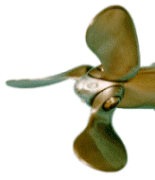
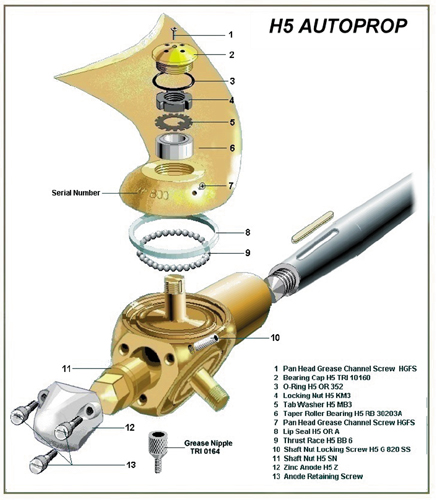
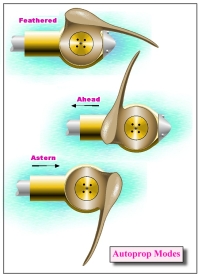
The Autoprop propeller (about €2,200): the off-axis blade pivots between three positions (feathered, ahead, astern).
4: Calculating and designing your boat propeller
Before buying a boat propeller, calculate the one that suits your engine and your hull. The boat propeller pitch calculator gives, from thrust, speed and diameter, the pitch, the slip and the Wageningen B-series propeller that delivers them. To understand what these quantities mean, first read the page on geometric pitch and effective pitch.
Heliciel includes the Wageningen B-series: the B-Screw Series window, opened from the File menu, sweeps the series and applies to the project the propeller that meets your requirements. You can also simulate a propeller duct (the "ducted propeller" option, which cancels the blade tip losses and therefore gives slightly overestimated efficiencies) and add a winglet at the blade tip.

To go further, we can build a propeller step by step with the boat propeller design tutorial, compare the propulsive efficiency of thruster propellers, or see how to choose the number of blades of a thruster propeller.
To see a marine propeller in the water it pushes, the case study boat propeller CFD simulates it from start to finish, with pressure on the blades and the wake shown in images.
 Global site map
 Mecaflux
 Tutorials Mecaflux Pro3D
 Tutorials Heliciel
 Tutorials Heliciel PRO CFD
 Mecaflux Store
 Compare software functions
 Quotes, Orders, Payment Methods
 project technical studies