
Design: propeller, turbine, screw, aerial, marine, turbine, tidal, wind, kaplan, foil, wings, 3D. Discover heliciel software:
VTOL "Vertical Take-Off and Landing" 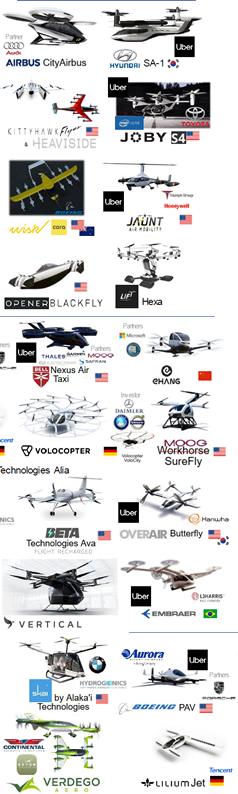
Multirotor drone propellers: design and optimization for VTOL and multicopter
The propellers of a multirotor drone are designed from the number of propellers, their layout (single stage or contra-rotating) and the load to carry. Heliciel models them in 3D in an interface dedicated to multirotors and multicopters, which simulates thrust, power consumption and transport speed, then exports the blades for manufacturing (STL for 3D printing, IGES for machining).
On this page:
- Designing and optimizing multirotor drone propellers
- Propellers for VTOLs, taxi drones and filming drones
- Performance calculation and 3D export of drone propellers
- Parameters of a multirotor project: configuration, frame, modules
- Video and worked examples
1: Designing and optimizing multirotor drone propellers
A multirotor, or multicopter, is a flying machine with more than two lift-generating rotors. The design of multirotor propellers, according to their number and to whether they are counter-rotating or not, is built into the Heliciel propeller design software, in an interface dedicated to modeling multirotors.
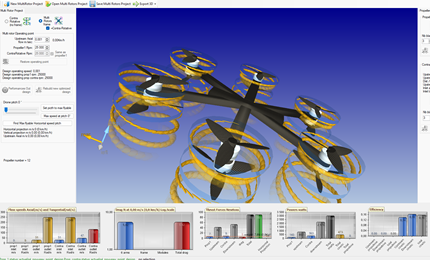
An octocopter with counter-rotating propellers in Heliciel's multirotor window: 3D view of the drone, with drag, thrust, power and efficiency charts at the bottom.
Mastering the design of drone propellers is essential for hobbyists and professionals alike, who adapt the propellers of their multirotor drone to their projects. FPV pilots who make their own custom drone propeller, and professional drone makers who want to optimize their industrial drones with specific propellers, must master the manufacture of multirotor drone propellers to achieve respectable flight performance and endurance.
2: Propellers for VTOLs, taxi drones and filming drones
Projects for vertical take-off machines (VTOL), taxi drones, quadcopters or octocopters are used for photography, parcel transport, geographic surveys, archaeology and many other applications.
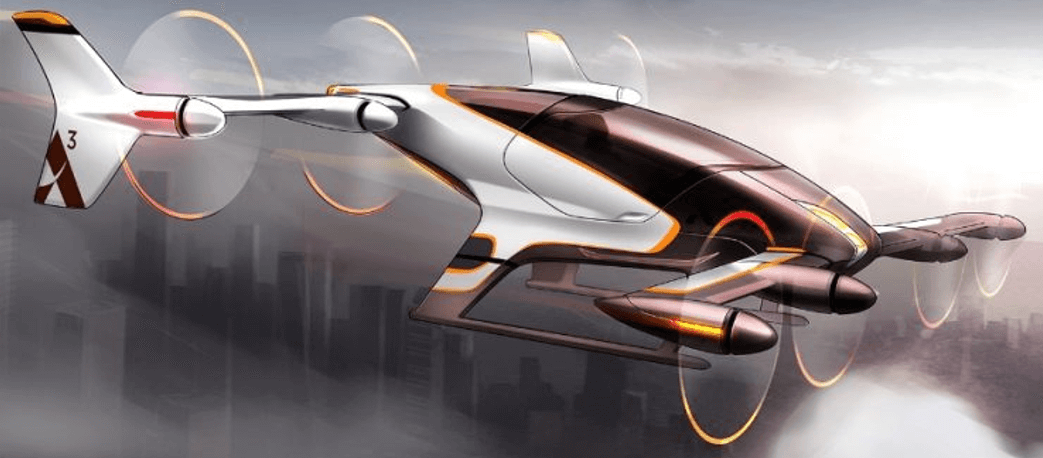
A taxi drone (Airbus) whose propellers change configuration between vertical take-off and horizontal flight.
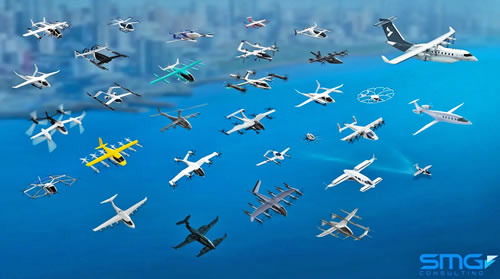
A glimpse of the variety of vertical take-off (eVTOL) projects.
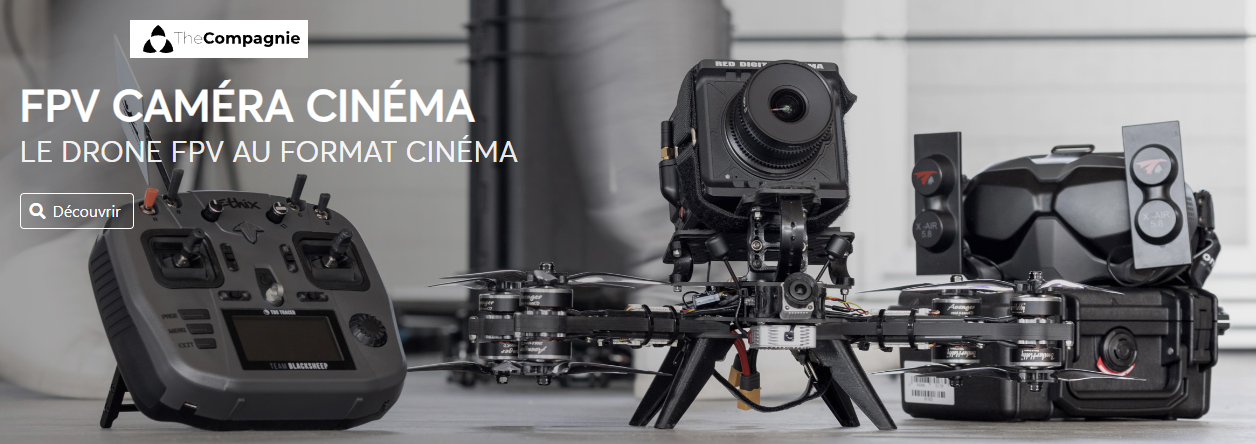
Example: eight contra-rotating propellers equip this customized FPV drone, which carries a cinema camera for sports reporting (ski competitions, car races) requiring endurance and power. It is built by thecompagnie.eu.
3: Performance calculation and 3D export of drone propellers
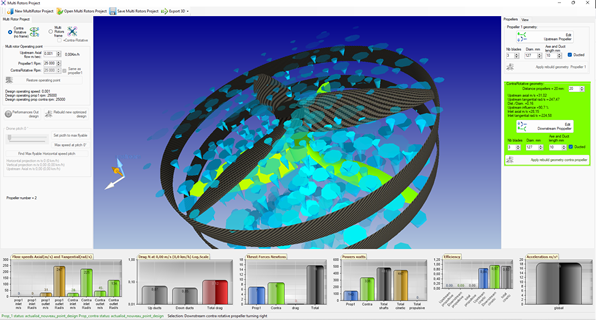
A counter-rotating propeller pair in the multirotor tool: the 3D view shows the two propellers and the wake, the charts give forces, powers and efficiencies.
Heliciel's multirotor propeller design tool has load-test functions and calculates maximum transport speeds, depending on rotation speeds and propeller characteristics. The blade shape, the airfoils, the chord and diameter dimensions and the shape of the blade generatrix can also be set in the Heliciel propeller design interface, which stays active alongside the multirotor tool.
Simulating the power consumed and the lift produced at various horizontal travel angles lets us export the propeller geometry in 3D STL or IGES format. We kept these two formats for distinct reasons: STL is easy to use in 3D printers, and IGES smooths the surface twist of the blades well, which serves aeronautical projects with high machining precision. You can learn more about the Heliciel software on the publisher's site.
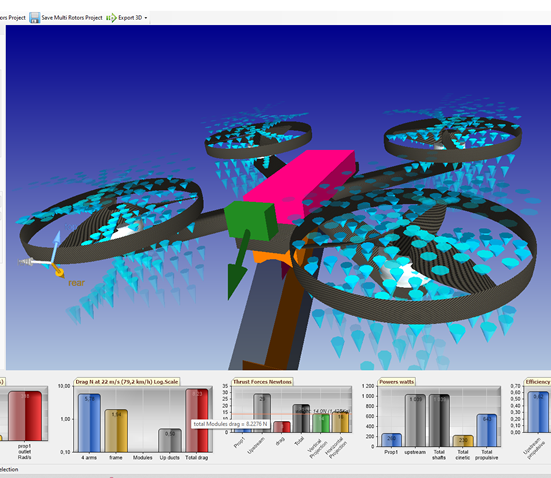
A quadcopter with ducted propellers: the charts at the bottom give drag (arms, frame, modules, ducts) at 22 m/s, thrust forces, powers and efficiencies.
4: Parameters of a multirotor project: configuration, frame, modules
The parameters of multirotor projects are numerous and allow a wide variety of configurations: with or without a blade-tip ring (ducted propellers), single stage or counter-rotating, with an adjustable axial distance between propellers. We also set the number of propeller arms, their width, and the dimensions of the base frame and of the onboard modules. These settings affect drag, hence the energy performance and the carrying capacity of the modeled rotor system.
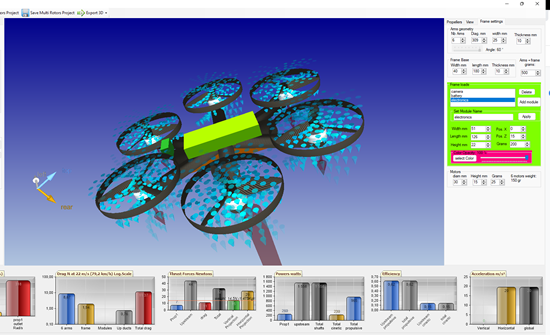
The frame settings tab: arms, base frame, onboard modules (camera, battery, electronics) with their dimensions and mass.
This propeller optimization interface for a specific project is a valuable aid for designing the propellers of VTOLs, filming drones, camera carriers, survey systems, parcel carriers, taxis or prototypes whose propellers must perform optimally.
5: Video and worked examples
Here is the video tutorial of the drone or multirotor propeller design interface of the Heliciel software:
Worked examples calculated with Heliciel, step by step, with the software's screenshots:
- 450 mm camera quadcopter: mass budget, thrust, camera gimbal, pitched flight, reading the charts;
- Carrying 1 kg: hexa or coaxial X8: thrust reserve, power, coaxial propellers, ducts;
- Contra-rotating ultralight propeller: propeller spacing, downstream speed, torques, exports.
To go further, we can look at the functions of the multirotor and VTOL project and of the contra-rotating propeller pair.
 Global site map
 Mecaflux
 Tutorials Mecaflux Pro3D
 Tutorials Heliciel
 Tutorials Heliciel PRO CFD
 Mecaflux Store
 Compare software functions
 Quotes, Orders, Payment Methods
 project technical studies