
For a given head and flow, the specific speed tells whether the machine will be a Pelton, a Francis or a Kaplan propeller.
Hydraulic turbine specific speed: Ns, NQe and NQh
The specific speed classifies turbines: for a given head and power, it tells whether the machine will be slow and wide, like a Pelton, or fast and compact, like a propeller or a Kaplan. The "Turbine type: specific speed" tab computes it in its three forms, from an estimated net head and a test rpm.
Turbine similitude tab, Turbine type: specific speed sub-tab, in the right part of the window. Each block explained here carries a ? help icon in the window: clicking the icon opens the matching section of this page directly.
Contents:
- Estimated net head: Hn = Hb − Dp
- Similitude test rpm
- Specific speed Ns
- Specific speed NQe
- Specific speed NQh
Estimated net head: Hn = Hb − Dp
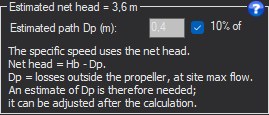
- Tick 10% of Hb for a first estimate.
- After balancing, untick and enter the loss actually computed.
The specific speed is computed with the net head, Hn = Hb − Dp, Dp being the path loss outside the runner at maximum flow, distributor fully open. Before any computation it is unknown: it is estimated, either at 10% of Hb with the tick box, or by an input. After the first balancing, enter the loss actually computed.
Similitude test rpm
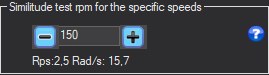
- Adjust the rpm with + and −.
- Watch the validation icons: the Kaplan one must light up.
- Carry this rpm over to the runner.
This rpm (with its equivalent in rev/s) is used to compute the three specific speeds. Adjust it with + and − until Ns falls in the statistical range of the desired type: the validation icons light up for Kaplan, slow Francis, fast Francis or Pelton. The runner can then take this rpm.
This window only sizes propeller and Kaplan turbines; Francis and Pelton are given for information.
Example
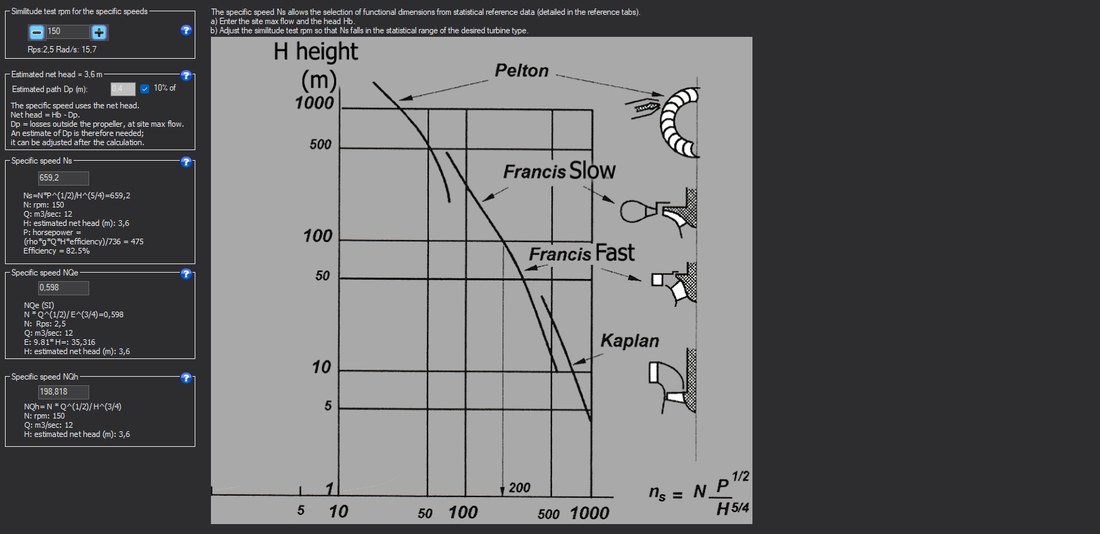
The Turbine type tab: test rpm, specific speeds and selection chart between Pelton, Francis and Kaplan.
Specific speed Ns
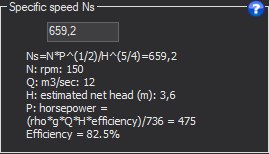
Ns = N·√P / H5/4, with N in rpm, H the net head (m), P the power in horsepower = ρ·g·Q·H·efficiency / 736, the efficiency being taken as 82.5%.
It is the historical index of turbine charts, and the one used by the curves of the statistics tabs.
Specific speed NQe
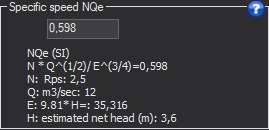
NQe = N·√Q / E3/4, N in rev/s, Q in m³/s, E = 9.81·H the specific energy (J/kg), H the net head.
Dimensionless, it does not depend on the unit system. It is the one used by the ESHA formulas for the runner diameter and the hub.
Specific speed NQh
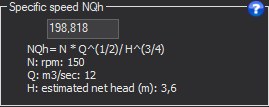
NQh = N·√Q / H3/4, N in rpm, Q in m³/s, H the net head (m).
Built on the flow rather than the power, it assumes no efficiency. It is used to compare with catalogues that use it.
Going further
The Hydro Turbine design reference page presents the complete method and a worked case. The other help pages of the window:
 Global site map
 Mecaflux
 Tutorials Mecaflux Pro3D
 Tutorials Heliciel
 Tutorials Heliciel PRO CFD
 Mecaflux Store
 Compare software functions
 Quotes, Orders, Payment Methods
 project technical studies