
Tutorial: designing an axial lift pump with Heliciel
A fish farmer has to circulate water between two ponds separated by a level difference (pressure losses included) of about 1.5 m, through a 200 mm pipe. He wants to carve the impeller of an axial pump immersed in the pipe, driven by an electric motor. This tutorial shows the computation… and above all the deep nature of axial pumps: large flows at low heads — and nothing else.
- Organisation and design phases:
- The axial pump model and the pressure/thrust conversion
- Explore the machine's domain (and its traps)
- The chosen design point: 549 m³/h at 1.55 m
- The lesson of the stator
- Summary and model to download
1: The model and the conversions: Heliciel's “axial pump” model comes at the right time: Ø 200 mm, hub 70 mm, 5 blades, in penstock mode. We switch its fluid to fresh water at 15 °C. As for the fan, two conversions drive everything:
- head → pressure: 1.5 m of water = ρ·g·H ≈ 14,700 Pa to be supplied;
- pressure → thrust: over the annular section S = 0.0276 m², it takes T = ΔP × S ≈ 406 N of thrust;
- flow → velocity: each m³/h imposes its axial velocity v = Q/S in the pipe.
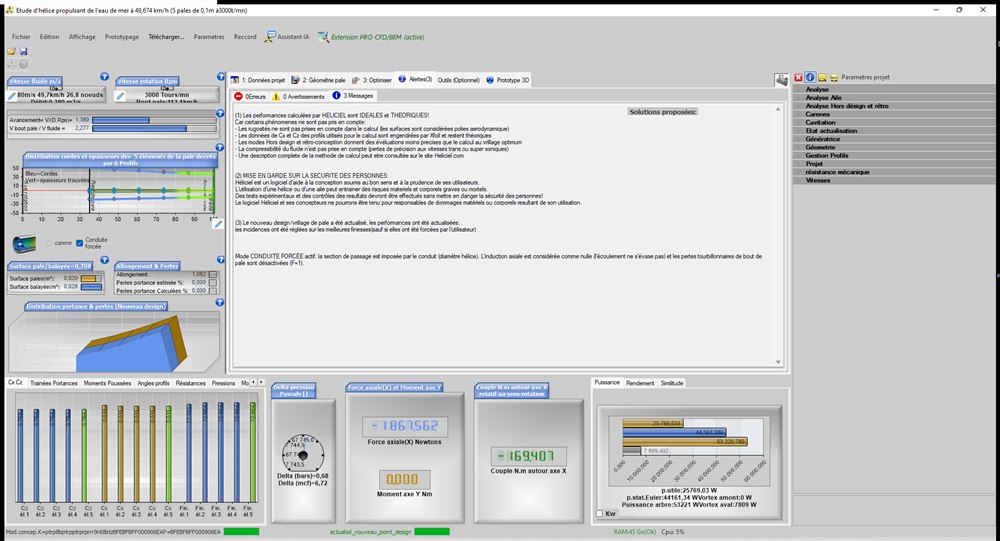
2: Explore the domain… and its traps: our first reflex — asking for 100 m³/h (v = 1 m/s) at 1,450 rpm — gives a final result: almost no thrust, and all the power gone into swirling the water. The advance ratio J = V/(n·D) was only 0.21: too much rotation for too little advance, the impeller screws the water instead of pushing it (the same trap as the fan driven at high rpm). Raising the flow to 250 m³/h (J = 0.52), the machine becomes healthy: thrust -83 N, i.e. 0.31 m of head, for 1.5 kW at the shaft. But 0.31 m is not enough…
- The pump affinity law gives the way out: at constant J (homologous machine), the head grows as the square of the rpm, and the flow as the rpm. To go from 0.31 m to 1.5 m: rpm × √(1.5/0.31) ≈ × 2.2 → 3,200 rpm… and the flow follows to about 550 m³/h.
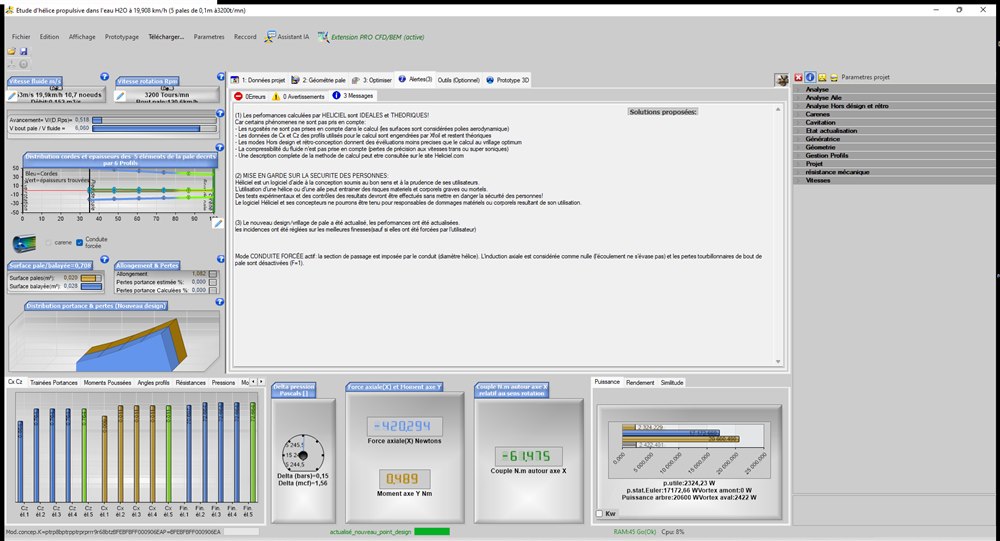
3: The chosen design point: design at 3,200 rpm, axial velocity 5.53 m/s (549 m³/h):
- ΔP = 15,246 Pa = 1.55 m of water — target reached;
- thrust -420 N (propulsive), torque 61.5 N·m, 20.6 kW absorbed at the shaft;
- J = 0.52, pitch angles from 35° at the root to 17.8° at the tip, geometric pitch 170 mm;
- no computation error or warning.
The sizing lesson is striking: a 200 mm axial pump “wants” 550 m³/h at 1.5 m — not 100 m³/h. If your need really is 100 m³/h at 1.5 m, it is not an axial impeller you need, but a mixed-flow pump (or a smaller pipe). Adapt the machine to the need, never the other way round.
4: The lesson of the stator: look at the mean downstream tangential velocity returned by the computation: 5.6 m/s of swirl, as much as the axial velocity! A large part of the 20.6 kW absorbed goes into rotating the water, energy lost for pumping (useful power = ΔP × Q ≈ 2.3 kW). This is precisely why all industrial axial pumps carry straightening vanes behind the impeller: they turn the swirl back into pressure and transform this poor balance into efficiencies of 70-80 %. Heliciel computes the bare impeller: its result gives you the exact thrust, head and torque of the runner — the stator is then drawn from this known swirl (5.6 m/s at the mean radius). For the complete impeller + stator study in a pipe, the Heliciel CFD module takes over.
5: Summary and model to download
- Axial pump Ø 200 mm (hub 70), 5 blades, fresh water, penstock mode;
- design point: 549 m³/h at 1.55 m at 3,200 rpm — thrust 420 N, torque 61.5 N·m, 20.6 kW at the shaft;
- downstream swirl 5.6 m/s: plan a stator to recover this energy;
- the reflexes: head → pressure → thrust; flow → velocity; watch J (0.4-0.7 = healthy zone); affinity law to transpose.
The complete project can be downloaded here: pompe_axiale_200mm_550m3h.hlc (open it with Heliciel). It is also included in the models supplied with the software. See also the axial pumps and water jets page.
I remain at your disposal for any remarks or further information at contact@heliciel.com
- JF Iglesias, Heliciel developer.
 Global site map
 Mecaflux
 Tutorials Mecaflux Pro3D
 Tutorials Heliciel
 Tutorials Heliciel PRO CFD
 Mecaflux Store
 Compare software functions
 Quotes, Orders, Payment Methods
 project technical studies