
Tutorial: designing the boat propeller of a fishing and leisure launch with Heliciel
The owner of a wooden fishing and leisure launch has to replace a worn propeller, with no original documentation. Rather than buying “the same one” again, he decides to recompute the propeller suited to HIS boat and HIS use. The data:
- Displacement hull: waterline length 6 m, beam 2.3 m, draught 0.55 m, displacement 2 tonnes, estimated wetted surface 12.5 m²;
- Target cruise speed: 7 knots (a reasonable hull speed for 6 m of waterline);
- Diesel engine of about 10 hp at 2,200 rpm, 3:1 gearbox → about 730 rpm at the propeller shaft;
- Maximum diameter under the counter: 400 mm, shaft immersed at 0.45 m, sea water.
The big question of a boat propeller is not “which propeller do I like”, but “what thrust does my hull demand”: we shall therefore start with the hull resistance, before drawing the propeller that overcomes it.
- Organisation and design phases:
- Compute the hull resistance (Holtrop & Mennen method)
- From resistance to target thrust (thrust deduction factor)
- Draw the propeller: Heliciel searches for the rpm itself
- Immersion and cavitation check
- The propeller off its design point: thrust/speed curves and equilibrium point
- Summary, alerts, files to download
1: The hull resistance: Heliciel includes the Holtrop & Mennen method for displacement hulls. We enter the hull geometry (block coefficient 0.40, midship coefficient 0.75, prismatic 0.60, waterplane 0.75, LCB -2 %, form factor 1.25). Result at 7 knots (3.60 m/s):
- total resistance: 634 N, of which 281 N of viscous friction, 286 N of wave resistance and 66 N of model-ship correlation;
- the complete curve shows the wave-resistance “wall”: 253 N at 5 knots, 538 N at 6 knots, 634 N at 7 knots — aiming at 8 knots with this hull would cost a great deal of power.
| Speed (knots) | 2 | 3 | 4 | 5 | 6 | 7 |
| Resistance (N) | 34 | 72 | 133 | 253 | 538 | 634 |
2: From resistance to target thrust: by sucking the water from under the counter, the propeller slightly “pulls” the boat backwards: this is hull suction, the thrust deduction. The thrust to be supplied is T = R / (1 - t). We take a thrust deduction factor t = 0.12, a customary value for this type of hull with an inboard shaft line (the author's assumption, to be adjusted if you have test data):
- T = 634 / (1 - 0.12) = 720 N of target thrust.
3: Draw the propeller: we open the “boat propeller” model supplied with Heliciel (the “sea water” fluid at 1,023 kg/m³ is already selected in it):
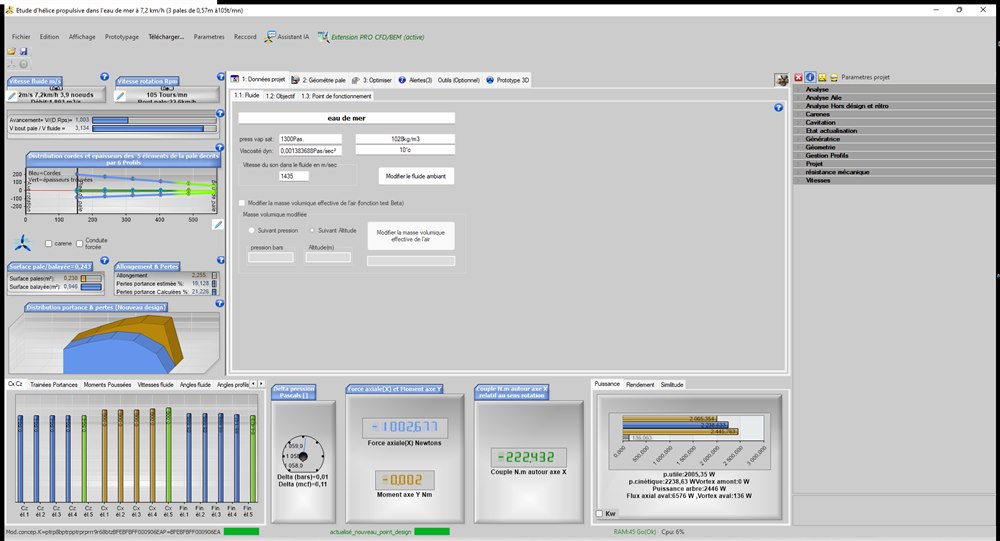
We then ask for a design at 400 mm diameter, 3 blades, at 3.60 m/s (7 knots), with a thrust target of 720 N: Heliciel then automatically searches for the rotation speed that produces this thrust (within 0.5 %), rebuilding the optimum twist at each trial. Result:
- rpm found: 737.5 rpm — to be compared with the ~730 rpm of our shaft line (2,200 rpm / 3): the existing gearbox is suitable;
- thrust: -718 N (negative = propulsive in Heliciel's axis convention: the axis follows the flow direction);
- torque absorbed: 43.7 N·m; shaft power: 3,378 W (4.6 hp) — our 10 hp engine keeps a wide reserve for rough seas and hull fouling;
- propulsive efficiency: 0.766; advance ratio J = 0.732; geometric pitch 442 mm at 0.7 R;
- blade section: NACA 1408 (maximum lift-to-drag ratio 64 at the Reynolds number of 500,000 met on the blade).
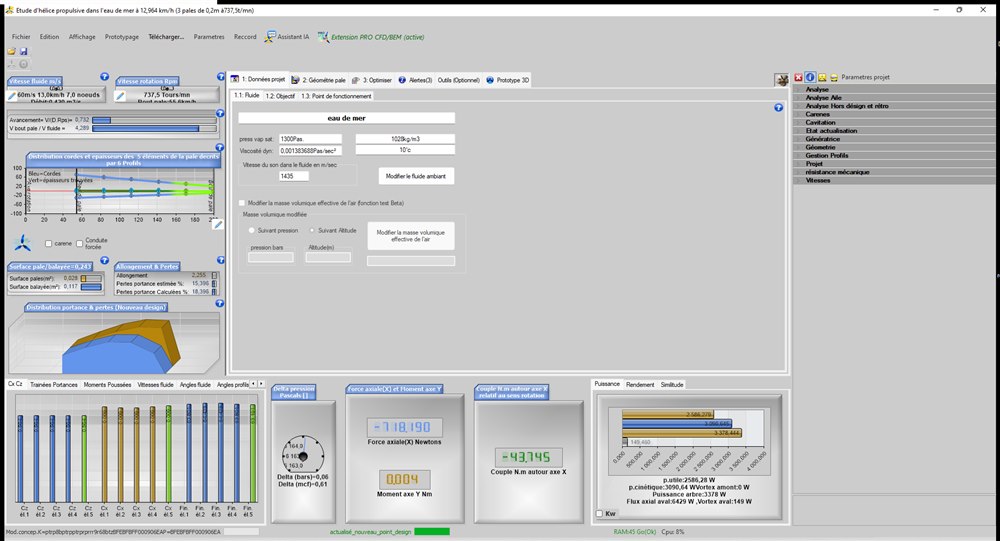
On the screenshot above, note the fluid tab (“sea water”, vapour pressure 1,300 Pa — it will be used for the cavitation computation) and, at the bottom, the permanent results banner: axial force -718.19 N, torque -43.7 N·m, shaft power 3,378 W.
4: Immersion and cavitation: Heliciel's marine design adds the shaft immersion (0.45 m here) and checks cavitation element by element:
- no cavitation detected at the operating point; cavitation number at the blade tip σ = 0.80;
- the margin is not huge: a smaller, or faster, propeller would cavitate. This is the reason behind the rule “the largest diameter at the slowest possible rpm”.
5: The propeller off its design point: our propeller is cut for 7 knots, but the boat accelerates from rest. The multi-point analysis sweeps the boat speed from 2 to 4.2 m/s at a constant 737.5 rpm, in “Off-design” mode (the geometry stays the one we have just frozen):
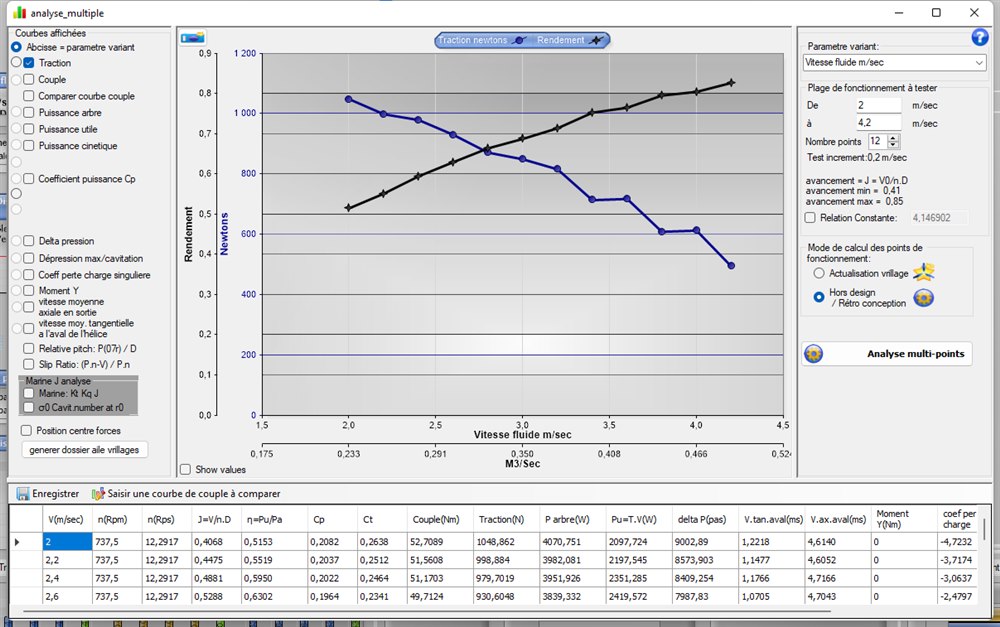
| Boat speed (m/s) | (knots) | Thrust (N) | Propulsive η | Shaft P (W) | Hull need T=R/(1-t) (N) |
| 2.0 | 3.9 | 1049 | 0.52 | 4071 | ≈146 |
| 2.6 | 5.1 | 931 | 0.63 | 3839 | ≈296 |
| 3.0 | 5.8 | 850 | 0.69 | 3705 | ≈517 |
| 3.6 | 7.0 | 718 | 0.77 | 3378 | ≈720 |
| 4.2 | 8.2 | 494 | 0.83 | 2510 | >900 |
Reading: at low speed the propeller pushes harder (1,049 N at 2 m/s) than the hull requires — the boat accelerates — then the available thrust decreases while the need rises; the two curves cross at 3.6 m/s = 7 knots: this is the equilibrium point, exactly our design point. The last column (hull need) cross-checks the Holtrop computation of step 1: it is this confrontation of available thrust and required thrust that validates a hull-propeller pair.
- 3-blade propeller Ø 400 mm, pitch 442 mm (0.7 R), NACA 1408 section, sea water;
- design point: 7 knots / 737.5 rpm — thrust 718 N, torque 43.7 N·m, 3,378 W, efficiency 0.766;
- no cavitation at 0.45 m immersion (tip σ 0.80);
- 10 hp engine + 3:1 gearbox: suitable, with reserve.
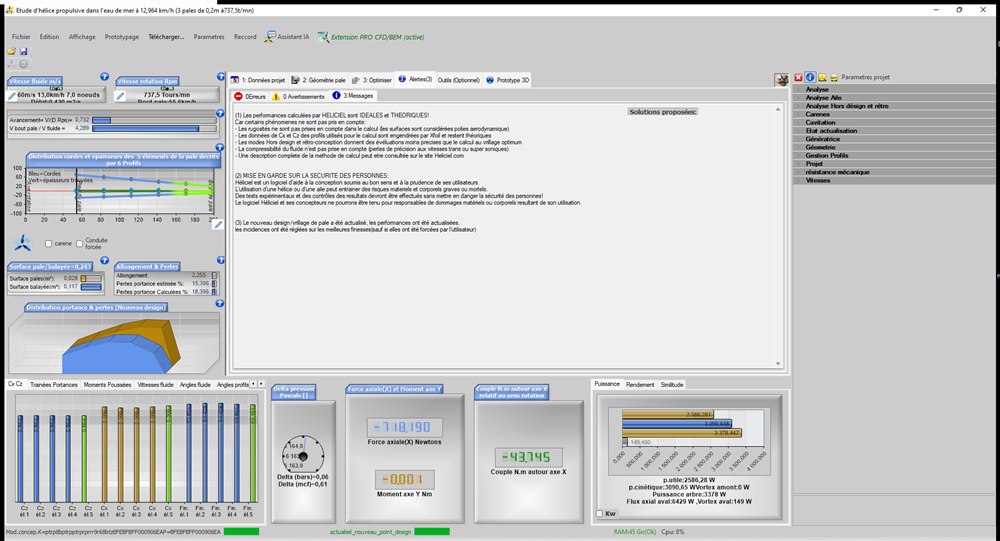
Do not forget the “Alerts” tab: Heliciel keeps reminding you there that its performance figures are theoretical (smooth surfaces, XFoil polars) and that caution is required during trials:
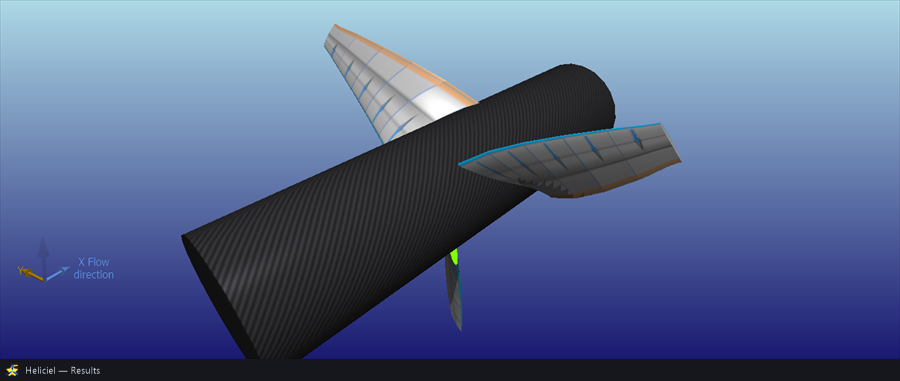
The 3D model of the final propeller, rendered by Heliciel:
Files of this tutorial:
- the Heliciel project: helice_bateau_7noeuds_400mm.hlc (included in the models supplied with the software);
- the 3D geometry as a low-resolution STL, ready for a preview or a scale model: helice_bateau_7noeuds_400mm.stl (4.2 MB). For actual machining, export from Heliciel as a full-definition STL or as STEP.
I remain at your disposal for any remarks or further information at contact@heliciel.com
- JF Iglesias, Heliciel developer.
Once the propeller is drawn, the case study boat propeller CFD shows what the simulation adds: the pressure on the blades, the jet, and the answer to the cavitation question.
 Global site map
 Mecaflux
 Tutorials Mecaflux Pro3D
 Tutorials Heliciel
 Tutorials Heliciel PRO CFD
 Mecaflux Store
 Compare software functions
 Quotes, Orders, Payment Methods
 project technical studies