
Propeller and wing theory: calculations
Propeller and wing theory, the basis of Heliciel's calculations, rests on blade element theory: Heliciel computes the performance of a propeller or a wing with blade element theory (BEM, Blade Element Momentum), coupled with Froude's momentum theory and corrected by Prandtl's vortex theory. This page lists the theories whose formulas are used, and points you to a dedicated page for each.
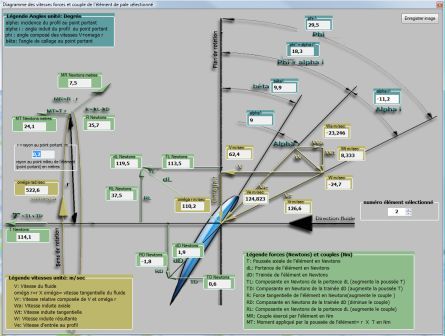
The blade element diagram in Heliciel: speeds, angles and forces are read element by element, with the induced speeds these theories allow us to compute.
Designing a propeller or a wing with the Heliciel software does not require mastering the theory. But knowing the formulas that produce the results helps you understand, and therefore check, the parameters of your project.
In this page:
- Theories common to propellers and wings
- Theory common to propellers
- Theories for energy-capturing propellers
- Theories for propulsion propellers
- Theoretical references and bibliography
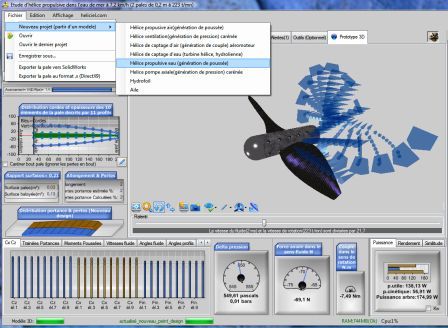
The Heliciel window, with the list of project models. The performance of the displayed propeller is computed by the vortex theory applied to propellers.
Performance predictions (power, lift, torque) for a wing or a propeller rest on practical mathematical tools that we gather here, in part. Thanks to Newton, Reynolds, Bernoulli, Beeckman, Froude, Prandtl, Glauert, and to those who inspired them (Descartes, Archimedes, Pythagoras, Euclid) for thinking to take notes, and then kindly allowing the rest of humanity to read the result.
The other bibliographic and internet sources are cited in detail. Some definitions point to a partner site, mecaflux.com.
1: Theories common to propellers and wings: calculation formulas
- The continuity equation says that the volume flow rate is the product of the speed by the duct section.
- Newton and the conservation of momentum remind us that every action creates a reaction.
- Reynolds gives us a bridge between different fluids and different scales.
- Bernoulli describes the balance of energies in a fluid stream, and lets us predict the pressure and speed state of the observed zones.
The work, energy, power and flow rate memo gathers the basic relations.
2: Prandtl's vortex theory for propeller calculation
- Prandtl's vortex theory (1918) lets us go from the 2D performance of a profile to 3D performance. It gives a method to compute lift losses according to the distance from the blade tip. It brings a correction factor which, integrated into the blade element method, makes results more accurate. The wing and propeller references detail this theory, in particular the Joncas thesis, which explains the vortex theory applied to propellers. For the finite-span wing, see the finite-span wing calculation by lifting line.
3: Theory of energy-capturing propellers (wind and tidal turbines)
- Froude's theory considers the speeds induced by the change of momentum, here in a power-extracting propeller (energy capture).
- Blade element theory, coupled with Froude's theory (BEM, Blade Element Momentum), applied to capture propellers, defines the axial and tangential induced speeds distributed along the blade. We divide the blade into elements and introduce the performance of the profiles element by element.
4: Theory of propulsion propellers (boat, airplane, fan)
- Froude's theory considers the speeds induced by the change of momentum, here in a propulsive propeller.
- Blade element theory, coupled with Froude's theory (BEM), applied to traction or propulsion propellers, defines in the same way the axial and tangential induced speeds distributed along the blade.
To go further, we can start with the induced velocity of a propeller, then read the efficiency of the propulsive propeller.
 Global site map
 Mecaflux
 Tutorials Mecaflux Pro3D
 Tutorials Heliciel
 Tutorials Heliciel PRO CFD
 Mecaflux Store
 Compare software functions
 Quotes, Orders, Payment Methods
 project technical studies