
Tutorial: designing an ultralight propeller (130 km/h cruise) with Heliciel
The amateur builder of a three-axis ultralight wants to carve a wood-and-carbon propeller suited to his aircraft, rather than fit a “catalogue” propeller. The data:
- Target cruise: 130 km/h (36.1 m/s) at sea level, air at 15 °C;
- Total drag of the ultralight in cruise estimated at 450 N (a machine of about 430 kg at a glide ratio of about 9.5 — the author's estimate for this scenario; replace it with your own measurement or drag budget);
- Rotax 912 UL engine (80 hp) with a 2.43 gearbox: 5,800 engine rpm = 2,387 rpm maximum at the propeller;
- Maximum diameter: 1,700 mm (ground clearance), 3 blades, fixed pitch.
- Organisation and design phases:
- Start from the aircraft propeller model
- Cruise design: Heliciel searches for the rpm giving 450 N
- The mistake to avoid: full rpm at low speed
- Available thrust curves from take-off to cruise
- Noise: blade passing frequencies and tip speed
- Summary and model to download
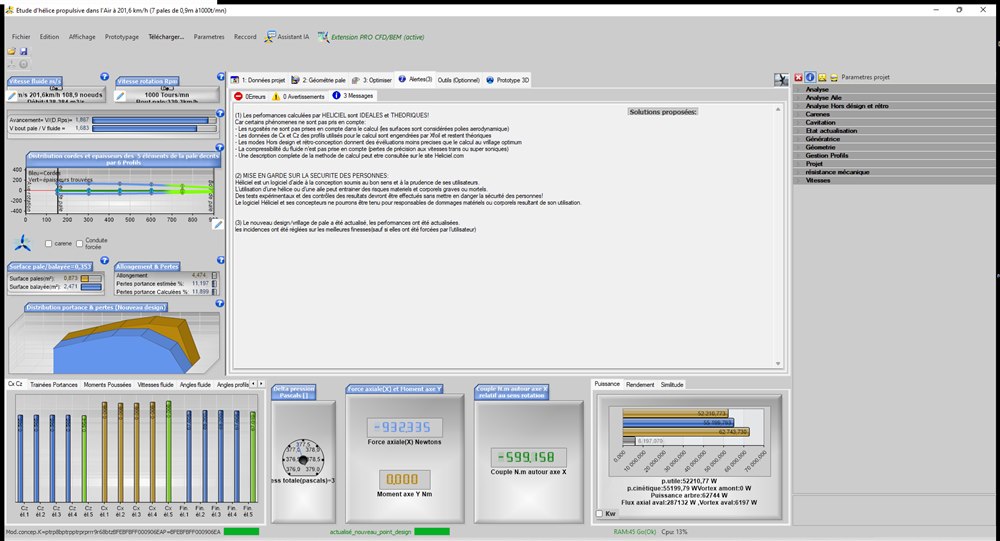
1: Start from the aircraft propeller model: the supplied model is a 1,800 mm propeller with… 7 blades (a multi-blade demonstration propeller). It does not matter: we are going to impose our own geometry. It is a good reminder that a model is a starting point, never a recommendation.
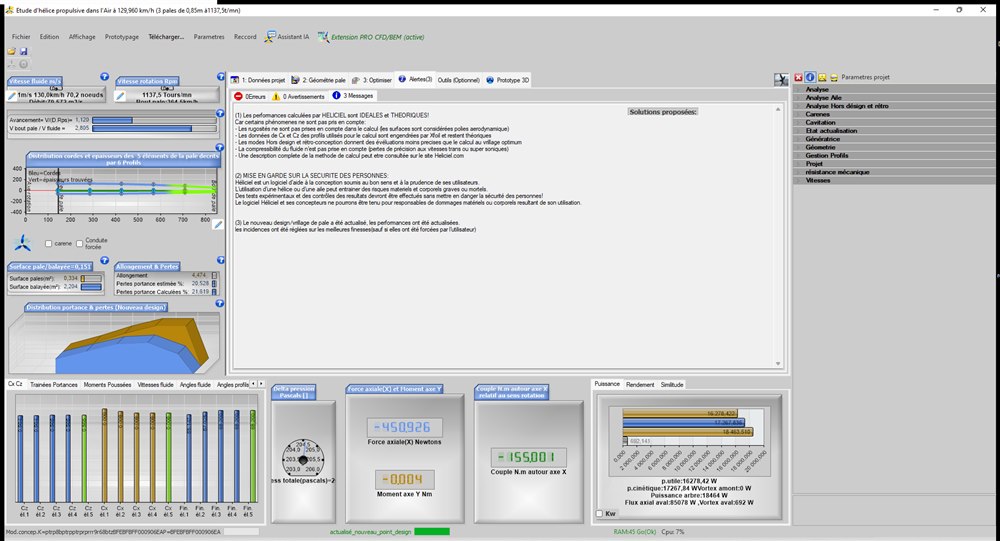
2: Cruise design: we ask Heliciel for a 1,700 mm, 3-blade propeller, in air at 15 °C at sea level, advancing at 36.1 m/s, with a thrust target of 450 N: the software searches on its own for the rotation speed that produces this thrust, rebuilding the optimum twist at each trial. Result:
- cruise rpm found: 1,137.5 rpm at the propeller (about 2,760 engine rpm through the 2.43 gearbox: an economical cruise setting for the Rotax);
- thrust -450.9 N (negative = propulsive in Heliciel's axis convention);
- propulsive efficiency: 0.88 — excellent, typical of a large, slow propeller;
- power absorbed: 18.5 kW (25 hp) out of the 59 kW available: the reserve will serve the climb;
- torque: 155 N·m at the propeller (64 N·m on the engine side); advance ratio J = 1.12; geometric pitch 2.45 m at 0.7 R;
- tip Mach number: 0.31 — very far from the sound barrier, a guarantee of quietness and efficiency.
3: The mistake to avoid: what happens if this fixed-pitch propeller is evaluated at full rpm (2,387 rpm) at 54 km/h, as at the start of the take-off run? Heliciel answers… 3,104 N of thrust for 309 kW absorbed — nearly 4 times the engine power, with 6 section stall warnings. This figure is not a software error: it simply says that the engine will never be able to drive this propeller at 2,387 rpm at low speed. In practice the propeller “holds back” the engine at a much lower rpm, and the available engine torque sets the operating point. This is THE compromise of the fixed-pitch propeller: cut for cruise, it restrains the engine at take-off (and vice versa). Hence the variable-pitch propellers of more demanding aircraft.
4: Available thrust from take-off to cruise: sweep of the flight speed from 20 to 42 m/s (72 to 151 km/h), at the cruise rpm of 1,137.5 rpm, geometry frozen (“Off-design” mode):
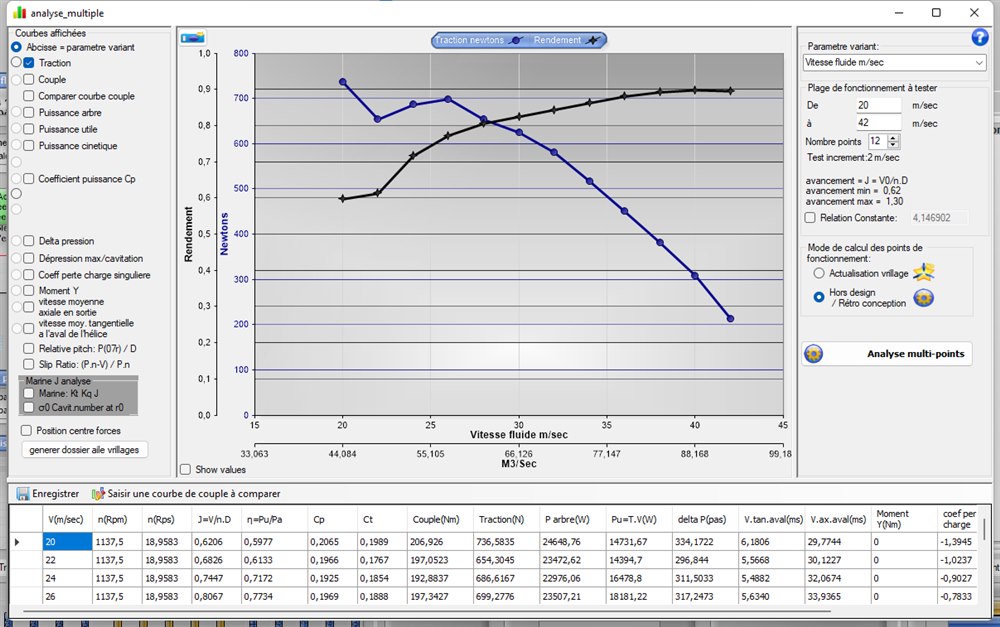
| Flight speed (km/h) | J | Thrust (N) | Propulsive η | Shaft P (kW) |
| 72 | 0.62 | 737 | 0.60 | 24.6 |
| 94 | 0.81 | 699 | 0.77 | 23.5 |
| 108 | 0.93 | 625 | 0.83 | 22.7 |
| 122 | 1.05 | 518 | 0.86 | 20.4 |
| 130 | 1.12 | 451 | 0.88 | 18.4 |
| 144 | 1.24 | 309 | 0.90 | 13.8 |
| 151 | 1.30 | 214 | 0.90 | 10.0 |
Reading: below cruise speed the available thrust exceeds the drag (698 N at 94 km/h against a need of about 450 N): this reserve is what makes the ultralight climb. Above 130 km/h the thrust collapses: our design point really is the cruise ceiling of this pitch setting. Efficiency stays above 0.83 over the whole useful range — the signature of a well-born propeller.
5: Noise: Heliciel provides the acoustic indicators (no sound level in dB — no acoustic model is built in; beware of software that promises a theoretical dB(A)):
- blade passing frequency: 56.9 Hz (harmonics 114 and 171 Hz): a low hum, far less tiring than the whistle of a fast propeller;
- blade tip speed: 101 m/s (Mach 0.31): below Mach 0.7, tip noise stays moderate.
6: Summary and model to download
- 3-blade propeller Ø 1,700 mm, pitch 2.45 m (0.7 R), fixed pitch;
- cruise at 130 km/h at 1,137.5 propeller rpm (2,760 engine rpm): thrust 451 N, efficiency 0.88, 18.5 kW absorbed;
- thrust reserve in climb: +250 N at about 95 km/h;
- tip Mach 0.31, BPF 57 Hz.
The complete project can be downloaded here: helice_ulm_130kmh_1700mm.hlc (open it with Heliciel). It is also included in the models supplied with the software. From this project: STL/STEP export of the blades, drawings, spar and strength check.
Warning: an aircraft propeller puts the pilot's life at stake. Heliciel's results are theoretical; manufacture, balancing and testing fall under the rules of the trade and ultralight regulations. Never fly a propeller that has not been proven on the test bench and in static runs.
I remain at your disposal for any remarks or further information at contact@heliciel.com
- JF Iglesias, Heliciel developer.
To see an aircraft propeller in cruise and in a static run in the air it stirs, read the case study aircraft propeller CFD: two very different flows, in pictures.
 Global site map
 Mecaflux
 Tutorials Mecaflux Pro3D
 Tutorials Heliciel
 Tutorials Heliciel PRO CFD
 Mecaflux Store
 Compare software functions
 Quotes, Orders, Payment Methods
 project technical studies