
Water mill: generating electricity from the mill's head
A water mill can generate electricity: its head, created by the weir and the leat, drives a water wheel or a turbine coupled to a generator. Across Europe, old mills have already taken this path, in the early 20th century or today, and their owners often bring the head back into service for small hydropower. This page explains how to estimate the power of a mill, how to choose between a water wheel and a turbine, presents mills equipped in France, the United Kingdom and Italy, and shows what Heliciel computes for you.
On this page:
- How many mills could generate electricity, in France and in Europe
- Estimating the power of a water mill: head and flow
- Water wheel, screw or turbine: how they work and how to choose
- Examples of equipped mills in France
- Examples of equipped mills worldwide: United Kingdom, Italy
- Water rights and permits
- Designing a mill turbine with Heliciel
- Frequently asked questions
1: How many mills could generate electricity, in France and in Europe
In 2022, the French federation of mill preservation associations (FFAM) published a first assessment of the electricity production potential of French water mills. It starts from the 82,000 mills counted in 1809 and estimates that about 36,000 mills could today be fitted with a turbine while complying with environmental regulations, with an average power of 22 kW per mill and an additional output of 2.8 TWh a year. The earlier studies it quotes gave 1 to 3.3 TWh a year for existing structures. These are the federation's estimates, not measurements; they give the order of magnitude: each mill is small, but there are many of them.
At European level, the study by Punys et al., Renewable Energy, 2019 assesses the potential of historic watermills, weirs and dams never used for power generation in 21 European Union countries. It relies on the RESTOR Hydro database of some 65,000 sites, mostly micro-hydro.
2: Estimating the power of a water mill: head and flow
The hydraulic power of a mill depends on two quantities: the head H, the level difference between the upstream leat and the tailrace, in metres, and the flow Q passing through the machine, in m³/s:
P (W) = ρ · g · Q · H
with ρ the density of water (about 1,000 kg/m³) and g = 9.81 m/s². Worked example: 1 m³/s under a 3 m head carries 1,000 × 9.81 × 1 × 3 = 29,430 W, i.e. 29 kW gross. That is the power of the water: the electricity produced is lower, because the head losses of the leat and pipe, then the efficiency of the machine and generator, must be deducted.
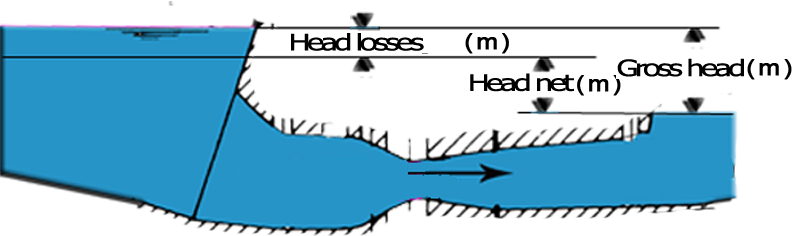
Gross head, head losses, net head: the net head is what works in the machine.
The flow is the hardest quantity to know: it varies with the seasons, and part of it must stay in the river (residual flow). The page measuring river flow presents measurement methods. The complete method, from site power to runner, is followed in the hydropower plant tutorial.
3: Water wheel, screw or turbine: how they work and how to choose
- The water wheel is the original machine of the mill. Slow and large, it takes water from above, from the side or from below. It keeps the look of the mill, but its slow rotation needs a gearbox to drive a generator.
- The hydrodynamic screw, or Archimedes screw, is an inclined screw turned by the water flowing down it. It suits very low heads.
- The turbine is more compact and turns faster. Within the ranges used by Heliciel, heads from 2 to 40 m call for a propeller or Kaplan turbine; the page water turbine types explains how they work and how to choose by specific speed.
The choice depends on the head, the flow and what should be kept of the mill. The French village of Gœulzin, presented below, chose a water wheel rather than a turbine it judged more productive but more fragile. Heliciel designs propeller and Kaplan turbines, used in the software for heads from 2 to 40 m; it does not compute water wheels or screws.
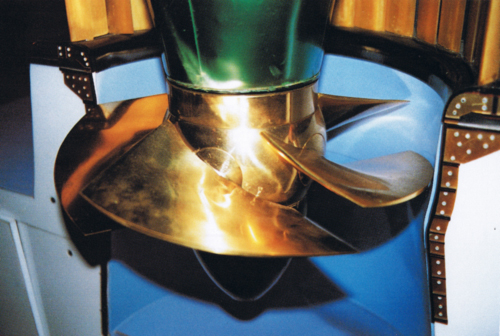
A Kaplan turbine: water passes through the guide vanes, then the propeller runner, and leaves through the draft tube.
4: Examples of equipped mills in France
Gœulzin (Nord): a village water wheel
The village fitted its 3 m head with a water wheel in February 2021, after renovating its street lighting. The calculations forecast 96,000 kWh a year; the wheel produced 61 MWh in 2021 and 75 MWh in 2023. The installation cost €408,000 excluding VAT, 71 % subsidised, and the village reports savings of €66,000 a year. Source: Banque des Territoires, April 2024 (in French).
Saint-Gaultier (Indre): two Kaplan turbines in a mill on the Creuse
The project re-equips the mill's hydropower plant for a maximum gross power of 274 kW and a net electrical power of 167 kW, replacing the two existing turbines with two vertical Kaplan turbines, with two fish passes for upstream migration, a downstream device, a canoe pass and a residual flow of 3.1 m³/s in the bypassed reach. Source: prefectoral order, Centre-Val de Loire region, 2023 (in French).
Port-Rhingeard (Entrammes, Mayenne): a mill turned power plant in 1930
A mill recorded in 1446 on the Mayenne river, rebuilt in 1858 with two Fontaine axial turbines, the first hydraulic turbines used in the department. In 1930 it was converted into a hydropower plant, with the machines installed in a new building against the mill. The heritage inventory still described it as operating at the time of its survey. Source: French national heritage inventory, Pays de la Loire (in French).
Cuisery (Saône-et-Loire): from flour mill to power generation
A mill on the Seille mentioned as early as 1323, one of the largest installations of the Bresse area at the end of the 18th century. Its wheels were replaced by cast-iron turbines around 1870; having become a flour mill, it stopped using water power, and activity ended in the late 1990s. In September 2003, a power plant was installed on the site. Source: heritage inventory, Bourgogne-Franche-Comté (in French).
5: Examples of equipped mills worldwide: United Kingdom, Italy
Outside France, refurbished mills show the same range of solutions: wheel, screw, Francis, Kaplan or cross-flow turbine.
Masson Mills (Derbyshire, England): a Francis turbine in a cotton mill
A former cotton mill on the Derwent, first driven by waterwheels. A 100 kW Gilkes pit-Francis turbine replaced one wheel in 1924; the current turbine, of the same type, dates from 1974: 160 kW on a 3.35 m head with 6,000 l/s, for an average output of 730 MWh a year. Source: Derwent Hydro case study.
Aberdulais (Wales): a large wheel and a turbine
At the former Aberdulais tin works on the River Dulais, an 8.2 m wheel with 72 buckets turns at five revolutions per minute and can produce up to 20 kW; a separate 200 kW turbine feeds the grid. Source: National Trust.
Howsham Mill (Yorkshire, England): a wheel and Archimedes screws
A corn mill from around 1755 on the Derwent, restored by a charity: a new wheel and an Archimedes screw were installed in 2007, the mill was connected to the grid in 2010, and a larger screw was commissioned in 2018. Source: Wikipedia.
Heron Corn Mill (Cumbria, England): a Kaplan turbine
An 18th-century water mill on the River Bela, fitted with a Kaplan turbine; part of the electricity is sold to the neighbouring paper mill. Source: Wikipedia.
Gants Mill (Somerset, England): a modern turbine beside an 1888 turbine
On the River Brue, a new turbine and generator were installed in 2003 to complement an 1888 Armfield turbine; the equipment is designed to produce up to 12 kW in continuous operation. Source: Somerset Rivers.
A mill in central Italy: Francis or cross-flow?
A 2024 university study compares, for a mill in central Italy converted into a power plant (0.65 m³/s under a 9 m gross head), a cross-flow (Banki) turbine and a Francis turbine. The Francis is chosen: 46.48 kW and nearly 150 MWh a year. Source: Di Tommaso et al., ECOS 2024.
6: Water rights and permits
Bringing a mill back into production is not only a matter of machinery. The water right attached to the mill, water legislation and ecological continuity (passage of fish and sediment) frame every project, and the Saint-Gaultier example shows the devices a permit file may require. Rules differ from country to country; in France, the steps are described in the ADEME guide on administrative and technical steps and ecological continuity (in French) (2024 edition). This page does not replace the advice of the authority in charge of water or of a consulting engineer.
7: Designing a mill turbine with Heliciel
For a propeller or Kaplan turbine, Heliciel's Hydro Turbine design workshop starts from the gross head and flow of the mill. It computes the specific speed, proposes the dimensions of the runner, guide vanes and draft tube, computes the pipe head losses, then the runner by blade element momentum theory (BEM) and the power balance. The workshop requires a HydroTurbine license.
- Water turbine types: Pelton, Francis, Kaplan and selection by specific speed.
- Kaplan turbine: how it works and diagram.
- Hydro Turbine tutorials and videos: designing a small hydro plant step by step.
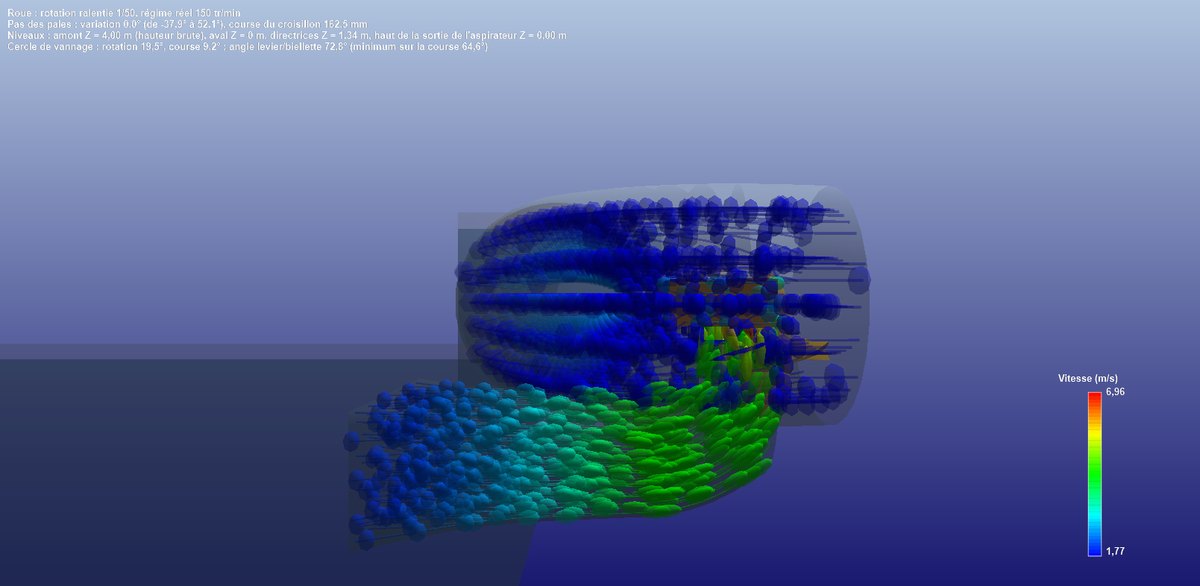
A small Kaplan hydro plant in dimensioned section, in Hydro Turbine design.
Hydro Turbine interface of Heliciel (requires a HydroTurbine license)
Frequently asked questions
Can a water mill generate electricity?
Yes. The head of a mill, created by its weir and leat, can drive a water wheel, a screw or a turbine coupled to a generator. Mills in France, the United Kingdom and Italy generate electricity this way, some since the 1920s and 1930s. The power depends on the head and the flow.
How much power can a water mill produce?
The gross hydraulic power is P = ρ·g·Q·H: about 9.8 kW per cubic metre per second and per metre of head. Head losses and the efficiency of the machine and generator must then be deducted. In its 2022 assessment, the French federation of mill preservation associations (FFAM) uses an average of 22 kW per mill that could be equipped.
Water wheel or turbine for a mill?
A water wheel keeps the look of the mill; a turbine is more compact and, according to the French village of Gœulzin, which chose a wheel, more productive but more fragile. For a propeller or Kaplan turbine, Heliciel designs the runner and the plant for heads from 2 to 40 m.
Is a permit needed to put a mill back into production?
Yes, in every country the water right attached to the mill, water legislation and fish passage rules frame the project. Check with the authority in charge of water in your country before any work; in France, the steps are described in the ADEME hydropower guide.
 Global site map
 Mecaflux
 Tutorials Mecaflux Pro3D
 Tutorials Heliciel
 Tutorials Heliciel PRO CFD
 Mecaflux Store
 Compare software functions
 Quotes, Orders, Payment Methods
 project technical studies