
Propeller: calculation, design and 3D modeling of propulsion and energy-capture propellers
Propeller calculation rests on a simple idea: each blade behaves like a rotating wing. For each slice of blade we calculate the relative and induced velocities, then the thrust, torque and efficiency of the propeller. This page presents the two families of propellers (propulsion and energy capture), the notion of pitch, and Heliciel's calculation methods and 3D modeling.
On this page:
- Propulsion propeller calculation: boats, aircraft and fans
- Energy-capture propeller calculation: wind turbines, tidal turbines and axial turbines
- Propeller pitch
- Propeller calculation methods and 3D modeling
The path of propeller calculation methods took a decisive step forward when the operation of blades was compared with that of rotating wings. Calculating the relative and induced velocities, due to rotation combined with the advance of the fluid, is essential to define the twist of propeller blades. Predicting power, lift or torque relies on practical theoretical tools, which you will find partly gathered here.
1: Propulsion propeller calculation: boats, aircraft and fans
Aircraft propellers, boat propellers and fans and ventilation are of the propulsion type. Their blades use the motor torque to accelerate the fluid and generate thrust by reaction (change of momentum). For details, see the page on aircraft, boat and fan propeller calculation.
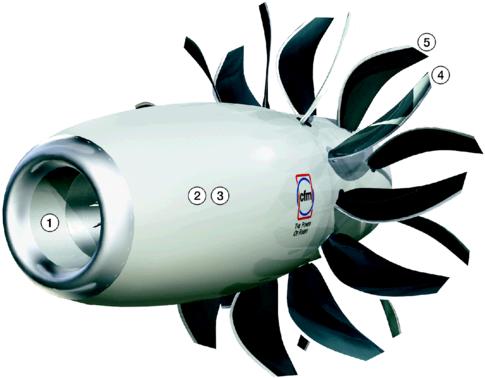
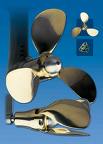
Two propulsion propellers: a contra-rotating aircraft propeller and a folding boat propeller.
2: Energy-capture propeller calculation: wind turbines, tidal turbines and turbines
Capturing the energy of fluids uses propellers to turn the motion of the fluid into energy. The propeller then becomes a motor. Wind turbines, tidal turbines and axial turbines use the torque generated on their blades to drive generators, pumps or machines.
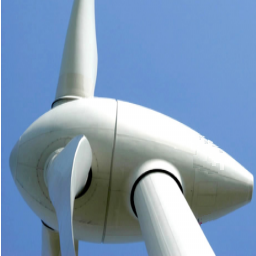
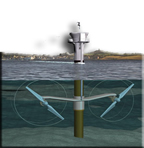
Two energy-capture propellers: a wind turbine and a tidal turbine.
3: Propeller pitch: geometric pitch and effective pitch
Pitch is defined in several ways, and it is important to tell them apart. The page on geometric pitch and effective pitch explains them.
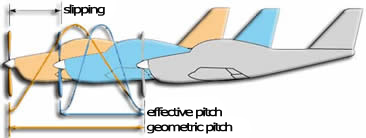
The geometric pitch, the effective pitch and the slip between them. (Figure labels in French: "Pas géométrique", "Pas effectif", "Glissement".)
4: Propeller calculation methods and 3D modeling
The propeller calculation methods predict performance, efficiency and the shape of blade profiles. Heliciel  is propeller calculation software for everyone: a simple knowledge of the basics of mechanics (force, torque, power, efficiency) is enough. It allows the calculation of propulsion propellers, the calculation of energy-capture propellers and the calculation of wings or hydrofoils.
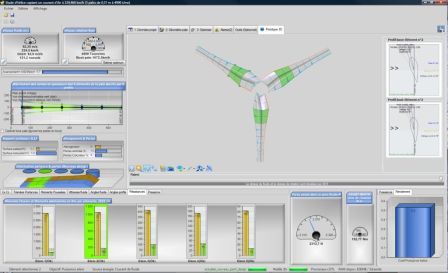
A calculation window of Heliciel: the blade is divided into elements, and the charts give the quantities of each element.
Heliciel uses airfoils whose performance and shapes are stored in a database to build a 3D propeller model. We can test the geometric shape of the blades, the number of blades and the rotation speed to evaluate thrust, torque and efficiency of the model. A plan of the blades and their profiles can then be edited.
To go further, we can see how twist and pitch angle are calculated along the blade, or how the history of calculation methods led to blade-element calculation.
 Global site map
 Mecaflux
 Tutorials Mecaflux Pro3D
 Tutorials Heliciel
 Tutorials Heliciel PRO CFD
 Mecaflux Store
 Compare software functions
 Quotes, Orders, Payment Methods
 project technical studies