
Airship and submarine hull drag: calculating lift and propulsion power
Heliciel calculates the drag of an airship or submarine hull by treating the hull as two very short symmetrical half-wings whose profiles have decreasing chords. The software gives the form drag, the total drag, the lift and the propulsion power at the chosen speed, for a half hull: double the values to get the complete hull.
In this article:
- Hull resistance: from force to power
- Calculating the drag of an airship or submarine in Heliciel
- Reading drag, lift and propulsion power
- Exporting the hull as IGS to CAD software
- Symmetrical profile or lifting profile?
1: Hull resistance: from force to power
Studying the resistance of a hull lets us predict the power needed to move it at a given speed. The resistance force therefore gives the power of the engine, or of the sails, that will move the vessel. This holds for every type of craft moving horizontally on a straight path: boats, aircraft, submarines, hydrofoils or airships.
We can study the aerodynamic performance of an airship, or the hydrodynamic performance of a submarine, with the Heliciel software. To do so, we consider the airship or submarine as made of two very short symmetrical half-wings whose profiles have decreasing chords.
A more specific page, the study of the resistance of a boat hull, covers in detail the different forces that make up the resistance of a surface vessel. Here we treat a hull assumed to be fully immersed in a fluid, such as an airship or a submarine, and the form resistance of a boat hull. The performance calculated here therefore includes neither wave resistance nor the friction resistance due to hull roughness.
For the total resistance of a surface vessel, waves included, Heliciel's ship wave and drag study does the calculation.
2: Calculating the drag of an airship or submarine in Heliciel
Choose an airship or submarine model in the File menu of the software: you start from an example whose dimensions you only need to change. If these models do not appear under File > New project (from a model), download the latest update of the Heliciel software.
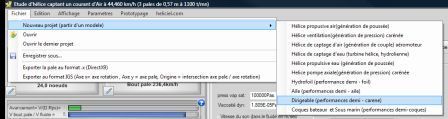
The File > New project (from a model) menu: the "Airship (half-hull performance)" and "Boat and submarine hulls" models are at the bottom of the list.
Here we loaded the airship model, but we could have chosen a submarine. To calculate the form resistance of a boat hull, select the submarine model; the wave resistance of a surface hull has to be calculated separately.
3: Reading drag, lift and propulsion power
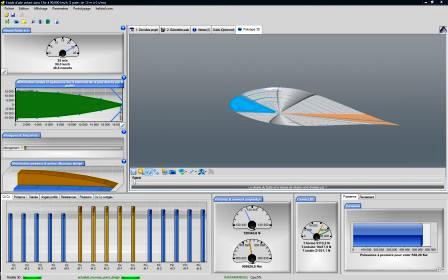
The results for a half hull: 3D prototype tab in the centre, drag and lift indicators at the bottom, propulsion power at the bottom right.
Heliciel gives the drag and lift of the submarine or airship, distinguishing form drag from total drag, which includes the drag caused by lift. The power needed to propel this half hull at the chosen speed appears in the results area, bottom right.
Warning: the model performance is given for half hulls. You must therefore double all the power, drag and lift values to obtain the performance of the complete airship or submarine hull. Surface roughness is assumed to be aerodynamically polished. If you want to include the drag due to a rougher hull, you can use the Mecaflux software to calculate drag on a rough surface.
4: Exporting the hull as IGS to CAD software
Heliciel exports the half hull and its mirror image in 3D IGS format, to build a model in CAD (computer-aided design) software such as SolidWorks. To export the half hull of a boat, airship or submarine, use the File > Export as IGS menu.
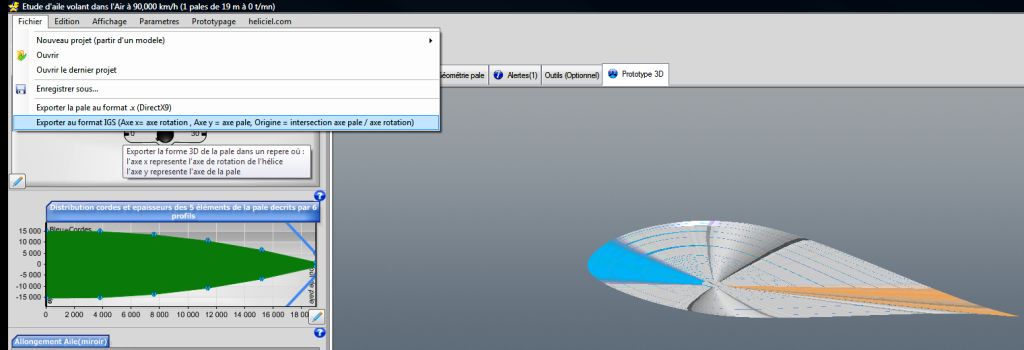
The File > Export as IGS command, here with the 3D prototype tab displayed.
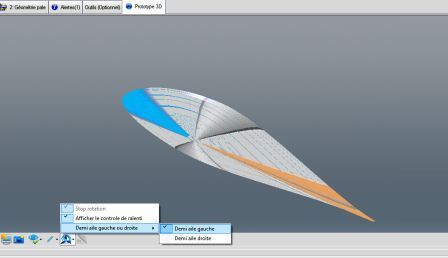
To create the symmetrical hull, which lets you build the complete model in an assembly, use the "Left or right half-wing" option of the 3D prototype tab.
After exporting the two hull files, left and right, in 3D IGS format, you only need to assemble them in your CAD software (here SolidWorks).
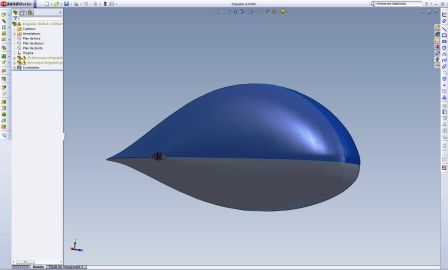
The complete hull, assembled in SolidWorks from the two half hulls.
5: Symmetrical profile or lifting profile?
Here we created a lifting airship: its speed tends to make it climb, because the model profile is not symmetrical. For an airship or submarine hull without lift, or for a boat hull, you need a symmetrical profile. To quickly select the symmetrical profiles in the profile database, use the Search > Search symmetrical profiles tab.
To go further, we can move on to the study of the resistance of a boat hull, or run the ship wave and drag study for the total resistance of a surface hull.
 Global site map
 Mecaflux
 Tutorials Mecaflux Pro3D
 Tutorials Heliciel
 Tutorials Heliciel PRO CFD
 Mecaflux Store
 Compare software functions
 Quotes, Orders, Payment Methods
 project technical studies