
The pressure in one point of the network is the sum of energies of dynamic and static pressures These transformations of energy are reversible or irreversible. The head loss is irreversible loss of pressure because the pressure drop is converted into heat or noise that you do not know transforming into pressure. (mecaflux pro 3D)
Keywords::
Pressure drop calculations software drop Reynolds Number Head losses Loss Formula load drop Pressure drop regular pressure losses Loss Plan hydraulic load flow calculations aeraulic Loss load losses Colebrook-White formulas losses led Roughness Viscosity
Fan design for ventilation, air conditioning and PC fans
Fan calculation for ventilation means sizing a ducted propeller that delivers a pressure rise equal to the pressure drop of the network, at the flow rate set by the specifications. The same approach applies to an air-conditioning fan, an aeraulic wind tunnel or a computer fan. The first stake is economic: a well-matched system can reach a propeller efficiency of 0.8, whereas an efficiency of 0.2 is not uncommon.
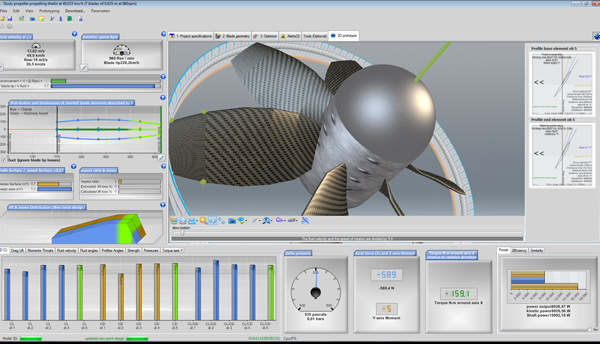
A ducted fan propeller seen in Heliciel, with its thrust, torque and power results. For the detailed calculation, see axial aeraulic fan design in Heliciel.
In this page:
- Fan efficiency: the economic stake
- Sizing a ventilation or air-conditioning fan
- Software for axial fan calculation
- Which fan shape to choose: turret type or blade root at 0.5 R
- PC fans: cooling and efficiency
 1: Fan efficiency: the economic stake
Before discussing the technical specifics of the air-conditioning fan, the aeraulic wind tunnel or ventilation, let us recall the economic and financial stake of correctly sizing ventilation propellers. The market potential for systems with high energy efficiency is considerable, and yet underexploited.
A fan propeller can run 24 hours a day. Its efficiency can be catastrophic if its operating point is not suited to the flow rate or pressure of the network section it feeds. Often, as a precaution, the fan is oversized, and the flow rate is then regulated by valves whose degree of opening generates a pressure drop. We then pay twice: the motor delivers more than needed, and the valve dissipates the excess.
An optimal ventilation system can reach an efficiency of 0.8 at the propeller, with a propeller matched to its motor, to the flow rate and to the desired pressure difference. Unfortunately, the consulting firm rarely has propeller design software and the time to refine efficiency, and a propeller efficiency of 0.2 is not uncommon. The ventilation systems of our buildings, factories, shops and administrations are so many sources of savings. An energy saving is income: it contributes to profit by reducing operating costs.
The report on electric motor consumption in industry gives the measure of it. Over the life of an electric motor, energy represents 96% of the overall cost, against 2.5% for purchase and 1.5% for maintenance.
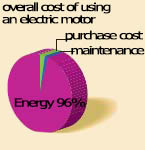
Overall cost of using an electric motor, from the report on motor consumption in industry: energy weighs 96%.
Consumers, decision-makers and buyers are increasingly trained, informed and competent about energy saving. We once bought a washing machine without worrying about its consumption; today we judge its design quality first by its energy efficiency. There is no need to use the ecological argument, which is obvious, to sell a system whose efficiency has been carefully designed: a consulting firm can easily stand out from another in a call for tenders with the clear economic argument of operating cost.
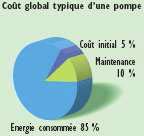
For a pump, the breakdown is comparable: energy consumed represents 85% of the overall cost (same report; chart labels in French).
Efficiency is therefore a product in its own right, and propellers are often the weakest link of that efficiency. We will remedy this and produce added value.
2: Sizing a ventilation or air-conditioning fan
As with axial pumps for liquids, the role of the fan is to generate a pressure rise at a given flow rate. Air-conditioning and ventilation networks must move air through ducts and conduits at the flow rate stipulated in the specifications.
This flow rate is set by the volume of the rooms to ventilate or air-condition. Fluid speeds in aeraulic ducts are generally limited by noise. A pressure-drop calculation software such as Mecaflux, a partner of Heliciel, lets the technician determine the pressure drop generated by moving the air at the required flow rate. The fan must then produce a pressure rise equal to this pressure drop, at the flow rate of the specifications.
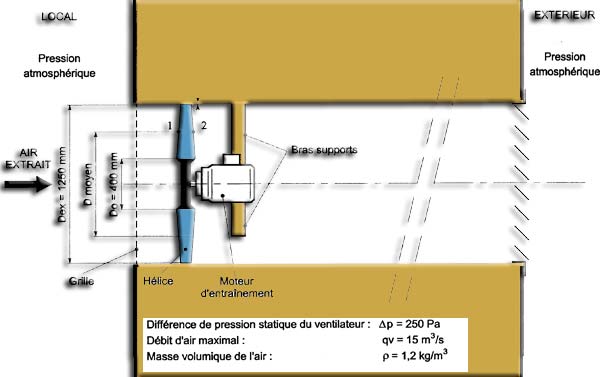
Example of a ventilation specification diagram: a fan in a duct crosses a wall, with a static pressure difference of 250 Pa, a maximum flow rate of 15 m³/s and an air density of 1.2 kg/m³ (labels in French). After the references "Climatisation et conditionnement d'air, distribution des fluides" by J. Bouteloup, M. Le Gay and J. Ligen.
An order of magnitude on this example. The power transmitted to the air equals the pressure difference multiplied by the flow rate: 250 Pa × 15 m³/s = 3,750 W. The power to supply on the shaft depends on the propeller efficiency: as an arithmetic illustration, 3,750 W / 0.8 gives about 4,700 W, and 3,750 W / 0.2 gives 18,750 W. This gap is what makes careful sizing valuable.
The sizing method is that of a propulsion propeller with a shroud. The pressure parameter is the major objective: the propeller will be heavily loaded.
3: Software for axial fan calculation
Heliciel includes a design assistant for axial fan propellers. You enter the flow rate, the pressure difference and the admissible speeds; the assistant proposes a first propeller, which you can then refine. The design and calculation of axial fan propellers are detailed on the page axial aeraulic fan.
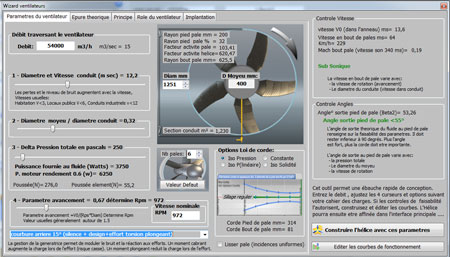
The aeraulic fan design wizard, for a flow rate of 54,000 m³/h (15 m³/s) and a pressure difference of 250 Pa: it proposes a diameter, a rotation speed and the matching motor power (interface shown in French).
The wizard is started from the File menu, then Wizard axial pump and fan blower. It is presented step by step in the aeraulic fan design software included in Heliciel.
4: Which fan shape to choose: turret type or blade root at 0.5 R
The shape of the propeller sets the compromise between flow rate and pressure. Here are a few examples of fan shapes.
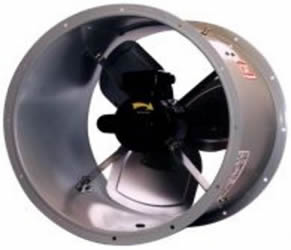 The turret-type fan suits high flow rates but cannot achieve a very high pressure difference with good efficiency. The blade root zone is less effective than the zone at radius 0.75. The strong pressure differences between upstream and downstream of the propeller, generated in the most effective zone, suffer losses at the blade roots.
 The high blade root configuration has blades whose root starts at 0.5 times the blade tip radius. The tangential speed at the blade root is then half that of the blade tip, much more than with a small hub. The effective zone covers the whole blade, and the pressure difference generated can be larger. On the other hand, the passage section narrows: the flow rate must remain low, otherwise a high pressure drop makes us lose the expected pressure benefit.
5: PC fans: cooling and efficiency
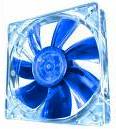 PC fans, meant to generate a high flow rate to cool the computer, do not need much pressure. Yet their propellers are often of the second type. As with the ducted boat propeller, efficiency is often sacrificed for reasons of size, but also of cost price. It is surprising that a computer, whose cooling consumes energy, is fitted with PC fans of mediocre efficiency. Could fan noise be a pleasure for manufacturers? We rather think buyers do not care, more focused on screen size or memory; the fan is nevertheless an important link in the energy consumption and cooling of the computer.
This PC case was designed to ensure optimal cooling:
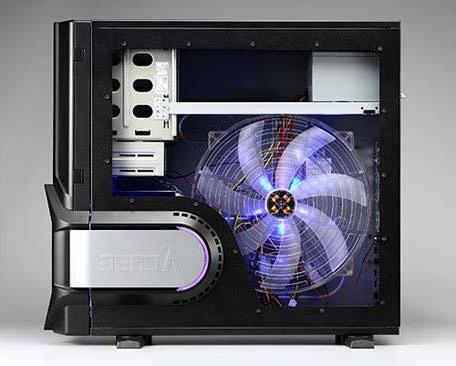
A computer has optimal operation for a given temperature. Fan noise and PC consumption are therefore not the only nuisances of a PC fan with poor efficiency: the performance of the computer also decreases. The fan of the graphics card, for its part, cools the graphics processor, whose performance also drops if it is poorly matched.
A short tour of the forums on PC and graphics card fans quickly sets the tone: "how to reduce PC fan noise" is a recurring question. Manufacturers often hide poor cooling efficiency behind performance measured at optimal operating temperature. Informed users know their PC performance depends on good cooling, and do not hesitate to invest in fans that perform better than those supplied.
A PC fan propeller is therefore like a propulsion propeller: its efficiency is linked to its size. Good PC fans are therefore... large!
A fan and a radiator in the same duct: the practical case fan CFD simulates the whole and gives the flow rate that actually passes.
To go further, we can see the detailed calculation of an axial aeraulic fan, how axial pumps reuse the same method for liquids, or how to choose the number of blades of a ducted propeller.
 Global site map
 Mecaflux
 Tutorials Mecaflux Pro3D
 Tutorials Heliciel
 Tutorials Heliciel PRO CFD
 Mecaflux Store
 Compare software functions
 Quotes, Orders, Payment Methods
 project technical studies