
A BEM-designed 10″ propeller, a 450 mm frame, a battery, a flight controller, a GPS and a camera gimbal: what the drone carries, what it draws, and what protruding equipment costs.
450 mm camera quadcopter: from mass budget to flight
The screenshots show Heliciel's French interface; the English label of each control is given in the text.
A camera drone is first a mass to carry: battery, electronics, gimbal. The question is not only "does my propeller push enough?", but "what is left once everything is fitted, and what does each piece of equipment cost?". This case study starts from an already calculated 10-inch propeller and installs it on a 450 mm quadcopter.
- Starting point: the project of the 10″ drone propeller tutorial (in French) — 254 mm, 2 blades, 5,800 rpm, designed for hover;
- What you get: the mass budget, the thrust margin, the power drawn, the drag item by item, and the 3D images for the file.
- Tutorial steps:
- Open the multirotor bench
- The 450 mm frame
- Battery and Kv: no-load speed
- Loading the drone
- The fixed point: what the drone carries
- Seeing the flow: vortices and induced speeds
- The camera gimbal
- Pitched flight
- Reading the result charts
1: Open the multirotor bench
With the 10″ propeller open in the designer, menu Files > Multi Rotors project. The window works on a copy of the propeller: the designer's project is not changed. The neighbouring entry, Contra Rotative project, opens the frameless contra-rotating pair (ultralight propeller case study).
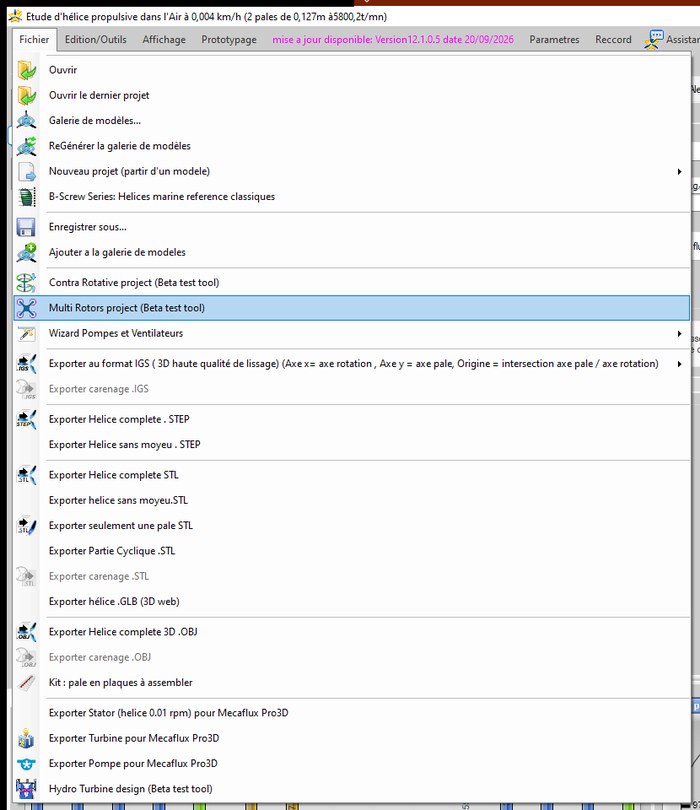
The menu entry
2: The 450 mm frame
Frame settings tab, Arms geometry group: 4 arms, 450 mm diagonal from motor axis to motor axis, 16 × 12 mm arms. Centre plate 150 × 90 mm, bare frame 280 g, four 55 g motors (Ø 28 mm, 30 mm high). Heliciel adds it up: 500 g empty, before any equipment.
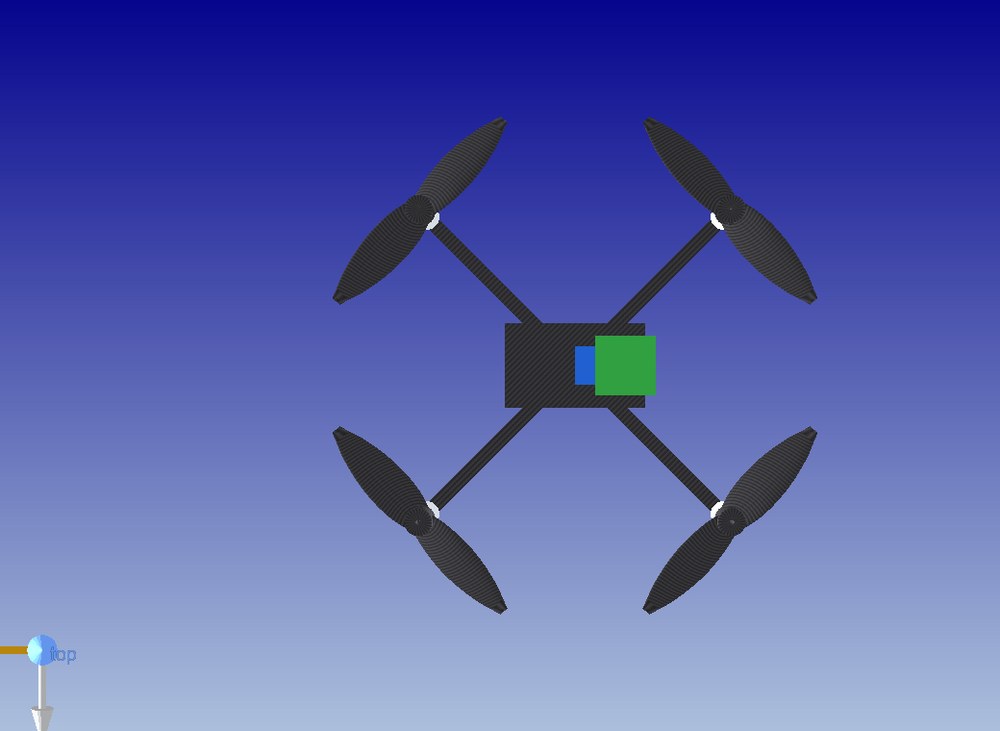
Top view: four arms in X, 10″ propellers
3: Battery and Kv: no-load speed
The Motors group has a calculator: number of LiPo cells in series (Battery S) and Kv constant. In 4S (14.8 V) with a 450 Kv motor, Heliciel displays 6,660 rpm. That is a no-load speed: loaded by the propeller, the motor turns slower. It must therefore exceed the propeller's design speed, here 5,800 rpm.
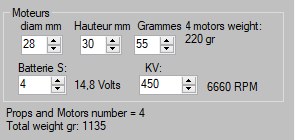
4S battery and Kv 450: 6,660 rpm no-load
4: Loading the drone
Frame loads group, Add module button. Each module gets a name, dimensions, a position (longitudinal and in height), a mass and a colour:
- 4S 5,000 mAh battery: 150 × 48 × 35 mm, 550 g, under the plate (orange);
- Flight controller: 40 × 40 × 15 mm, 40 g, on the plate (blue);
- GPS on mast: 60 × 60 × 15 mm, 45 g, 70 mm above the plate (green).
Total mass rises to 1,135 g. For each module Heliciel also computes the overflowing surface: the part of its surface that sticks out beyond the centre plate. The battery and the controller, within the plate's footprint, do not overflow; the GPS overflows by 300 mm².
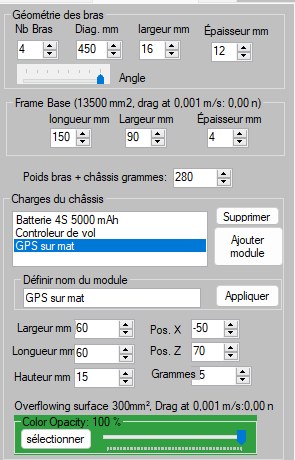
The modules and their settings
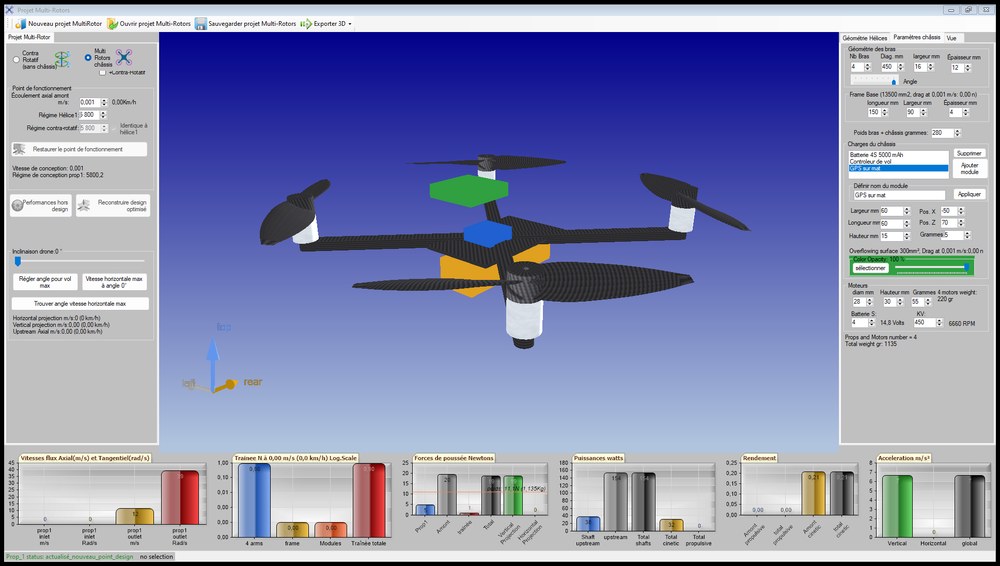
The complete window: settings on the right, loaded drone in the centre, results at the bottom
5: The fixed point: what the drone carries
At zero speed (hover), with the three modules, Heliciel gives:
- Total thrust of the 4 rotors: 19.6 N
- Drone weight (1,135 g): 11.1 N
- Drag, from the arms alone in the rotors' downwash: 0.90 N
- Net vertical thrust: 18.7 N
- Total shaft power: 153.7 W
- Available vertical acceleration: 6.66 m/s²
The margin is comfortable: the net thrust is 1.7 times the weight. The drag at the fixed point deserves a word: at zero speed nothing drags in free air, but the arms are under the propellers, in the flow they accelerate downwards. That downwash loads them — a loss the calculation of the propeller alone does not see.
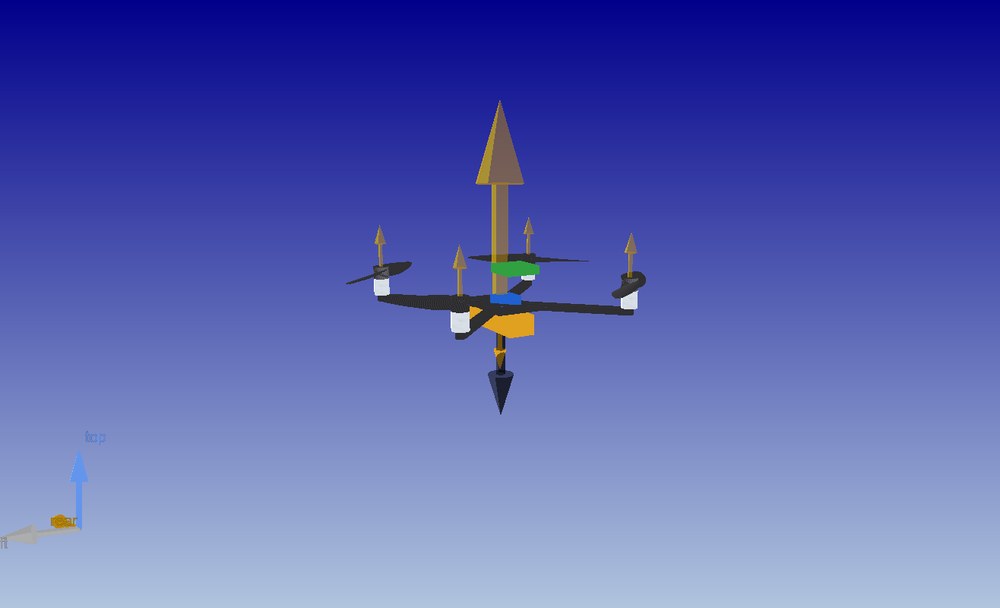
View tab: thrust of each rotor, resultant upwards, weight downwards
6: Seeing the flow: vortices and induced speeds
The View tab displays what the BEM calculation knows of the flow. Tip vortex: the free vortices shed at the blade tips, as rings under each rotor. Inducted speed (in the Upstream Prop. particles group): particles crossing the disc at the calculated induced speed.
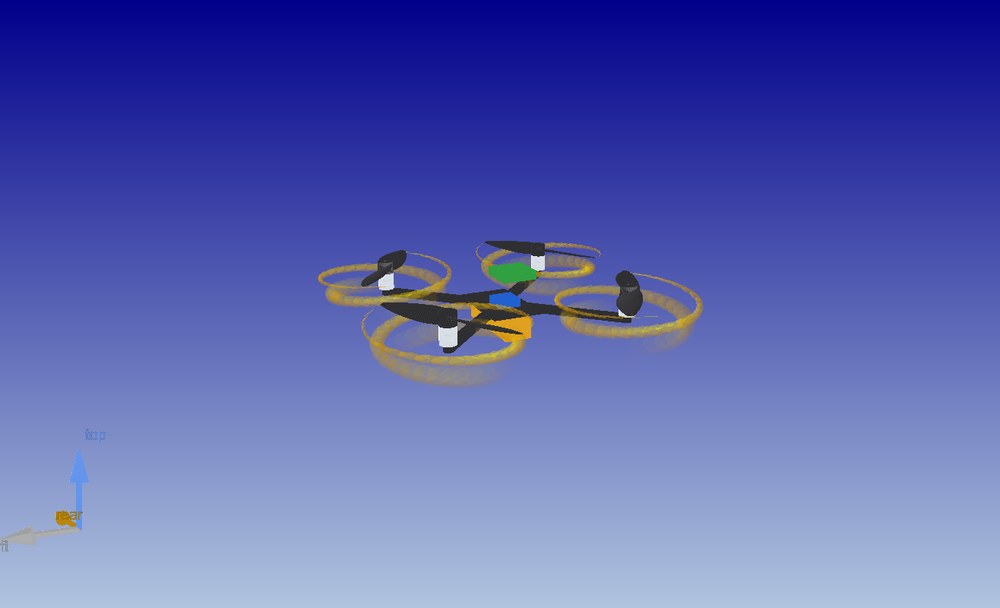
Tip vortices alone, propellers spinning
Closer up, the same scene shows both together, then the particles alone: the air is drawn in from above and thrown downwards, and the arms sit in that jet.
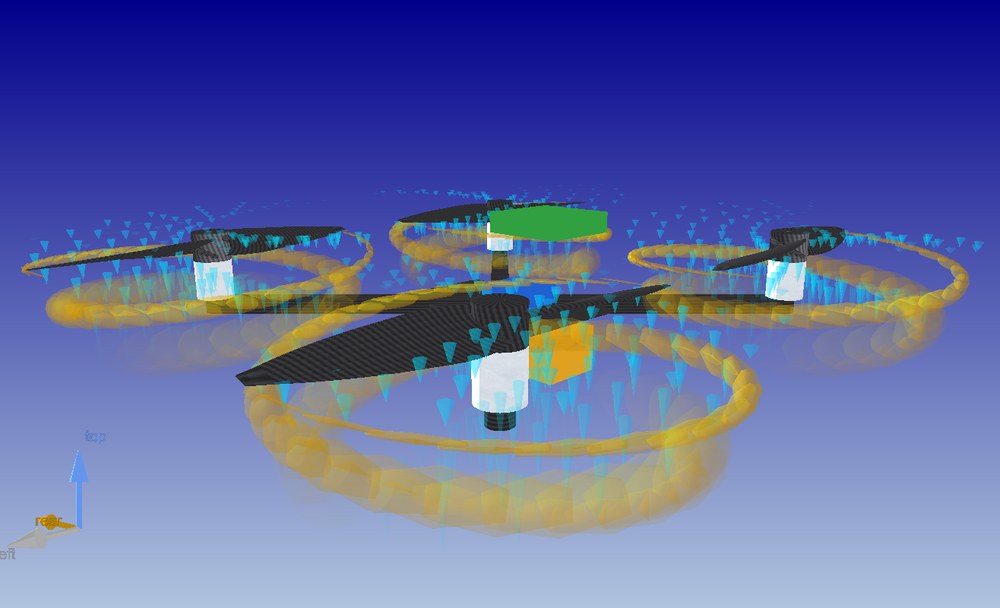
Particles and vortices shown
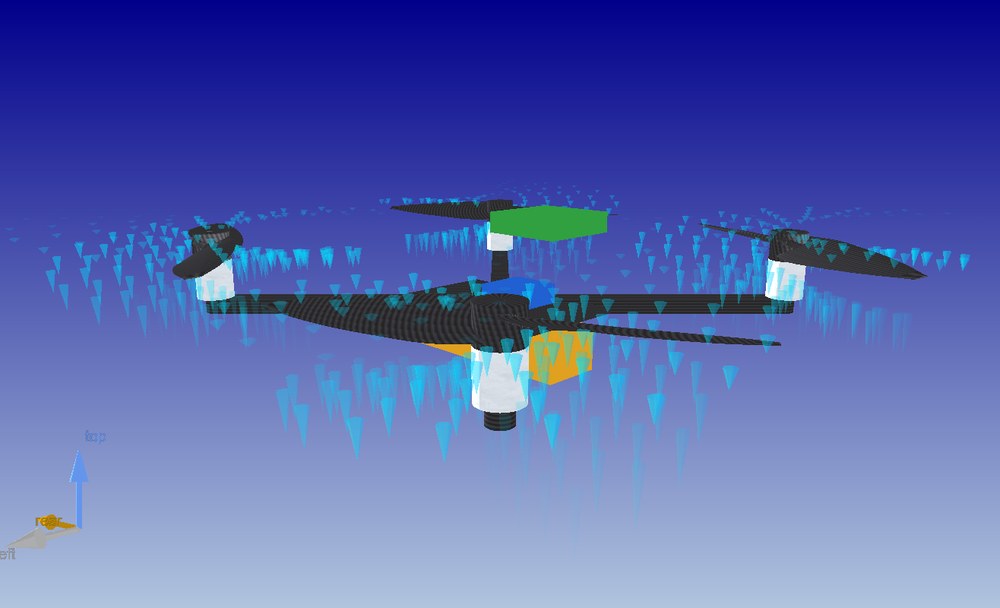
Vortices hidden: the particles alone
7: The camera gimbal
Now the payload: a 110 × 90 × 100 mm gimbal, 320 g, fitted at the front under the plate (red). It overflows widely: Heliciel measures 8,550 mm² of overflowing surface. Total mass rises to 1,455 g (14.3 N).
At the fixed point its drag is zero: the gimbal is not in the rotors' jet and the air around it is still. It therefore costs first through its mass. Its surface only counts when moving.
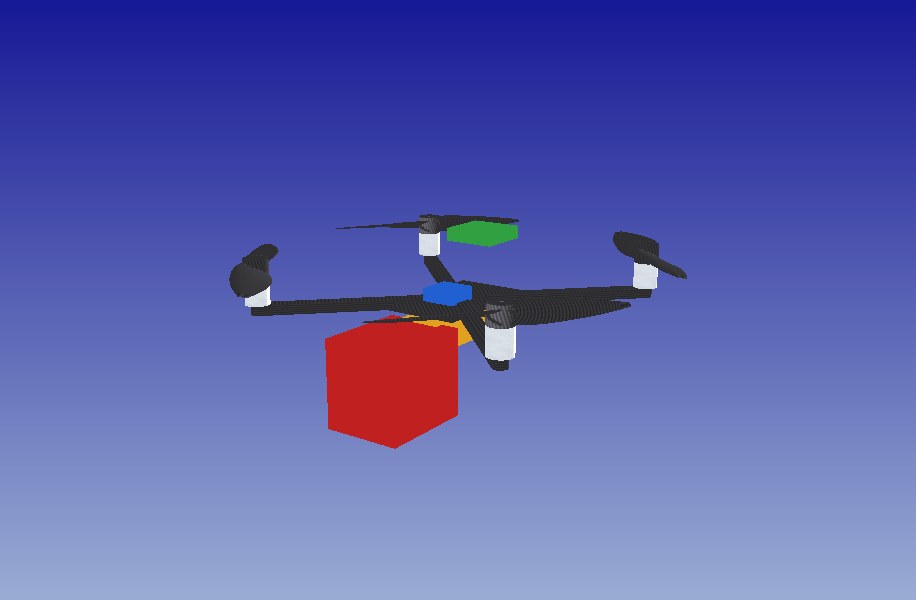
The camera gimbal, overhanging at the front
8: Pitched flight
On a frame, it is the pitch that moves the drone forward. The flow through each propeller stays purely axial: that is what the BEM calculation of each rotor handles. Pitching the frame tilts the propeller axes; thrust and flow speed then split into a horizontal and a vertical part.
The Frame Pitch angle tests group looks, at a given pitch, for the axial flow speed up to which the drone still carries its weight: Heliciel raises that speed step by step and stops when the vertical component of the net thrust meets the weight. It displays the horizontal and vertical projections of that speed.
At the point found, the horizontal thrust is not zero: Heliciel says so in its message — "At this speed the horizontal thrust is not zero, so the speed will continue to increase, but the vertical lift force will decrease under the weight". The result is therefore the limit speed at which the chosen pitch still holds the drone in the air.
Two commands: Max horizontal speed at pitch 0° (and any other pitch set on the slider) and Find Max flyable Horizontal speed pitch, which looks for the pitch giving the largest horizontal projection: every 5°, then to the degree around the best angle.
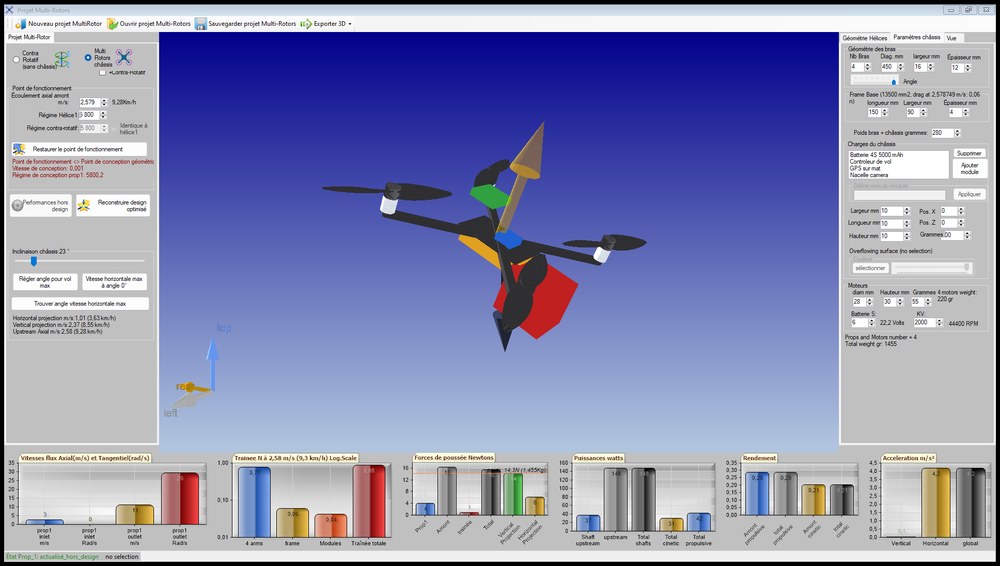
The drone pitched at the best angle found, and the study buttons
The method: measuring the effect of pitch, angle by angle
To see what pitch changes, run the same search at several angles and keep the same view each time: View tab, Left button (side view), Show Weights vectors, Show Thrust vectors and Show Drag vectors ticked, Show only global sums. The pitch slider sets the angle, Max horizontal speed starts the search, and the group displays the speed projections.
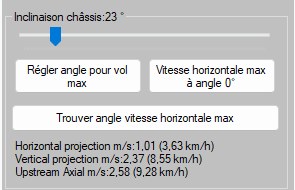
At 23°: horizontal projection 1.01 m/s, vertical 2.37 m/s, axial flow 2.58 m/s
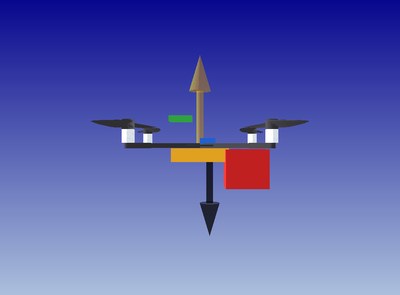
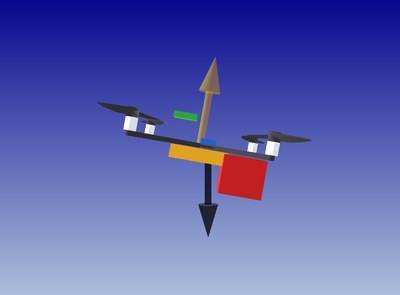
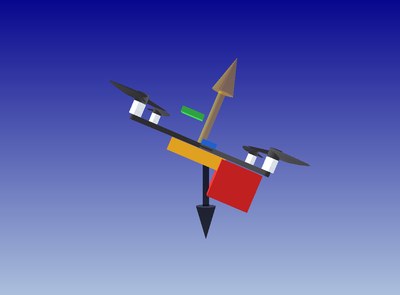
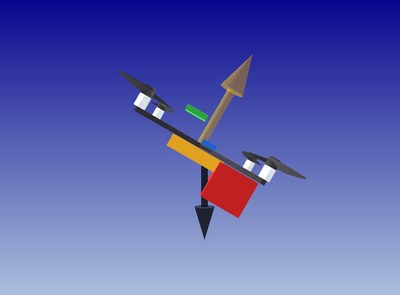
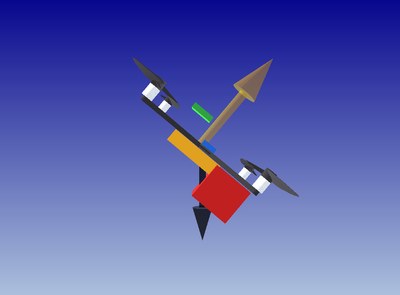
0°, 10°, 23°, 30° and 40°: the resultant thrust (light arrow) follows the pitch and grows longer, the weight
(dark arrow) stays vertical
Readings on the quad with gimbal (1,455 g, weight 14.3 N), propellers at 5,800 rpm:
| Pitch | Axial flow | Horizontal projection | Vertical projection | Thrust of the 4 rotors | Remaining horizontal thrust | Shaft power |
|---|---|---|---|---|---|---|
| 0° | 3.20 m/s | 0 | 3.20 m/s | 15.6 N | 0 | 145.6 W |
| 10° | 3.20 m/s | 0.56 m/s | 3.15 m/s | 15.6 N | 2.6 N | 145.6 W |
| 23° | 2.58 m/s | 1.01 m/s | 2.37 m/s | 16.5 N | 6.1 N | 148.2 W |
| 30° | 0.72 m/s | 0.36 m/s | 0.63 m/s | 18.1 N | 8.7 N | 146.0 W |
| 40° | 0.001 m/s | 0 | 0 | 19.6 N | 12.0 N | 153.7 W |
What the table shows:
- The more you pitch, the less vertical thrust remains: to carry the weight, the rotors must work in a slower flow, where they push harder — thrust goes from 15.6 to 19.6 N between 0° and 40°, the axial speed falls from 3.20 to 0 m/s;
- the horizontal projection goes through a maximum: zero at 0° (everything is vertical), zero at 40° (no speed left), it peaks in between. Find Max flyable Horizontal speed pitch locates it: 23°, 1.01 m/s;
- 40° is the edge of the envelope: at that angle the drone only carries its weight at rest. Heliciel gets it directly: arc cosine of the weight over the net thrust at the fixed point;
- the remaining horizontal thrust grows with the angle: it is what accelerates the drone forward (4.2 m/s² at 23°, see the charts below).
9: Reading the result charts
The bottom of the window holds six charts, updated at every calculation. Here they are at the 23° flight point (axial flow 2.58 m/s).
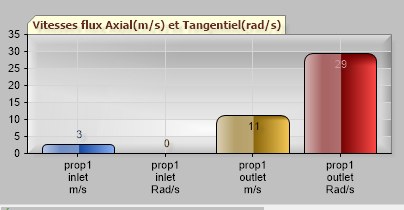
Flow speeds
Axial (m/s) and tangential (rad/s) flow speeds: what the propeller does to the air. inlet = entry, outlet = exit. Air enters at 3 m/s (2.58 m/s rounded) without rotation, and leaves at 11 m/s with a rotation of 29 rad/s. That exit rotation is energy lost for propulsion — it is what a contra-rotating propeller recovers.
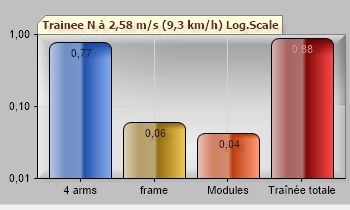
Drag, on a logarithmic scale
Drag, at the flow speed given in the title, on a logarithmic scale (each gridline is ten times the previous one): arms (4 arms) 0.77 N, centre plate (frame) 0.06 N, modules 0.04 N, total 0.88 N. The arms dominate: they sit in the propellers' jet, much faster than the incoming flow.
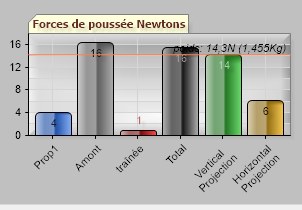
Thrust forces, and the weight line
Thrust forces: one rotor (Prop1, 4 N), the four rotors (Amont = upstream, 16 N), the drag, the total, then its vertical (14 N) and horizontal (6 N) projections. The red line is the weight (14.3 N for 1,455 g): the green bar of the vertical projection must reach it for the drone to hold its altitude.
Powers
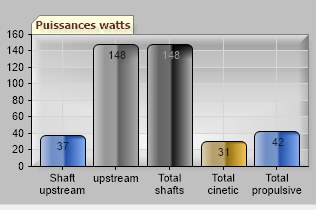
Powers: shaft of one propeller (Shaft upstream, 37 W), of the four (148 W), total of the shafts (148 W — there are no downstream propellers here), kinetic power left in the jet (31 W) and propulsive power, thrust times flow speed (42 W). This is the figure to compare with the motors and the ESC.
Efficiencies
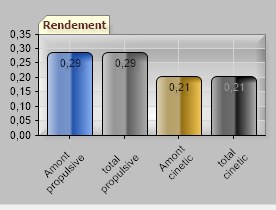
Efficiency: propulsive, propulsive power over shaft power (42 / 148 = 0.29); kinetic, share of the shaft power turned into jet energy (31 / 148 = 0.21). At the fixed point the propulsive efficiency is zero by definition (zero speed): it is read in flight.
Accelerations
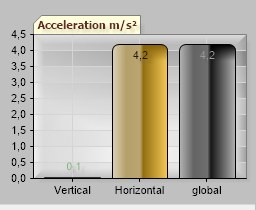
Acceleration: vertical 0.1 m/s² (the weight is carried, within the search precision), horizontal 4.2 m/s²: the remaining horizontal thrust (6.1 N) divided by the mass (1.455 kg). The drone would therefore keep accelerating forward.
Going further: hexa or coaxial X8 to carry a payload, the contra-rotating ultralight propeller, the multirotor project overview.
 Global site map
 Mecaflux
 Tutorials Mecaflux Pro3D
 Tutorials Heliciel
 Mecaflux Store
 Compare software functions
 Quotes, Orders, Payment Methods
 project technical studies