
Six rotors side by side, or four stacked pairs? Heliciel quantifies what the coaxial layout gains in thrust reserve, and what it costs in power.
Carrying 1 kg: hexacopter or coaxial X8?
The screenshots show Heliciel's French interface; the English label of each control is given in the text.
A delivery drone must carry a payload with a reserve: to manoeuvre, for the wind, for the battery that runs down. Two layouts answer within the same footprint: more arms (hexa), or two stacked propellers on each arm (coaxial X8). Heliciel calculates both, and the X8 is calculated honestly: its lower propeller works in the jet of the upper one.
- Tutorial steps:
- The requirements
- The hexa
- The coaxial X8
- What the lower propeller receives
- Thrust reserve: off-design
- The ducts
- The summary
- Exporting the downstream blade
1: The requirements
650 mm diagonal frame, 180 × 120 mm plate, 450 g bare frame, 55 g motors; 4S 5,000 mAh battery, controller and GPS taken from the quad; a 1 kg parcel (200 × 150 × 120 mm) under the frame. Why 650 mm: on a hexa, neighbouring motors are half a diagonal apart. At 450 mm that would be 225 mm for 254 mm propellers — they would overlap. At 650 mm, 325 mm.
2: The hexa
Frame settings tab: Nb Arms = 6, diagonal 650 mm. Then Rebuild new optimized design at the fixed point (flow 0.001 m/s, the hover convention).
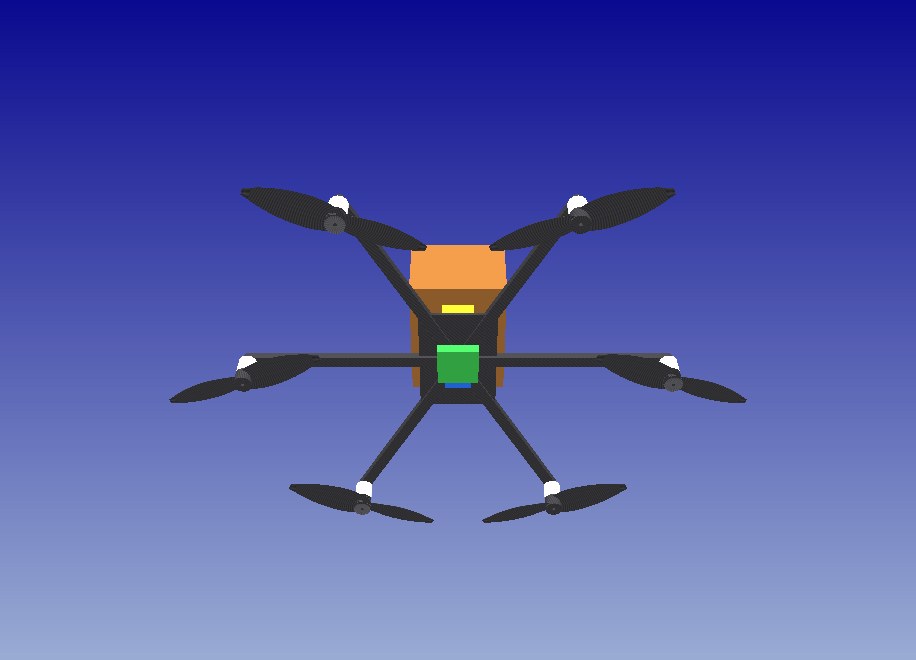
The hexa from above: six rotors, parcel under the plate
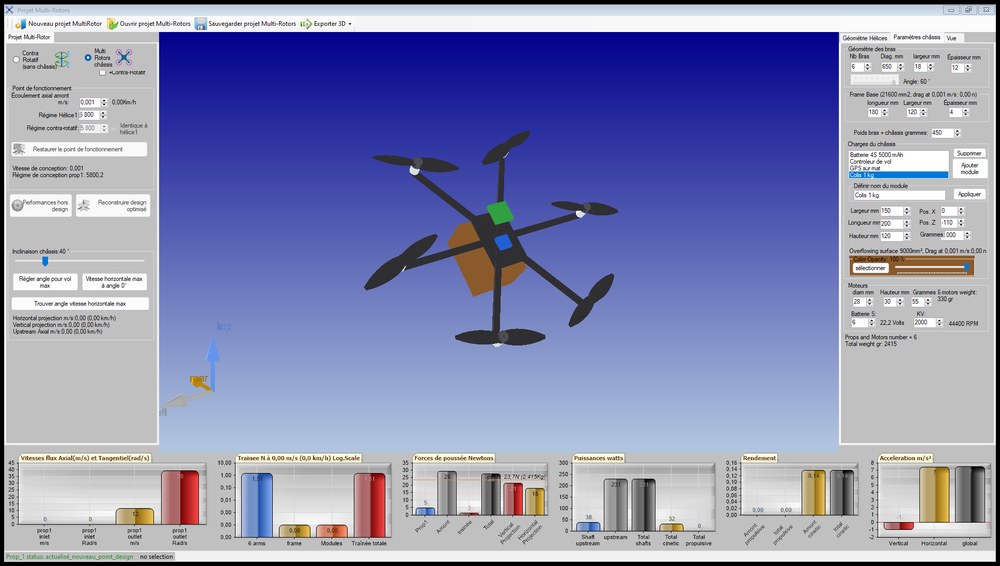
The complete window: 6 propellers, 2,415 g
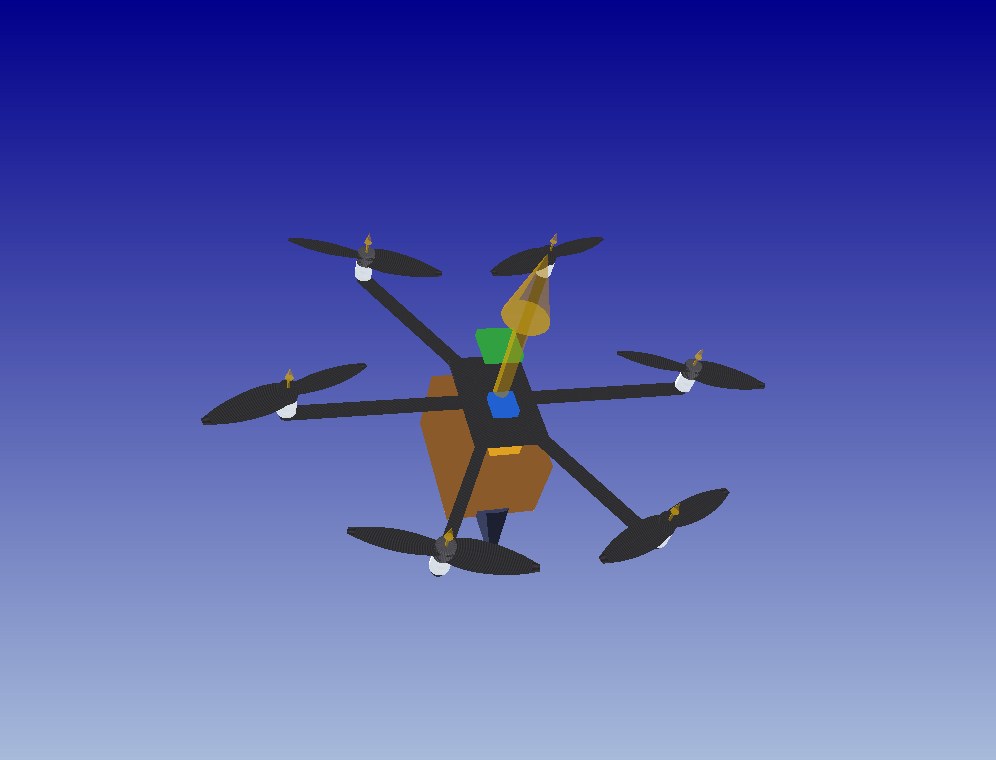
Six thrusts, one resultant
At the fixed point: 29.4 N of thrust for 23.7 N of weight, 230.6 W at the shafts. The drag of the six arms in the rotors' downwash takes 1.5 N away: the net thrust is 1.18 times the weight. That is tight.
3: The coaxial X8
Same frame, Nb Arms = 4 and the +Contra-Rotative box: eight propellers, two per arm, turning in opposite directions. Two more motors: 2,525 g. On rebuild, Heliciel first designs the upper propeller, then the lower one for the flow it receives.
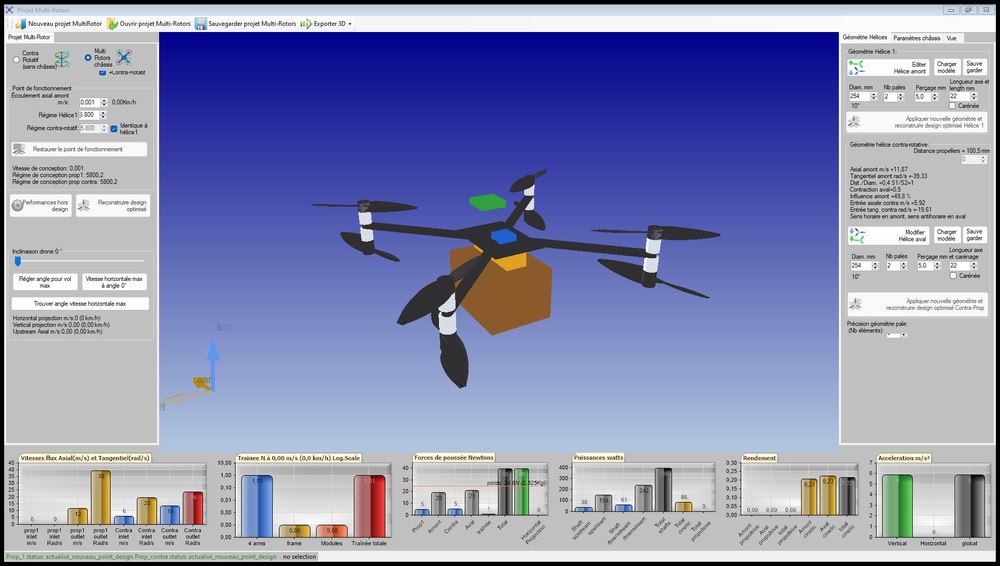
The X8 and the Propellers Geometry tab
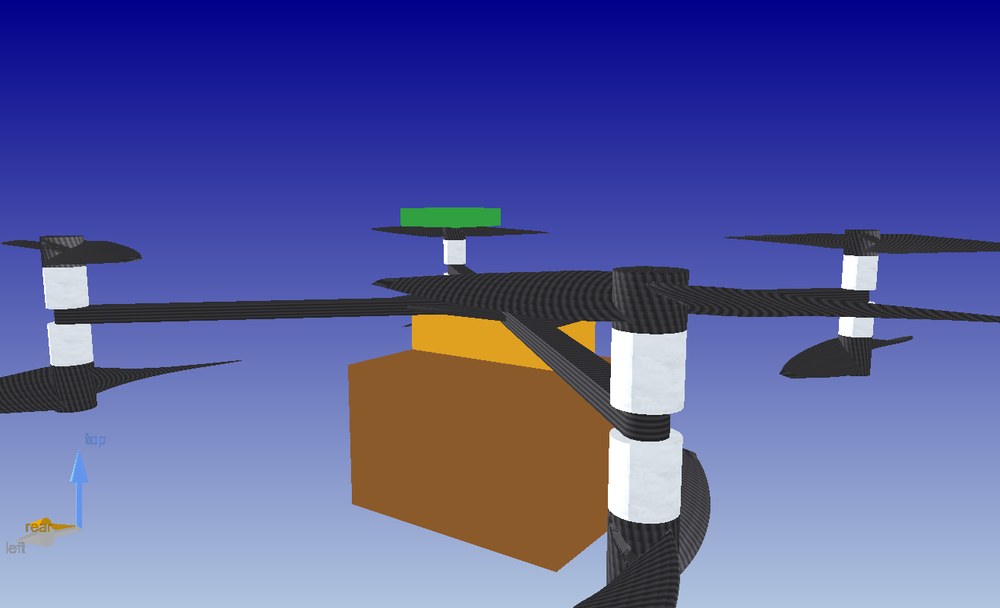
A coaxial pair: one propeller above the arm, one below
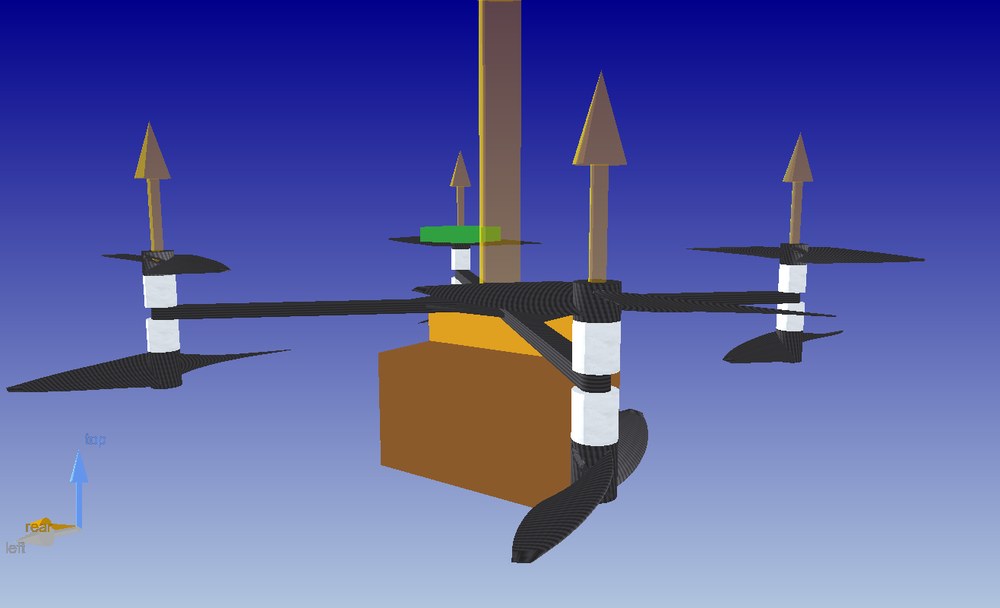
Upstream and downstream thrusts: here the lower propeller pushes slightly more
4: What the lower propeller receives
The ContraRotative propeller geometry group displays the interaction model. The distance between the two propeller planes cannot be entered here: it is deduced from the frame (motor height, arm thickness, shaft lengths): 100.5 mm, i.e. x/D = 0.40. The influence factor, 49.8%, says what share of the upper propeller's wake reaches the lower one.
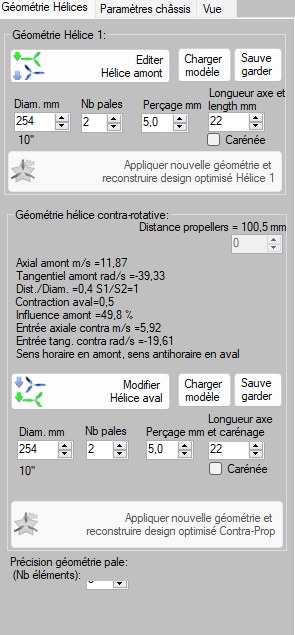
The interaction model, read in the interface
The lower propeller therefore receives a flow of 5.92 m/s and a rotation of −19.6 rad/s, opposite to its own. It was designed for them. Result per propeller: upper 4.90 N for 38.4 W, lower 5.27 N for 60.5 W. The lower propeller pushes slightly more, but needs 58% more power: it works in air that is already accelerated.
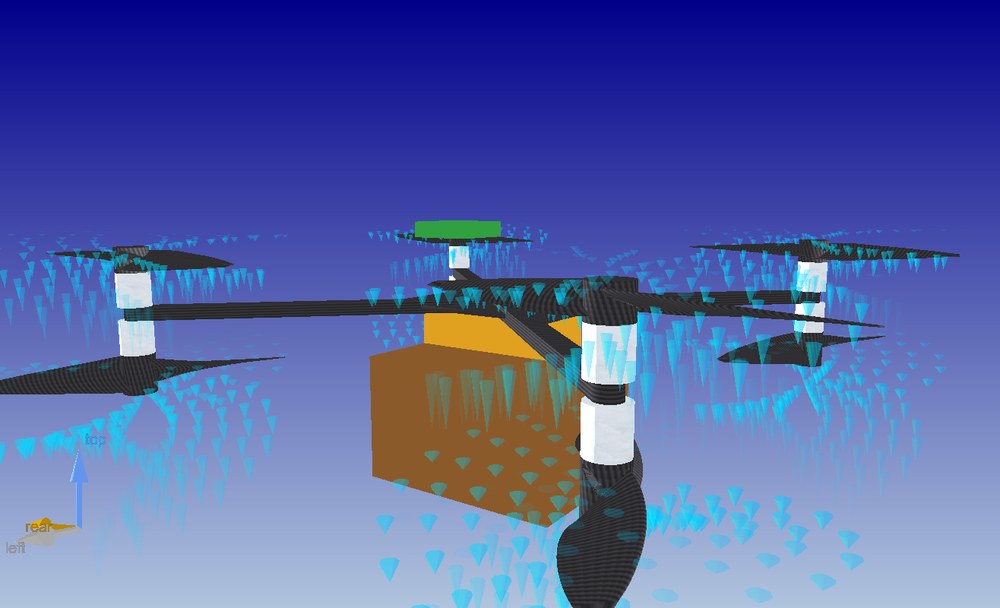
Upstream and downstream particles: the upper stage's jet feeds the lower one
5: Thrust reserve: off-design
Performances Out design recalculates the drone at another speed without changing the blades: this is what the flight controller does when it speeds the motors up or down. At 5,000 rpm the hexa no longer holds its weight (20.8 N net for 23.7 N); the X8 does (29.5 N for 24.8 N). At 6,300 rpm the X8 pushes 47.9 N — nearly twice its weight.
6: The ducts
Ducted box on both stages, then rebuild. Two effects on screen and in the figures: the tip vortices disappear (the duct prevents them), and a duct drag appears (0.20 N upper, 0.08 N lower). In this fixed-point case the thrust gains almost nothing (40.8 against 40.7 N): the value of the duct is judged here on criteria other than fixed-point thrust — propeller protection, for example.
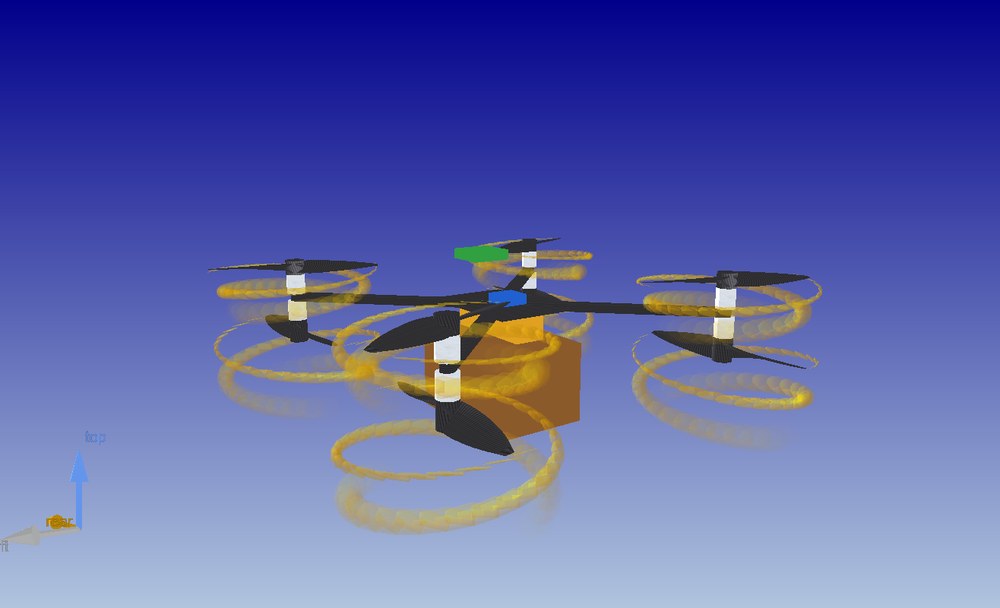
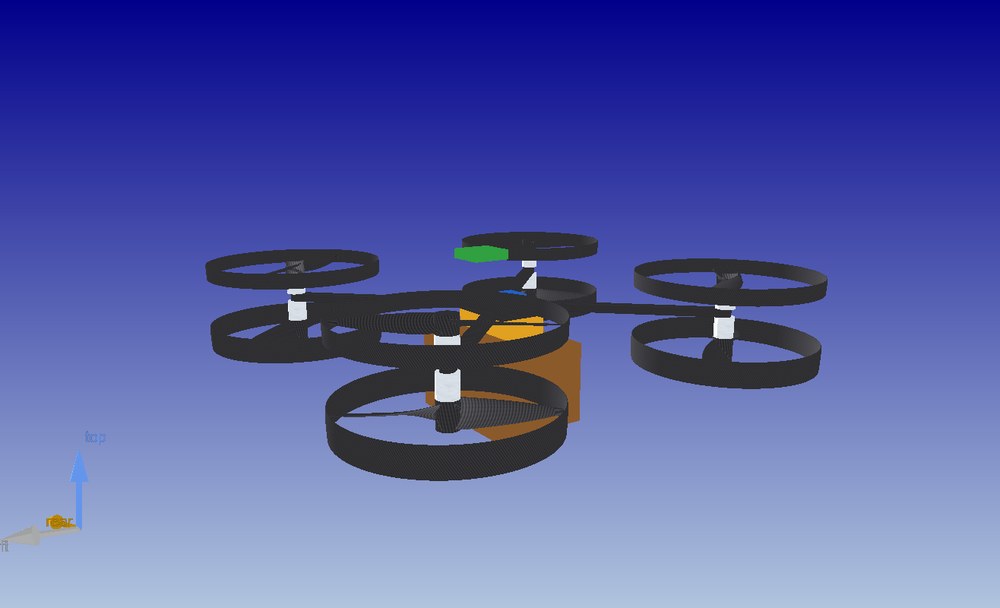
Without ducts, two stages of vortex rings per arm; with ducts, none
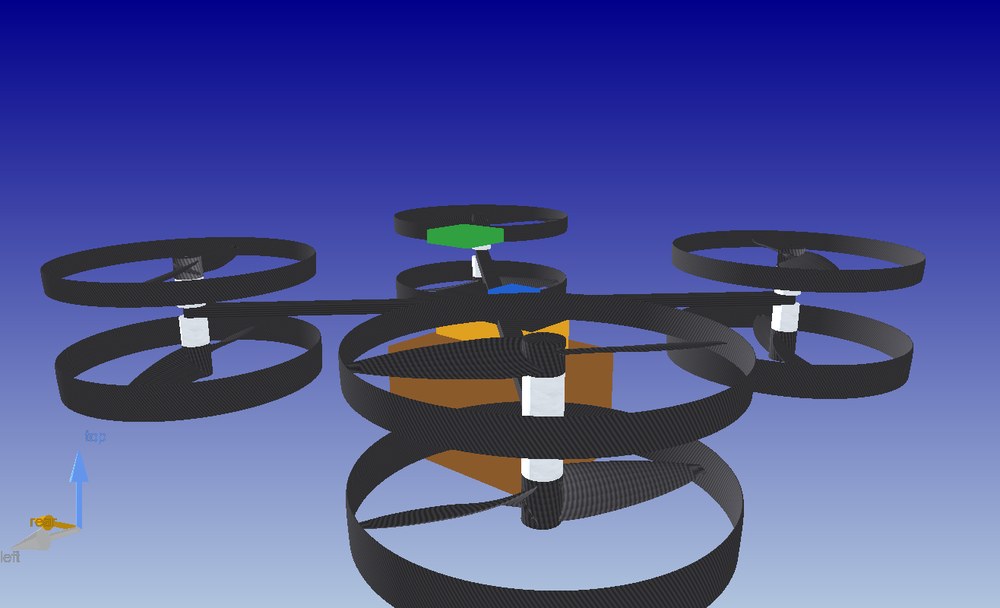
A ducted pair
7: The summary
| Hexa | Coaxial X8 | Ducted X8 | |
|---|---|---|---|
| Propellers / motors | 6 | 8 (4 upstream + 4 downstream) | 8 |
| Total mass | 2,415 g (23.7 N) | 2,525 g (24.8 N) | 2,525 g (24.8 N)* |
| Total thrust | 29.4 N | 40.7 N (19.6 upstream + 21.1 downstream) | 40.8 N |
| Drag at the fixed point | 1.51 N (arms) | 1.01 N (arms) | 1.29 N (arms 1.01 + ducts 0.28) |
| Net thrust / weight | 1.18 | 1.60 | 1.59 |
| Shaft power | 230.6 W | 395.7 W (153.7 upstream + 242.0 downstream) | 396.5 W |
| Thrust per watt | 0.127 N/W | 0.103 N/W | 0.103 N/W |
| Off-design, same geometry, speed changed: | |||
| at 5,000 rpm | 21.9 N, 149 W — no longer lifts (20.8 N net) | 30.3 N, 255 W — still lifts (29.5 N net) | — |
| at 6,300 rpm | 34.6 N, 293 W | 47.9 N, 503 W | — |
* The bench does not count the mass of the ducts: for a complete budget, add it as a module.
- The X8 has the reserve: 1.60 times its weight against 1.18, and it still lifts at 5,000 rpm.
- The hexa has the efficiency: 0.127 N per watt against 0.103, i.e. about 19% less power for the same thrust — more endurance for the same battery.
- The difference comes from the lower stage: 0.087 N/W against 0.127 for the upper one. That is the price of coaxial compactness, and Heliciel calculates it instead of estimating it.
8: Exporting the downstream blade
Toolbar, Export 3D: the downstream blade, left-hand version — it turns
opposite to the upstream one —, in STL for printing or IGES for CAD. The duct exports the same way. The project is
saved in the .mlrot format (Save Multi Rotors Project).
Going further: the camera quadcopter and the flight study, a contra-rotating pair on its own, adjustable spacing, the multirotor project overview.
 Global site map
 Mecaflux
 Tutorials Mecaflux Pro3D
 Tutorials Heliciel
 Mecaflux Store
 Compare software functions
 Quotes, Orders, Payment Methods
 project technical studies