
Propeller propulsion: why it is the future for boats and aircraft
A propeller thruster gives a high propulsive efficiency because it slightly accelerates a large mass of fluid, instead of strongly accelerating a small mass. Left behind when jet engines and waterjets seemed to have overtaken it, the propeller of boats and aircraft is becoming a leading technical solution again, as energy saving matters more. Here we explain why, with the relation between force, mass and acceleration, then with a canoe image.
In this page:
- The propeller thruster: the optimal propulsive efficiency
- Thrust of a propeller: F = M × A
- Large or small propeller: the pizza shovel story
- Boat, aircraft or ventilation propeller: the same principles
1: The propeller thruster: the optimal propulsive efficiency
The jet engine was the symbol of power and modernity, but its propulsive efficiency is low: of the order of 20 to 30% at most, according to the figures we use here. The propeller is therefore coming back to the front of the stage, with 80 to 95% efficiency announced for the contra-rotating propeller (these are orders of magnitude, to be related to the speed and the operating point, which we detail in the page on propulsive efficiency).
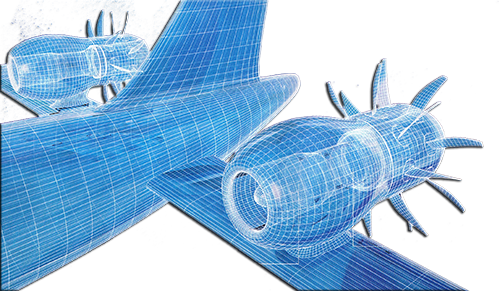
Wireframe view of an aircraft fitted with unducted-propeller engines: the return of the propeller thruster in aviation.
Before discussing the characteristics of marine or aircraft propellers, let us introduce a few notions that will help us understand how propulsive propellers (aircraft, ships, ventilation) work.
2: Thrust of a propeller: F = M × A
Whatever the fluid, air or water, the thrust propeller (or tractor propeller) uses the reaction phenomenon to push the vehicle. The force applied to the fluid is equal and opposite to the force applied to the propeller axis.
As Newton explained, force equals mass times acceleration: F = M × A. The thrust is therefore proportional to the mass of fluid accelerated. To generate the same force, we can:
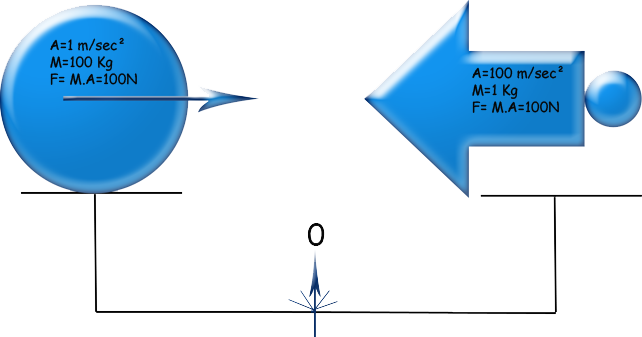
The same force F = M × A = 100 N, obtained with a large mass (100 kg) lightly accelerated (1 m/s²) or with a small mass (1 kg) strongly accelerated (100 m/s²).
| Slightly accelerate a large amount of fluid. A large propeller, generating little lift relative to the blade area: this is a lightly loaded propeller. | Strongly accelerate a small amount of fluid. A small propeller, generating a lot of lift relative to the blade area: this is a heavily loaded propeller. |
The difference matters for energy. The thrust equals F = (mass of fluid accelerated per second) × (change in fluid speed). For the same thrust, the kinetic energy left in the jet, lost to forward motion, equals half the thrust multiplied by this change in speed: it therefore decreases when the change in speed decreases, that is, when the propeller is larger.
3: Large or small propeller: the pizza shovel story
A little story to picture this relation between mass and acceleration. Let us hold a canoe race. As a paddle, we can choose between a pizza shovel and a coffee spoon. By pushing hard on the pizza shovel, or by paddling very fast with the small spoon, we will produce the same thrust on the water.
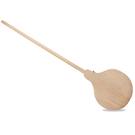
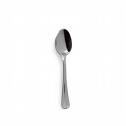
On the left the pizza shovel, which accelerates a lot of water very little; on the right the coffee spoon, which accelerates little water a lot.
In your opinion, who will waste the most energy in leaks around the surface that transmits the force to the water? The one paddling flat out with a small spoon, or the one who chose the pizza shovel? Which would you choose, instinctively, without thinking?

A competition canoeist: he paddles flat out, and his blade is much bigger than a spoon.
That is cheating: he is paddling flat out with a pizza shovel!
All this to say that the larger the propeller, the fewer the leaks, and the better off we are. This holds for boat propellers, aircraft propellers and ventilation propellers.
4: Boat, aircraft or ventilation propeller: the same principles
A boat propeller, an aircraft propeller and a ventilation propeller have different shapes, because the installation constraints and the ambient fluid differ. But the principles that generate the propulsive force, explained here, are identical.
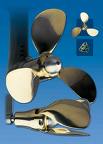
A folding boat propeller: its shape is dictated by the sailboat, the principle is identical.
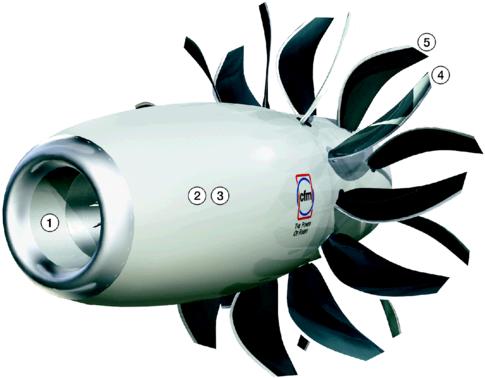
A mock-up of an aircraft engine with contra-rotating unducted propellers (open rotor): the same law F = M × A, in air.
Another point of view, more theoretical but very important, lets us evaluate the return on our effort relative to the travel speed: the propulsive efficiency of the propeller.
To go further, we can see how the rotation speed of the propeller, the fluid speed and the propeller diameter combine, or choose the number of blades of a thruster propeller.
 Global site map
 Mecaflux
 Tutorials Mecaflux Pro3D
 Tutorials Heliciel
 Tutorials Heliciel PRO CFD
 Mecaflux Store
 Compare software functions
 Quotes, Orders, Payment Methods
 project technical studies