
Enter a diameter, a thrust and an advance speed: Heliciel sweeps the whole B series and hands you back the propeller giving the best open water efficiency.
Wageningen B series: selecting and applying a reference marine propeller
Designing a boat propeller from a blank page is possible in Heliciel; starting from a reference propeller is possible too, and it is often quicker. The Wageningen B series is the best documented family of marine propellers: dozens of geometries tested in a towing tank, whose complete open water behaviour is known. Heliciel carries it, sweeps it for you, and applies to the project the one that meets your specification.
What you do in this tutorial: start from a diameter, a thrust and an advance speed, obtain the propeller of the series giving the best efficiency, then turn it into a modifiable Heliciel project.
- Prerequisite: a marine propeller project open (the "water propulsion propeller" model of the Files menu, or your own project);
- Duration: a few minutes, the sweep is immediate;
- What you get out of it: a number of blades, an area ratio, a P/D, a rotation speed — and a geometry applied to the project.
- Tutorial outline:
- What the B series brings, and where it stops
- Opening the B-Screw Series window
- Describing the need rather than the geometry
- Reading the ranking by efficiency
- Checking on the K_T and K_Q curves
- Applying to the project, at two levels
- And then: back to design
1: What the B series brings, and where it stops
A propeller of the B series is named by three numbers: its number of blades, its developed area ratio Ae/A0, and its pitch to diameter ratio P/D. Heliciel covers the series from 3 to 7 blades, all the area ratios, and P/D values from 0.60 to 1.40. The geometric reference used is the one published by Carlton.
These propellers were tested in a towing tank: their thrust and torque coefficients are not computed, they are measured. That is what makes them a yardstick. But a yardstick has a domain: segmental and aerodynamic sections of classical shape, operation free of cavitation, tests run at a reference Reynolds number of 2 × 10⁶. A heavily loaded propeller, a very fast one, or one intended for a fluid that is not sea water falls outside that domain: the series remains a useful comparison, it stops being a prediction.
2: Opening the B-Screw Series window
Files menu, entry Wageningen B-screw series. The window opens on three tabs: Best propeller, Series performance and Understanding these figures.
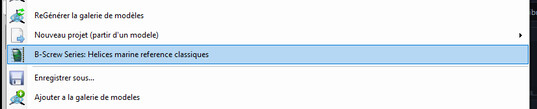
The menu entry that opens the series
3: Describing the need rather than the geometry
In the Best propeller tab you do not describe a propeller: you describe what you expect from it.
- Propeller diameter (mm): in practice the largest value the hull clearance allows. It is an installation constraint before being a hydrodynamic choice;
- Required thrust (N): the resistance of the hull at the point aimed at. If you do not know it yet, it is computed in the ship wave and resistance study;
- Fluid / advance speed (m/s): the speed of the boat at the operating point, not the maximum speed of the engine.
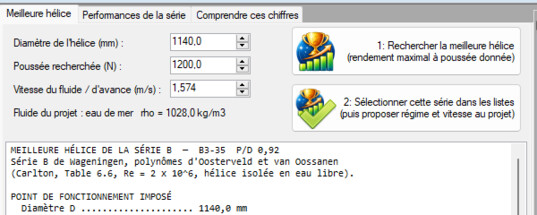
Three specification figures are enough to launch the sweep
4: Reading the ranking by efficiency
Heliciel then sweeps the whole series and ranks the propellers by open water efficiency at the requested point. Each line of the ranking carries the corresponding number of blades, area ratio, P/D, rotation speed and advance coefficient J.
Two reading reflexes: the first line is not necessarily the right one — a higher area ratio costs a little efficiency but keeps cavitation further away; and the rotation speed announced must be one your engine and your gearbox can hold. The ranking gives you the candidates, the arbitration is yours.
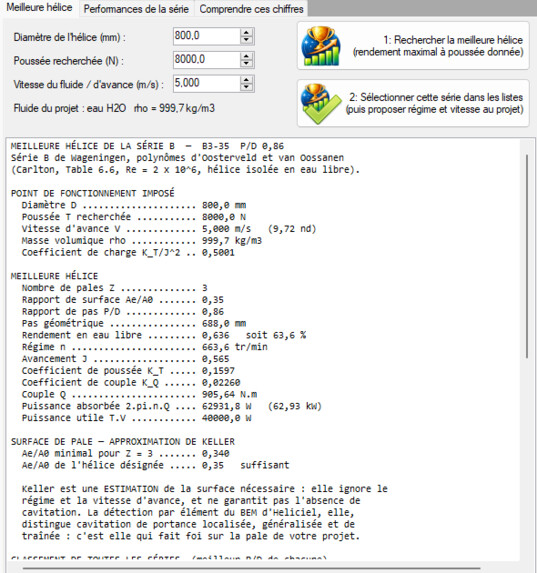
The ranking: number of blades, area ratio, P/D, rotation speed and J
5: Checking on the K_T and K_Q curves
The Series performance tab plots the thrust coefficient K_T and the torque coefficient K_Q against J, and places the Optimal operating point retained by the search. This is the classical reading of a marine propeller: it tells you how the thrust collapses as the boat accelerates at constant rotation speed, and where the efficiency maximum lies.
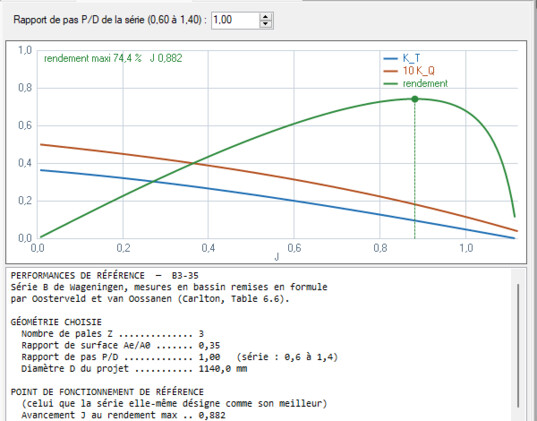
K_T and K_Q against J for the propeller selected
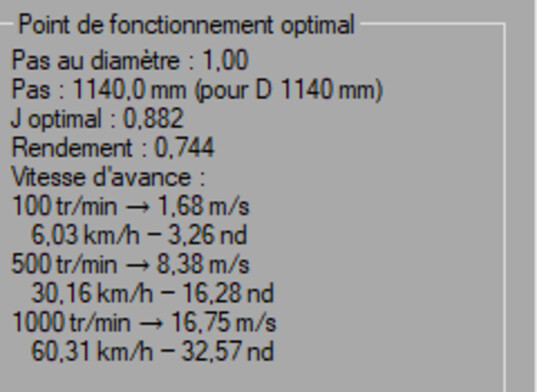
The optimal point, read from the series and not estimated
The Understanding these figures tab restates these definitions for those meeting them for the first time. The same reading then applies to your propeller: Kt, Kq and J in the multiple analysis.
Validation. Heliciel's BEM computation laid over the published curves of four propellers of the series, B4-70 at pitch ratios 0.60, 1.00 and 1.40 and B3-50 at unit pitch, over the whole J sweep: validating Heliciel against published data.
6: Applying to the project, at two levels
A reference propeller is only of interest if it becomes a modifiable project. Heliciel offers two levels of application, and they do not serve the same purpose:
- Chord distribution and sections only: you take over the planform of the series — the blade width station by station and the sections — and let Heliciel compute the pitch angles by blade element theory, for your operating point;
- Complete geometry: you also take over the pitch angles imposed by the P/D of the series. The project then switches to reverse engineering mode: the geometry is imposed, and Heliciel computes its performance instead of deriving it.
The first level is for designing with the series as an inspiration. The second is for reproducing a series propeller, or for comparing it honestly with your own design.
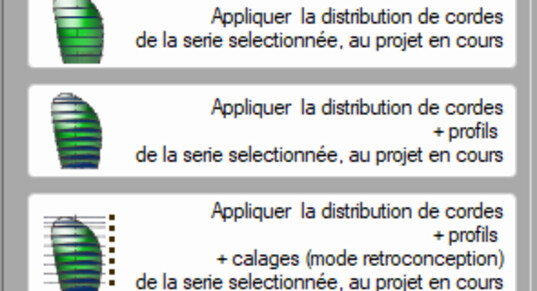
The two levels of application to the current project
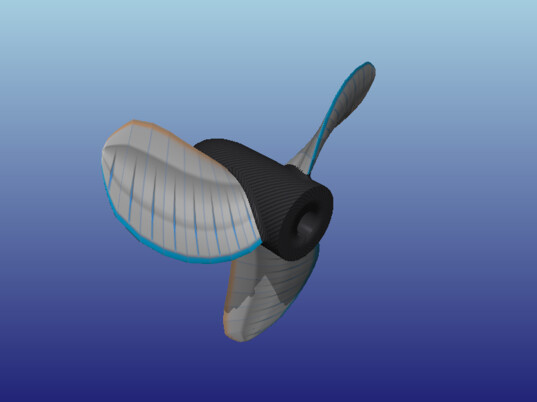
The series geometry turned into a Heliciel project: modifiable, exportable
7: And then: back to design
The series has given you a credible starting point in a few minutes. The rest of the work, however, falls outside the domain of the series: real rotation speed, real fluid, sections chosen from your own database, cavitation check, blade strength. This is where Heliciel's blade element calculation takes over again.
- The genetic analysis, to search rotation speed, number of blades and chord distribution together;
- The cavitation check, which is precisely the limit of the domain of the series;
- The 3D exports, to get the part out.
To understand pitch and slip first, the page Propeller pitch calculator offers the same B series sweep online, without installing the software.
 Global site map
 Mecaflux
 Tutorials Mecaflux Pro3D
 Tutorials Heliciel
 Tutorials Heliciel PRO CFD
 Mecaflux Store
 Compare software functions
 Quotes, Orders, Payment Methods
 project technical studies