Propeller advance parameter: definition, formula and J calculation
Advance ratio J and pitch ratio P/D give the slip. All three, computed for your duty: propeller pitch calculator
The propeller advance parameter, written J (or γ, gamma), is the ratio of the upstream fluid velocity to the product of the propeller diameter and its revolutions per second: J = V / (n·D). It is a dimensionless similarity coefficient: it lets you compare propellers of different sizes, because two geometrically similar propellers running at the same J work in the same way. Anglo-Saxon authors and naval architects call it J (advance ratio); Heliciel displays it under the name gamma (γ).
Contents:
- Advance parameter J: definition and formula
- Where to read the advance parameter in Heliciel
- What the advance ratio J is for: similarity, slip and efficiency
1: Advance parameter J: definition and formula
The advance parameter of the propeller is the ratio:

The "Avancement = V/(D.Rps)" bar of the Heliciel main window, showing the value 2.5 here.
The advance parameter equals the upstream fluid velocity divided by the product of the propeller diameter and the number of propeller rotations per second. In other words, J is the advance of the fluid during one turn of the propeller, expressed in propeller diameters. It is written J = V / (n·D), with V in m/s, n in revolutions per second and D in metres. It therefore has no unit, and it is zero at bollard or static condition, when the fluid velocity is zero.
Here is an example, chosen to fix ideas. A propeller 0.40 m in diameter turns at 720 rpm, that is 12 rev/s, in a fluid arriving at 5 m/s. Its advance parameter is J = 5 / (12 × 0.40) = 1.04. To go from revolutions per minute to revolutions per second, just divide by 60.
2: Where to read the advance parameter in Heliciel
The similarity parameter "advance" (gamma or J) is displayed in the propeller parameters, under "analysis, similarity advance parameter". You impose the fluid velocity, the diameter and the rotation speed; Heliciel computes J and lists it with the other similarity coefficients.
The project parameters window lists, with the advance parameter gamma, the thrust coefficient Kt, the torque coefficient Kq and the similarity efficiency. An advance bar V/(D.Rps) is also shown in the main window.
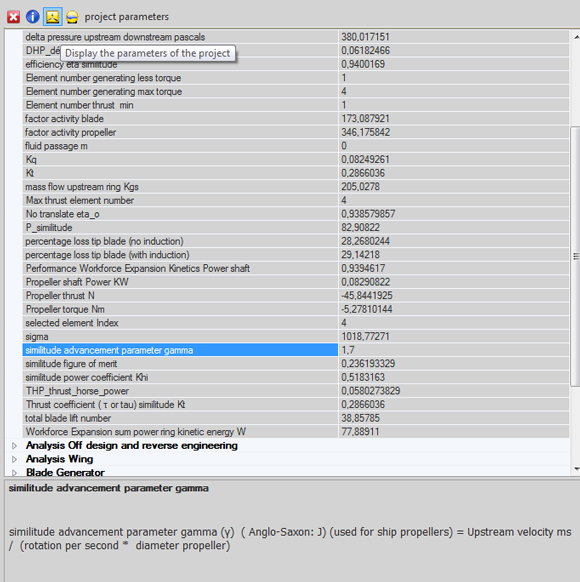
The project parameters window. The line "similitude advancement parameter gamma" is selected: it equals 1.7, and its definition appears at the bottom of the window. Above it are Kt (0.2866) and Kq (0.0825).
3: What the advance ratio J is for: similarity, slip and efficiency
The parameter J is the input variable of propeller curves "in coefficients". As a function of J, we plot the thrust coefficient Kt = T / (ρ·n²·D⁴), the torque coefficient Kq = Q / (ρ·n²·D⁵) and the efficiency η = J·Kt / (2π·Kq). T is the thrust, Q the torque, ρ the fluid density. Once these curves are known for one propeller, they hold for any similar propeller, whatever its size. On the capture above, J = 1.7, Kt = 0.2866 and Kq = 0.0825 do give J·Kt / (2π·Kq) ≈ 0.94, the value the window shows as similarity efficiency.
The advance parameter is also tied to pitch. If P/D is the pitch ratio of the propeller (pitch P divided by diameter D), the apparent slip is s = 1 − J / (P/D). When J reaches the pitch ratio, the apparent slip is zero and the thrust becomes close to zero. For the difference between geometric pitch and effective pitch, see the page on propeller pitch.
To go further, we can see how the propeller rotation speed sets the operating point, or calculate the pitch, the slip and the efficiency for your requirements with the propeller pitch calculator.
 Global site map
 Mecaflux
 Tutorials Mecaflux Pro3D
 Tutorials Heliciel
 Tutorials Heliciel PRO CFD
 Mecaflux Store
 Compare software functions
 Quotes, Orders, Payment Methods
 project technical studies