
Water turbine types: Pelton, Francis and Kaplan, diagrams and selection
A water turbine turns the head and flow of a stream into torque on a shaft. Coupled to a generator, it becomes a hydroelectric turbine, the hydro turbine of a power plant. There are three main types: the Pelton turbine, an impulse turbine for high heads and small flows; the Francis turbine, a reaction turbine for medium heads; and the Kaplan or propeller turbine, a reaction turbine for low heads and high flows. The choice is not made by eye: the specific speed, computed from the net head, the flow and the rotational speed, points to the right type. This page shows how each turbine works and its diagram, then the selection method, with an example computed by Heliciel.
On this page:
- Impulse turbines and reaction turbines
- Pelton turbine: how it works and diagram
- Francis turbine: how it works and diagram
- Kaplan and propeller turbine: how it works and diagram
- Selecting the turbine type by specific speed
- Water turbine comparison table
- Other turbines: bulb, Straflo, Crossflow, Turgo
- What Heliciel computes
- Frequently asked questions
1: Impulse turbines and reaction turbines
Every hydraulic turbine uses the same resource: a mass of water falling from a height, the head, with a flow rate. They fall into two families depending on the form in which the runner receives this energy.
An impulse turbine receives kinetic energy only: the whole head is first converted into velocity in a nozzle, and the jet strikes the runner at atmospheric pressure. The Pelton is an impulse turbine.
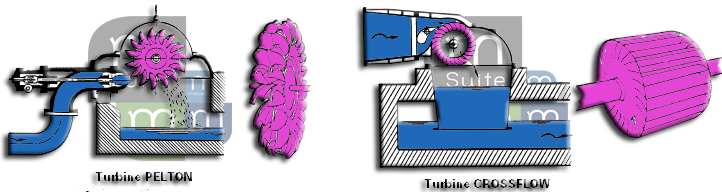
Impulse turbines: a jet, a runner, atmospheric pressure.
A reaction turbine runs full of water: the runner works inside a pipe, and the water gives it both velocity and pressure. The head is a pressure, which the runner uses up as the water passes through. The Francis and the Kaplan are reaction turbines.
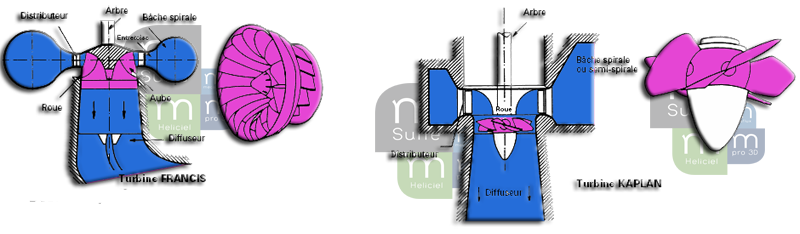
Reaction turbines: Francis and Kaplan work in a pipe, under pressure.
The components of a reaction turbine, spiral casing, guide vanes, runner and draft tube, are described in detail on the page Kaplan turbine: components and operation.
2: Pelton turbine: how it works and diagram
The Pelton turbine is a wheel fitted with double-cup buckets. One or more nozzles direct a high-velocity water jet at them; the central ridge of each bucket splits the jet in two and turns it almost all the way back, which transfers the momentum of the water to the wheel. The flow is controlled in the nozzle. The best bucket speed is half the jet speed.
It is the turbine for high heads and small flows: Heliciel uses it for heads from 20 to 1,300 m and a specific speed Ns from 2 to 30, the range of the single-jet Pelton statistics.
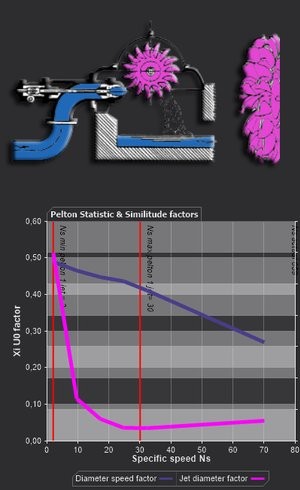
A Pelton diagram and its statistical curves versus Ns: the runner speed factor and the ratio of runner diameter to jet diameter. The red limits are Ns = 2 and Ns = 30.
Heliciel gives Pelton dimensions for information: runner diameter, jet diameter and bucket proportions, detailed in the statistics help page.
3: Francis turbine: how it works and diagram
The Francis turbine is a reaction turbine. Water arrives through a spiral casing, passes through a distributor with adjustable guide vanes, enters the runner moving towards the axis, then leaves along the axis into the draft tube. The guide vanes control the flow and set the water swirling; the fixed runner blades take it up.
It covers medium heads. Heliciel uses two sets of statistics: the slow Francis, from Ns 45 to 199, and the fast Francis, from Ns 200 to 500, both for heads from 10 to 550 m. The larger Ns, the more open the runner, and the closer it gets to an axial runner.
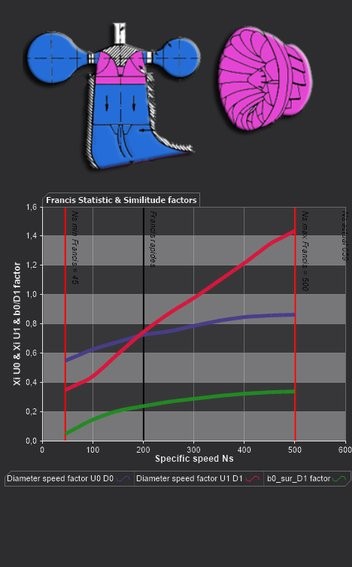
A Francis diagram, its runner, and the statistical factors versus Ns: runner inlet and outlet speed, guide vane height b0/D1. The red limits are Ns = 45 and Ns = 500.
4: Kaplan and propeller turbine: how it works and diagram
The Kaplan turbine is a propeller placed in a pipe. Water, set swirling by the spiral casing and the guide vanes, flows through the runner parallel to the axis, then slows down in the draft tube. Its blades are adjustable: together with the guide vanes they form a double regulation that keeps a good efficiency when the flow varies. A propeller turbine has the same runner with fixed blades, controlled by the guide vanes alone.
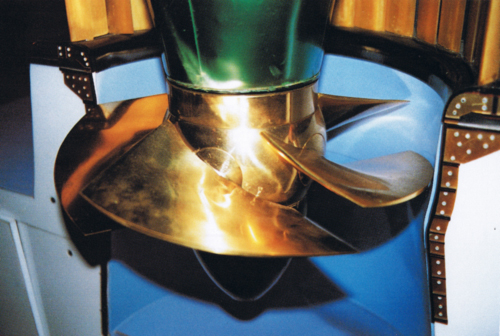
A Kaplan turbine diagram: water enters through the casing, swirls in the guide vanes, passes through the runner and leaves through the draft tube.
It is the turbine for low heads and high flows: Heliciel uses it for heads from 2 to 40 m and a specific speed Ns from 350 to 2,000. Its statistics give, as a function of Ns, the runner diameter, the hub, the guide vane height and an indicative number of blades.
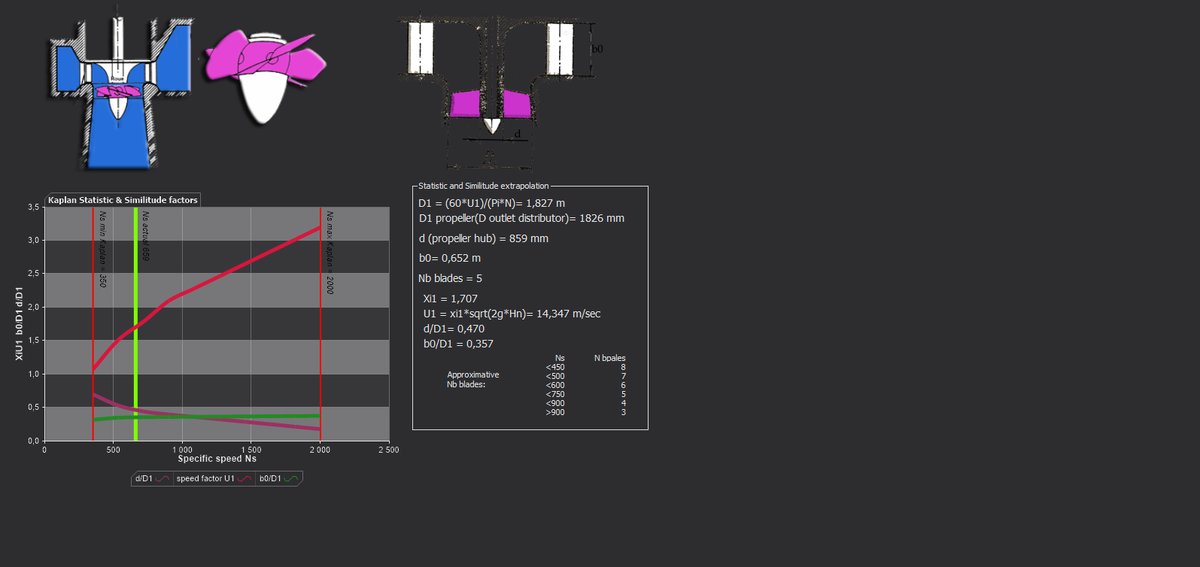
The propeller-Kaplan statistics at Ns = 659 (green line): 1,827 mm runner, 859 mm hub, b0 of 0.652 m, five blades. These are statistical starting values: the tutorial then uses a 1,868 mm runner from the ESHA formula.
Hydro Turbine interface of Heliciel (requires a HydroTurbine license)
How the Kaplan works in detail, its four components and the relation between guide vanes and runner are covered in the turbine chapter: Kaplan turbine: how it works and diagram,guide vanes and propeller, design method.
5: Selecting the turbine type by specific speed
For a given head and flow, several machines are possible: a slow, wide runner, or a fast, compact one. The specific speed decides between them. Heliciel uses the historical form of the charts:
Ns = N · √P / H5/4
with N the speed in rpm, H the net head in metres and P the power in metric horsepower, P = ρ·g·Q·H·efficiency / 736, the efficiency being taken as 82.5 %. The ranges below only hold in this system of units. The two other forms, the dimensionless NQe and NQh, are explained in the specific speed help page.
Example computed by Heliciel, the site of the hydropower plant tutorials: 12 m³/s, 4 m gross head, net head estimated at 3.6 m (10 % losses, first estimate), test speed 150 rpm. Heliciel computes Ns = 659.2, NQe = 0.598 and NQh = 198.8. Ns falls in the Kaplan range, 350 to 2,000, and the 4 m head in its 2 to 40 m range: the turbine will be a Kaplan. The statistics then suggest five blades, the Ns range from 600 to 750 corresponding to five blades.
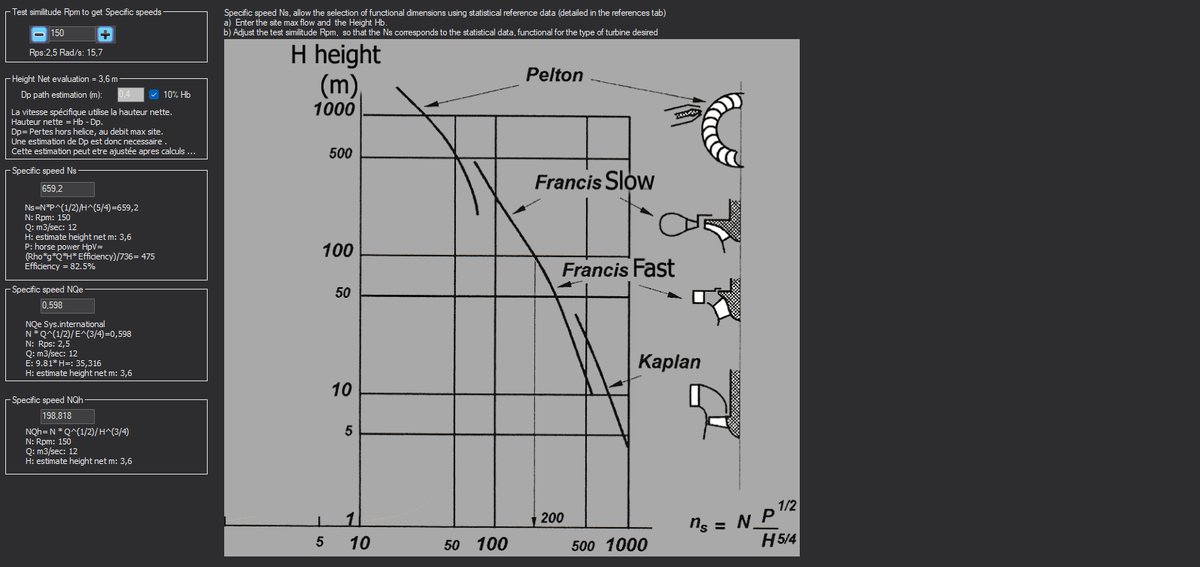
The specific speed calculation and the selection chart: Pelton for high heads, slow then fast Francis, Kaplan for low heads.
Hydro Turbine interface of Heliciel (requires a HydroTurbine license)
Three remarks to read the result:
- The speed sets Ns. For the same site, a faster runner has a larger Ns. The test speed is adjusted until Ns falls in the range of the desired type, then the runner takes that speed.
- The ranges overlap or leave gaps. Between Ns 350 and 500, both the fast Francis and the Kaplan are possible. Between 30 and 45, none of the types used by Heliciel fits.
- Heliciel tests the gross head of the site against the head range of each type, and uses the estimated net head in the Ns calculation.
6: Water turbine comparison table
| Type | Family | Head (Heliciel) | Ns (Heliciel) | Flow in the runner | Flow control |
|---|---|---|---|---|---|
| Pelton | impulse | 20 to 1,300 m | 2 to 30 | free jet on buckets | nozzle |
| Slow Francis | reaction | 10 to 550 m | 45 to 199 | towards the axis, then along it | guide vanes |
| Fast Francis | reaction | 10 to 550 m | 200 to 500 | towards the axis, then along it | guide vanes |
| Kaplan | reaction | 2 to 40 m | 350 to 2,000 | parallel to the axis (propeller) | guide vanes and adjustable blades |
| Propeller | reaction | same runner as the Kaplan | parallel to the axis (propeller) | guide vanes only | |
Heads and specific speeds: ranges used by Heliciel to validate the type; Ns in rpm, metric horsepower and metres.
7: Other turbines: bulb, Straflo, Crossflow, Turgo
- The bulb turbine is a Kaplan whose generator sits in a sealed, submerged casing in line with the flow; the guide vanes alone set the water swirling.
- The Straflo turbine is a propeller turbine whose generator is placed as a ring around the runner.
- The Crossflow turbine, or Banki turbine, is an impulse turbine in which the water crosses a drum-shaped runner twice.
- The Turgo turbine is an impulse turbine close to the Pelton, whose jet strikes the runner at an angle.
Bulb and Straflo have a propeller runner: Heliciel computes their runner as that of a propeller turbine. Crossflow and Turgo are not covered by Heliciel.
8: What Heliciel computes
Heliciel's Hydro Turbine design workshop sizes propeller and Kaplan turbines: it computes the specific speed, proposes the statistical dimensions, then draws and computes the whole plant, from the penstock to the draft tube, with a runner computed by blade element momentum theory (BEM). The Francis and Pelton statistics are shown for comparison. The Hydro Turbine design workshop requires a HydroTurbine license.
- Hydro Turbine design user guide: the complete method and a worked case study.
- Hydro Turbine tutorials and videos: designing a small hydro plant step by step.
- Specific speed help page and statistics help page: the software's formulas.
- Water mill electricity: water wheel or turbine, and equipped mills in France, the UK and Italy.
Frequently asked questions
Water turbine, hydro turbine, hydroelectric turbine: what is the difference?
They are the same machine seen from three sides. A water turbine turns the energy of water into torque on a shaft; coupled to a generator, it forms a hydroelectric turbine, often simply called a hydro turbine. Its type, Pelton, Francis or Kaplan, is chosen from the head and the specific speed.
Which water turbine for a low head?
For a low head and a high flow, the choice is a propeller or Kaplan turbine, the bulb turbine being a Kaplan whose generator sits in a submerged casing. Heliciel uses the Kaplan for heads from 2 to 40 m and a specific speed Ns from 350 to 2,000.
What is the difference between a Kaplan and a Francis turbine?
Both are reaction turbines working under pressure in a pipe. In a Francis, water enters the runner towards the axis and leaves along the axis; it covers medium heads. In a Kaplan, water flows through a propeller parallel to the axis; its adjustable blades follow the flow variations of low-head sites.
What is the specific speed of a turbine?
It is the index that classifies turbines: Ns = N·√P / H^(5/4), with N in rpm, P in metric horsepower and H the net head in metres. A small value means a slow, wide runner such as the Pelton; a large value a fast, compact runner such as the Kaplan.
Does Heliciel compute Pelton and Francis turbines?
No. Heliciel's Hydro Turbine design workshop sizes propeller and Kaplan turbines. It computes the specific speed and shows the Francis and Pelton statistics for information, to compare, without drawing or computing a Francis or Pelton runner.
 Global site map
 Mecaflux
 Tutorials Mecaflux Pro3D
 Tutorials Heliciel
 Tutorials Heliciel PRO CFD
 Mecaflux Store
 Compare software functions
 Quotes, Orders, Payment Methods
 project technical studies