
see also: evolution propeller design methods
First propeller design: geometry and sections Propeller design point and off-design Sizing VTOL propellers through AI promptsNumber of propeller blades: how to choose for an aircraft, a boat or a wind turbine
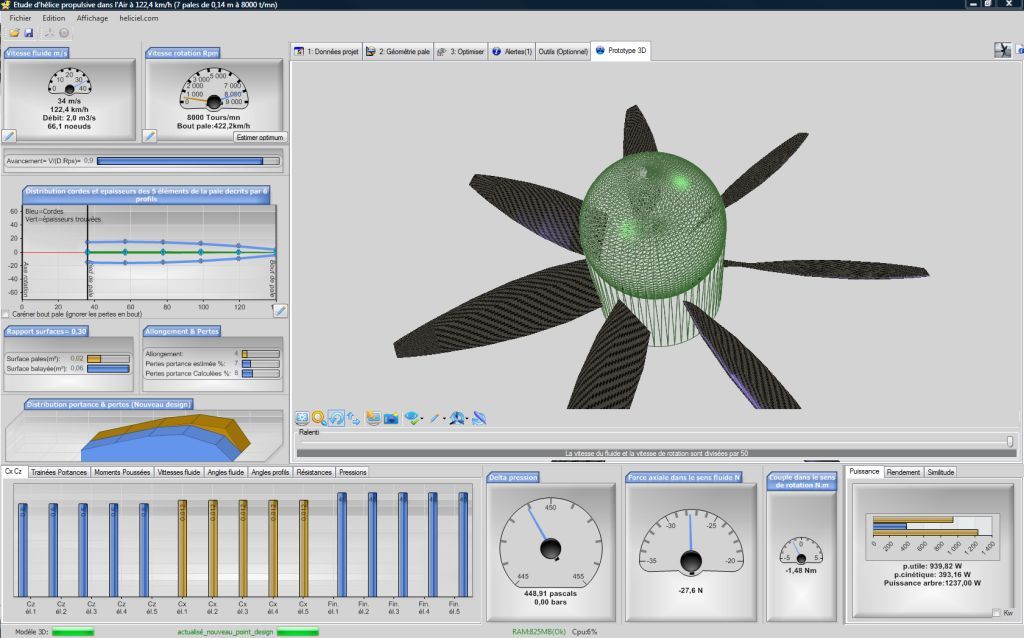
A seven-blade propeller with 0.14 m blades studied in Heliciel (3D prototype, 8,000 rpm, fluid at 34 m/s): the solidity of the disc grows with the number of blades.
The number of blades of a propeller is chosen to absorb the engine's power without penalising efficiency too much: the more power, the more the disc solidity must grow, and the simplest way to raise it is to add blades. There is no answer of the kind "the best number of blades is 5": the choice remains a compromise between efficiency, diameter, tip speed, weight, noise and, in water, cavitation. We set out the reasoning here, valid for the wind turbine propeller, boat propulsion, the aircraft propeller or the fan.
On this page:
- Why does a more powerful engine need more blades?
- The six levers for absorbing more power
- Why four of these levers are limited
- Propeller solidity: chord or number of blades?
- When the hub is full: the contra-rotating propeller
- Choosing by application: aircraft, boat, wind turbine, fan
1: Why does a more powerful engine need more blades?
We have already discussed the influence of the number of blades in the article on optimising propeller rotation speed and number of blades. But the requirements of a propeller include many other constraints. In a liquid, for example, the number of blades also lets you act on cavitation.
To understand why a propeller needs more blades as the engine improves, recall its role. It must absorb the engine's power and pass it on to the fluid crossing its disc. The energy given to the fluid to accelerate it generates a thrust force on the blades. If propeller and engine are poorly matched in power, the system loses efficiency and performance suffers.
2: The six levers for absorbing more power
When engine power increases, the designer has a limited number of options for drawing a propeller able to absorb more:
- Increase the angle of attack of the blade profiles. The blades' lift increases, which allows more energy to be given to the fluid flow.
- Increase the diameter of the propeller disc, that is, lengthen the blades. The blades transfer more energy by acting on a larger volume of fluid.
- Increase the rotation speed of the propeller. The same amount of energy is transferred, but in a shorter time.
- Increase the camber (or curvature) of the profiles. A propeller blade is made of profiles, like a wing. Increasing its camber creates a larger thrust force, as a wing's camber creates more lift.
- Increase the chord (or width) of the blades.
- Increase the number of blades.
3: Why four of these levers are limited
Several of these options create more problems than they solve, and they are generally impractical for various reasons:
- Angle of attack: it is set by the angle that optimises the blade's aerodynamic efficiency, that is, the best finesse (lift-to-drag ratio). Changing it means losing efficiency to gain it elsewhere. (The original article wrote "blade length" here; it is the angle of attack that is meant.)
- Diameter: lengthening the blades raises the tip speed, which is a major problem (see the next point). For an aircraft, a larger propeller also needs a longer landing gear so the blade does not scrape the runway, which has a domino effect on other structures and adds weight.
- Rotation speed: if the tip speed approaches or exceeds the speed of sound, the aerodynamic performance of the profiles can collapse.
- Profile camber: profiles are chosen to optimise aerodynamic efficiency. Modifying them sacrifices one kind of efficiency to another again, and higher camber can also cause blade structural problems.
4: Propeller solidity: chord or number of blades?
That leaves two levers: the chord and the number of blades. Both increase the propeller's solidity. Solidity compares the area of the disc occupied by solid parts, the blades, with the area left open to the fluid. The higher it is, the more power the propeller can transfer to the fluid.
It can be put into figures. For N blades of mean chord c and radius R, solidity is σ = N·c/(π·R). Take a hypothetical example: three blades with a mean chord of 0.10 m on a propeller of 1 m radius give σ ≈ 0.095. With five identical blades, σ ≈ 0.16. At equal chord, doubling the number of blades doubles σ; doubling the chord at equal blade number also doubles it, but at the cost of a lower aspect ratio.
Increasing the chord is the simplest move, but also the least efficient. The ratio of length to area of the blade, the aspect ratio, decreases, and tip losses increase, so performance falls. Increasing the number of blades is therefore the more attractive approach. As engine power has grown over the years, aircraft designers have added more and more blades.
5: When the hub is full: the contra-rotating propeller
Once they ran out of room on the hub, designers adopted the contra-rotating propeller, that is, two coaxial propellers turning in opposite directions. They also bring an efficiency gain, because the second propeller recovers part of the energy spent setting the fluid in rotation as it passes through the first.
The history of the aircraft propeller shows the same logic: the three-blader replaced the two-blader around 1930, for its gyroscopic advantages and a diameter reduced by about 7% according to Jean Grampaix. The four-blader brings the same improvements, but its efficiency is a little lower, because the blades interact.
6: Choosing by application: aircraft, boat, wind turbine, fan
The reasoning above starts from an engine that imposes its power. Depending on the application, other criteria weigh in the choice, and we list them without figures, because they depend on each project:
- Boat propeller: in water, more blades spread the load over a larger area, which helps limit cavitation. This is one of the arguments that raise the number of blades on marine propellers.
- Aircraft propeller: diameter is limited by tip speed and ground clearance, which pushes towards adding blades rather than lengthening them.
- Wind turbine: the machine runs at a tip speed ratio (the ratio of blade tip speed to wind speed) that is often high, and that is the situation in which few blades are chosen. We return to this point on the page about the wind and tidal turbine propeller.
- Fan: the fan mainly seeks flow and pressure, often at a moderate tip speed and under a noise constraint. The same compromise applies, with its own priorities.
Noise also enters the choice. It increases with tip speed; more blades at a smaller diameter and lower speed can reduce that tip speed for the same absorbed power. That is why both solidity and a moderate rotation speed are sought.
Heliciel calculates the rotation speed that gives the best efficiency for a geometry you have defined, from its optimisation tab. For a fuller study, the multiple analysis displays performance as a function of rotation speed and lets you compare propellers with different numbers of blades. See the optimisation of rotation speed and number of blades.
This article is freely inspired by an article by Jeff Scott, which we translated and completed.
To go further, we can see how rotation speed sets the operating point, or read the history of the aircraft propeller to see how the number of blades evolved.
 Global site map
 Mecaflux
 Tutorials Mecaflux Pro3D
 Tutorials Heliciel
 Tutorials Heliciel PRO CFD
 Mecaflux Store
 Compare software functions
 Quotes, Orders, Payment Methods
 project technical studies