
Tutorial: designing a 900 mm river hydrokinetic turbine with Heliciel
The owner of an old mill has a millrace with a steady current and wants to immerse a hydrokinetic turbine in it to power his house. The site data, collected before the study:
- Current speed: 2.5 m/s at the centre of the millrace (measured with a current meter at mean low water); up to 3.5 m/s in flood;
- Usable depth: 1.5 m → rotor limited to Ø 900 mm to keep clearance at the bottom and at the surface, shaft immersed at 0.75 m;
- Fresh water at 12 °C;
- 3 blades, transmission through a step-up gearbox to a generator.
This tutorial is the “water” twin of the home wind turbine tutorial: same approach, but a fluid 830 times denser — and a new phenomenon to watch, cavitation.
- Organisation and design phases:
- Start from the tidal turbine model and adapt it to the site
- First design point… and diagnosis of an unsuitable rpm
- Optimum rpm and chosen design point
- Cavitation check
- Power curve against the current, and cavitation in flood
- Summary and model to download
1: Start from the tidal turbine model: the “tidal turbine” model supplied with Heliciel is a 16-metre, 2-blade tidal machine in sea water — nothing like our river, and deliberately so: this tutorial shows precisely how to ADAPT a model to your project.
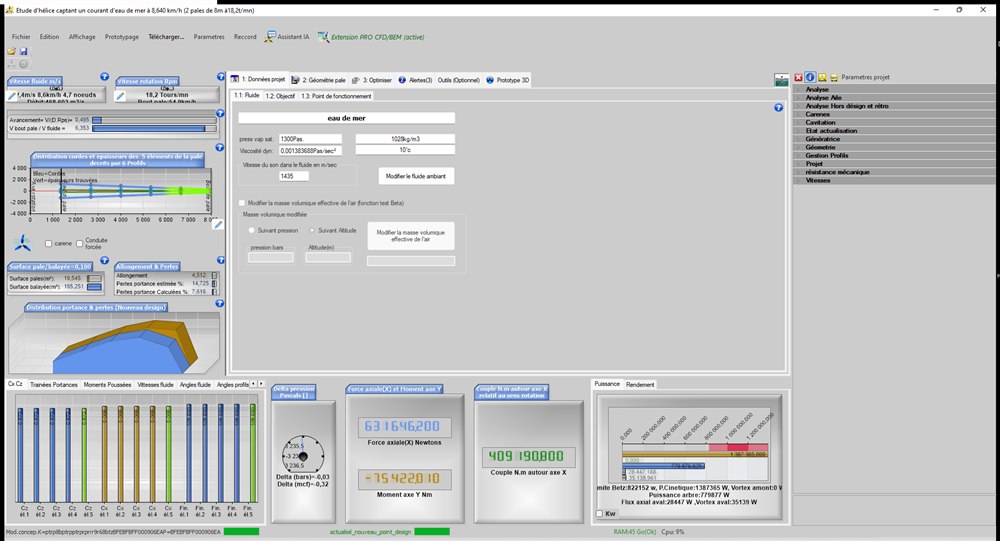
The adaptations, in order:
- fluid: fluid editor, “water H2O” at 12 °C → density 999.43 kg/m³, saturation vapour pressure 1,520 Pa (this value will be used for the cavitation computation);
- diameter: 900 mm — Heliciel rescales all the chords (140.6 mm at the root, 28.1 mm at the tip);
- immersion: 0.75 m → static pressure at the shaft 107,353 Pa (atmosphere + water column), displayed with the available cavitation number σ = 36.8;
- 3 blades instead of 2.
2: First design point… and diagnosis: we rebuild the twist at 2.5 m/s keeping the rpm inherited from the model: 18.2 rpm (that of the 16 m machine!). The verdict is final:
- Cp = 0.024 — 4 % of Betz, a derisory power of 116 W;
- tip speed ratio λ = 0.34: the blades are almost motionless relative to the current, set at more than 80°;
- Heliciel raises 7 warnings.
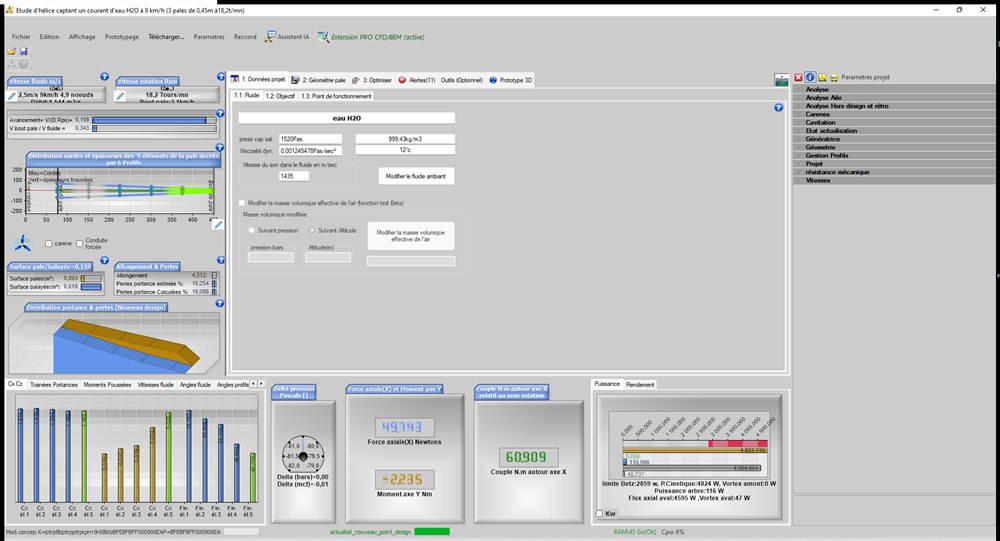
The lesson: a rotation speed never carries over from one machine to another. The tip speed ratio λ (blade tip speed / fluid speed) is the quantity that is preserved, not the revolutions per minute: our small rotor must turn much faster than the 16 m machine to work at the same λ.
3: Optimum rpm: the automatic search for optimum efficiency (“3: Optimise” tab) finds 250 rpm, Cp = 0.565 and 2,725 W… but reports two “downstream axial velocity reversal” inaccuracies on elements 2 and 3: at this loading, the water speed behind the rotor falls almost to zero — the computation flirts with the physical extraction limit, and the performance may be overestimated. Rather than display a flattering but fragile figure, we step back one notch: 220 rpm.
- Cp = 0.540 (91 % of Betz), no error or warning;
- shaft power: 2,607 W — compare with the 514 W of the 3 m wind turbine: 5 times more power with 11 times less swept area, that is what the density of water changes;
- torque: 113 N·m at 220 rpm;
- axial drag: 1,866 N (190 kgf!) — the frame and the anchoring in the millrace must take this load permanently;
- tip speed ratio λ = 4.15.
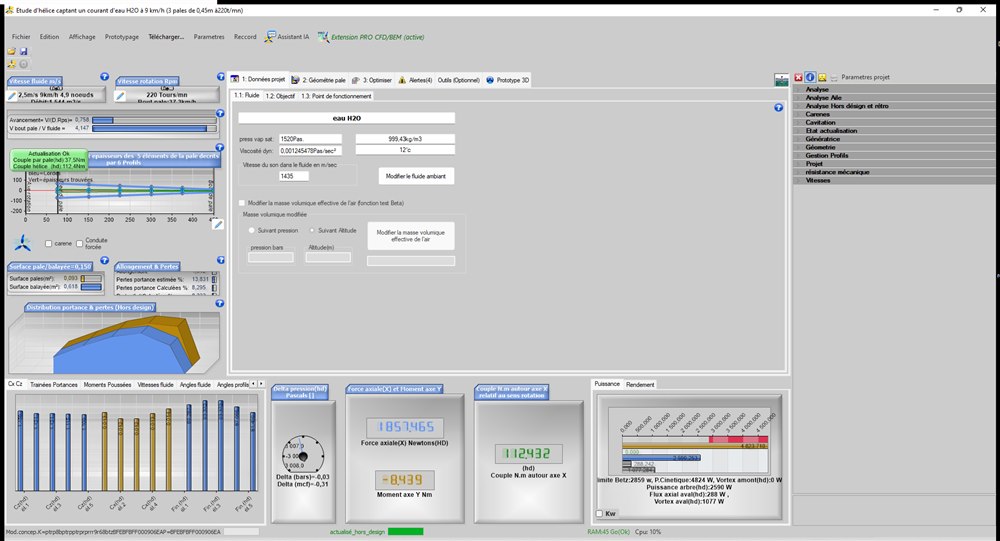
4: Cavitation check: in water, too strong a depression on the suction side makes the water boil cold: bubbles, blade erosion, loss of lift. Heliciel computes for each blade element the cavitation number σ and the critical depression (105,833 Pa here). At the rated operating point (2.5 m/s, 220 rpm, shaft at 0.75 m):
- no cavitation detected: σ decreases from the root (11.5) to the blade tip (1.86), which stays above the critical threshold.
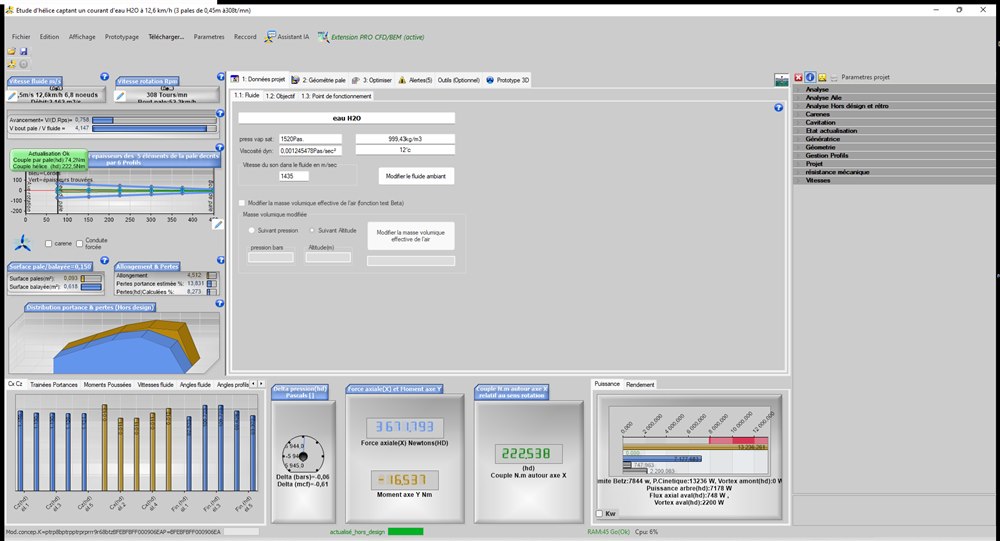
5: Power curve against the current… and the flood: sweep of the water speed from 1 to 3.5 m/s in “Off-design” mode (our blade is frozen!) at constant λ = 4.147 (the gearbox + MPPT keeps the rotor at its best efficiency):
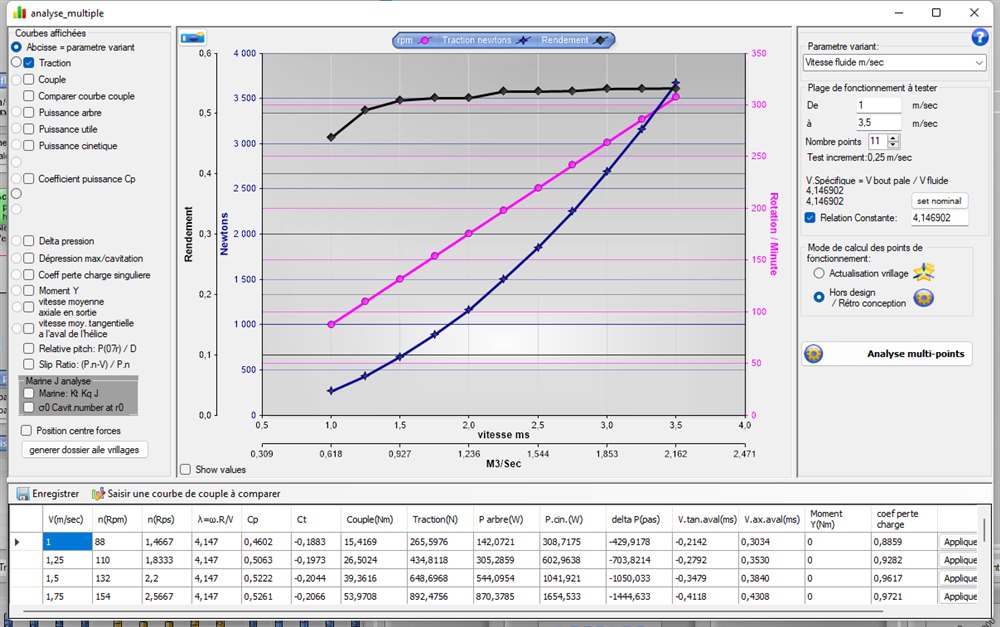
| Current (m/s) | Rpm | Cp | Torque (N·m) | Drag (N) | Shaft P (W) |
| 1 | 88 | 0.460 | 15.4 | 266 | 142 |
| 1.5 | 132 | 0.522 | 39.4 | 649 | 544 |
| 2 | 176 | 0.526 | 70.5 | 1166 | 1299 |
| 2.5 | 220 | 0.537 | 112.4 | 1857 | 2590 |
| 3 | 264 | 0.541 | 163.2 | 2695 | 4512 |
| 3.5 | 308 | 0.542 | 222.5 | 3672 | 7178 |
And in flood? We rerun the cavitation analysis at 3.5 m/s and 308 rpm: this time Heliciel detects cavitation at the blade tip (element 5, σ = 0.95 below the threshold). The anchoring drag climbs to 3,672 N. Operating conclusion: in flood, the rpm will have to be limited (leaving the optimum λ, deliberately) or the machine lifted out — the table above and the cavitation computation give all the figures needed to set this protection.
6: Summary and model to download
- 3-blade hydrokinetic turbine Ø 900 mm, fresh water 12 °C, shaft immersed at 0.75 m;
- design point 2.5 m/s / 220 rpm: Cp 0.540, 2,607 W at the shaft, torque 113 N·m;
- no cavitation at the rated point; tip cavitation from 3.5 m/s at constant λ → rpm limiting in flood;
- anchoring load: 1,866 N at the rated point, 3,672 N in flood.
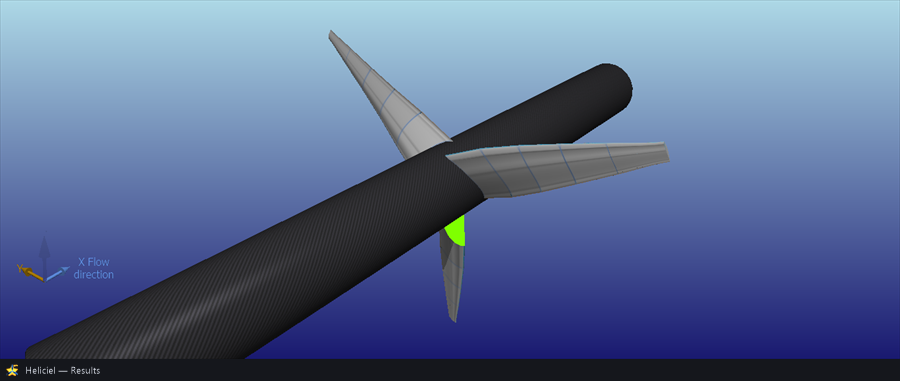
The 3D model of the final turbine, rendered by Heliciel:
The complete project can be downloaded here: hydrolienne_riviere_900mm.hlc (open it with Heliciel). It is also included in the models supplied with the software.
The computed performance is theoretical (smooth surfaces, XFoil polars): allow the usual margins and run cautious trials. Mind also the regulatory obligations before any installation in a watercourse.
I remain at your disposal for any remarks or further information at contact@heliciel.com
- JF Iglesias, Heliciel developer.
To watch the current slow down behind the rotor and read the loads on the structure, read the case study tidal turbine CFD: a 16 m rotor simulated from end to end.
 Global site map
 Mecaflux
 Tutorials Mecaflux Pro3D
 Tutorials Heliciel
 Tutorials Heliciel PRO CFD
 Mecaflux Store
 Compare software functions
 Quotes, Orders, Payment Methods
 project technical studies