
Wind power: where the wind comes from and how much energy a wind turbine captures
Wind power is the kinetic energy of the wind, which comes from temperature differences between air masses. A wind turbine captures at best about 60% of it (the Betz limit), and the conversion chain to electricity then leaves 30 to 50% of that. In the end, 14 to 36% of the wind energy at the site reaches the consumer, depending on the size of the machine.
We start from the origin of the wind, then follow its energy to the wall socket, with figures. On this page:
- 1: Where does the wind come from?
- 2: From wind power to electricity: the chain of efficiencies
- 3: Wind turbine power: formula, wind speed and swept area
- 4: The Betz limit: why only 60%
- 5: How much wind energy is produced? The balance
1: Where does the wind come from? The origin of wind power
Wind power uses the movement of air masses around the planet and local geographical thermal effects to drive generators or various machines. This air movement, the wind, is the product of temperature differences. Temperature changes the density of the air: warm air, being lighter, tends to rise when it meets cold air.
The heat source that makes the air rise is the earth's crust, heated by solar radiation but also by phenomena at the centre of the Earth. Solar radiation is the result of nuclear reactions, and the heat of the earth's magma is another product of them: wind power is therefore, ultimately, a nuclear energy! It still has the immense advantage of managing its own waste, and of having run long enough for us to judge it with some hindsight: it should not hold too many surprises for us any more.
The energy problem is complex, and the perfect solution that will bring everybody to agreement remains to be found. Meanwhile, wind power looks like a promising path, one we must master to increase our energy independence.
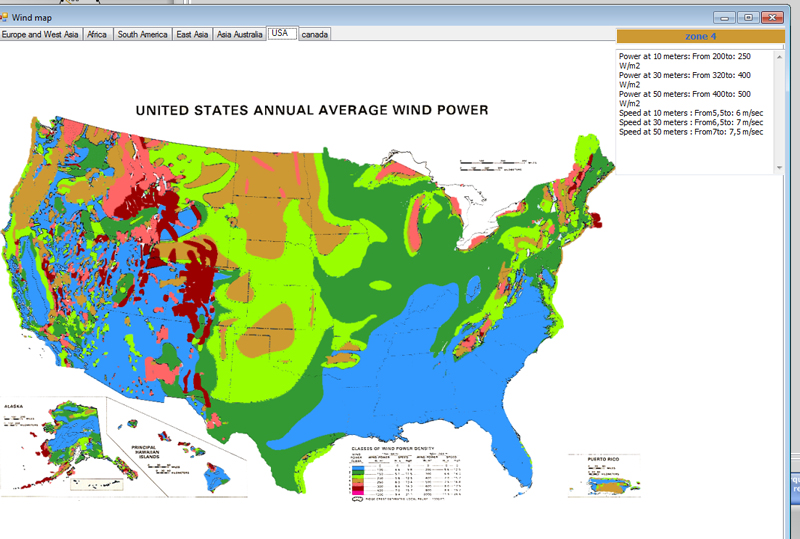
The wind map window of Heliciel: the coloured areas show the level of available wind power, and the panel on the right gives the values for the chosen point.
The Heliciel software includes a series of interactive wind maps of the world. They open from the wind maps button ("Cartes Vents" in the French interface) of the objective tab, when the chosen objective is the capture propeller: you read the wind resource of your region before sizing the machine.
2: From wind power to electricity: the chain of efficiencies
We saw in the history of the propeller that wind energy has been harnessed for a very long time. Today, energy has taken a universal form, electricity. Universal, but not perfect: very practical in many respects, it costs a little at each conversion. Here are the efficiencies of each link, as we record them:
- Wind turbine rotor: its efficiency varies from 0.2 to 0.85 of the Betz limit, in the best case.
- Gearbox, if any: efficiency from 0.7 to 0.98.
- Generator or alternator: mechanical/electrical efficiency of 0.8 to 0.9 at most. We therefore lose 10 to 20% of the captured energy.
- Rectifier, if needed: efficiency from 0.9 to 0.98.
- Transformer: efficiency from 0.85 to 0.98.
- Electricity transmission: line losses give an efficiency of 0.9.
- Battery storage: expensive and poorly controlled, with an efficiency of 0.7 to 0.8.
- Conversion back to mechanical energy (electric motor): efficiency from 0.7 to 0.9 if the motor is used properly. In industry, a badly sized motor, poor lubrication, wrong belt tension or no variable-speed drive at start-up cause significant losses. The savings made on the initial investment then turn into an energy sink.
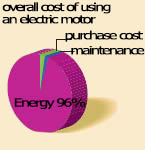
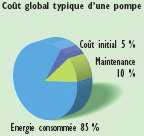
Over the life of an electric motor or a pump, the energy consumed makes up almost the whole cost: 96% for the motor, 85% for the pump. From the report on motor consumption in industry (in French).
Much progress therefore remains to be made. Inventors and researchers who gain a few tenths of a point of efficiency on any link of the chain will save fortunes for factories, individuals and states. The energy sector keeps a considerable potential for creating wealth, at every level: new low-friction bearings, the fan of a PC or of an air conditioner, products with the best efficiency are now chosen first.
3: Wind turbine power: formula, wind speed and swept area
Building a wind turbine for the pleasure of capturing the wind is poetic, but rarely the builder's final goal. The investment must be paid back by an energy output worth more than its cost. Two factors set the power of the wind turbine, and so the wind energy produced:
- The speed and power of the wind. The power of the wind turbine is proportional to the cube of the wind speed: doubling the speed multiplies the power by eight. For a given site we cannot control this factor, it is set by the environment. The air density, which depends on altitude, also plays a significant role. Finally, the wind is not a steady flow of energy: its speed varies over time, and the average power delivered cannot be computed simply from the average speed, since the average of the cubes is not the cube of the average. The page on reference speed and wind power goes further into this.
- The captured area. The power is proportional to the area swept by the rotor, because wind energy is a transformation of the wind's kinetic energy. The larger the rotor, the greater the mass of air captured; the size of the rotor is set by the investment.
P = 0.5 × ρ × S × V³
P is the power of the wind crossing the disc (W), ρ the air density (kg/m³), S the area swept by the rotor (m²) and V the wind speed (m/s).
4: The Betz limit: why a wind turbine captures only 60% of the wind energy
The capturable power: we can capture only about 60% of the wind energy, exactly 16/27 or 59.3%. This constraint is inseparable from taking kinetic energy with a rotor immersed in an unconfined stream of fluid: taking speed energy means slowing the air mass.
Suppose we took all the speed energy of the air: that air mass would be stopped. To let a new air mass through the rotor, we would have to push the stopped one, which would consume energy. The rotor would clog up, and the air would rather flow around the wind turbine than through it. Energy engineers therefore cannot take all the kinetic energy of the air mass.
This phenomenon was quantified by studying the change of momentum, then formulated more precisely by Froude's theory and the Betz limit.
The efficiencies of the conversion systems: every link of the chain deserves care, but the rotor efficiency can range, as we saw, from 0.2 to 0.85 of the Betz limit. The aerodynamic quality of the wind turbine blades is therefore to be taken seriously: it is a power factor that depends only on our skill and our knowledge of wind turbine rotor technique.
5: How much wind energy is produced? The balance
- The capturable wind energy is at best 60% of the energy of the site.
- Converting the captured energy leaves us only 30 to 50% of the capturable energy.
The product of these two factors gives 18 to 30% of the wind energy. The measurements in the table below, taken on real machines, give between 14 and 36% depending on the size of the wind turbine and the average wind speed: small wind turbines run between 14 and 20%, medium-sized ones between 23 and 36%.
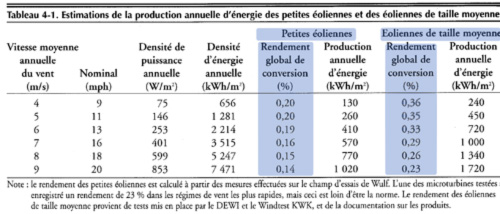
Annual wind energy production and overall conversion efficiency for average wind speeds of 4 to 9 m/s: efficiency falls as the average wind rises (from 0.20 to 0.14 for a small wind turbine, from 0.36 to 0.23 for a medium-sized one). The table is in French.
Some precautions are needed to compute the energy of a site: the page on reference speed and wind power details them.
Conclusion. Between 14 and 36% of the energy: the capture efficiency of wind energy is catastrophic, pitiful, derisory, poor… Calm down, let us keep it in perspective: wind energy is free! Once the investment is repaid and the maintenance paid, it is all profit, and it is clean. The nuisances must not be neglected (noise nearby, appearance, disturbance to birds), but they are easier to manage than radioactive waste, CO2 emissions or flooded valleys. So build wind turbines, make your own energy, and be among those with that enigmatic smile when they feel the wind rising.
To go further, we can compute the power of a wind turbine as a function of wind speed, see how a wind pump adapts its rotor to the water need, or consult the bibliographic references.
 Global site map
 Mecaflux
 Tutorials Mecaflux Pro3D
 Tutorials Heliciel
 Tutorials Heliciel PRO CFD
 Mecaflux Store
 Compare software functions
 Quotes, Orders, Payment Methods
 project technical studies