
Propeller blade twist and section pitch angle
Blade twist follows the pitch. The pitch ratio P/D and the pitch in millimetres, from which each profile's pitch angle follows: propeller pitch calculator
The pitch angle of a blade section is the angle between its chord and the propeller's plane of rotation; blade twist is the difference in pitch angle between the root and the tip of the blade. A blade is twisted because the fluid does not reach it at the same angle along its whole length: near the hub, rotation is slow and the fluid arrives mostly along the axis, whereas at the blade tip rotation dominates and the fluid arrives almost in the plane of rotation. Twist lets every section work at the right angle of attack.
On this page:
- Pitch angle: the angle we measure
- Why the blade is twisted
- Twist, from root to tip
- "The" pitch angle of a blade: at which radius?
- Pitch angle and variable pitch
1: Pitch angle: the angle we measure
On a real blade, the easiest angle to measure is that of the section chord relative to the plane of rotation. This angle is called the pitch angle of the section. It depends only on the blade geometry, not on the speed of the boat or aircraft.
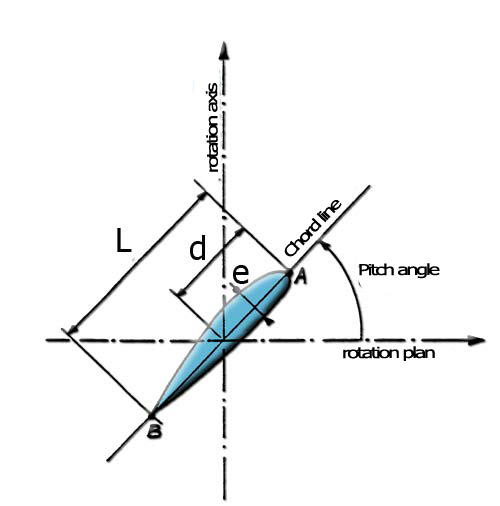
The blade section in cross-section: the pitch angle is measured between chord AB and the plane of rotation.
The pitch angle is linked to the geometric pitch of the section by P = 2π r × tan β, as explained on the page about propeller pitch.
2: Why the blade is twisted
Each section sees the fluid arrive at an apparent angle φ, measured from the plane of rotation. This angle combines two speeds: the speed of advance V, the same over the whole disc, and the rotational speed ω r, which grows with radius. As a first approximation, leaving out the induced velocities that the blade element calculation adds:
tan φ = V / (ω r)
For a section to work at the intended angle of attack α, its pitch angle must be β = φ + α on a propulsive propeller, and β = φ − α on a wind or tidal turbine, which takes energy from the fluid instead of giving it.
Example: let us take again the boat from the pitch page, moving at 3 m/s with a propeller turning at 5 revolutions per second (ω = 31.4 rad/s). At 10 cm from the axis, ω r is 3.14 m/s and the apparent angle reaches 43.7°. At 40 cm, ω r is 12.6 m/s and the apparent angle drops to 13.4°. To keep the same angle of attack everywhere, the pitch angle must therefore lose about 30° from root to tip: that is blade twist.
3: Twist, from root to tip
Blade twist is the angle between the chord of the tip section and that of the root section. It measures how much the blade is twisted along its length.
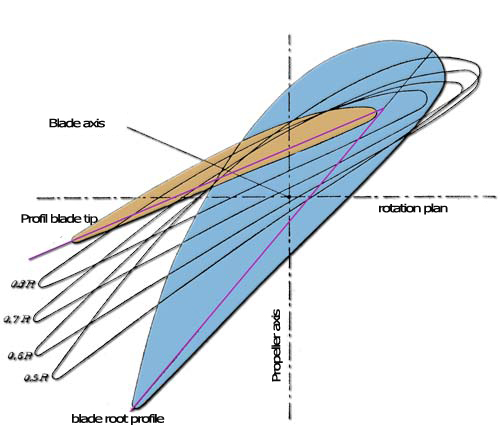
Sections of the same blade stacked from root (0.5 R) to tip: their chord lies down progressively towards the plane of rotation.
Heliciel computes the apparent angle of each blade element, induced velocities included, then applies by default the section's best lift-to-drag angle of attack: the blade twist follows from this calculation. The pitch angle of each section can then be adjusted by hand if needed: set the blade section pitch angle and pitch.
4: "The" pitch angle of a blade: at which radius?
Since the pitch angle changes along the blade, a "blade pitch angle" only makes sense if we know at what distance from the axis it was measured. Most often it is given at 75 % of the radius (0.75 R) in aviation, and the pitch at 70 % of the radius (0.7 R) in marine practice. Some data sheets give it at the blade tip.
Before comparing two propellers, or reproducing the pitch angle of an existing blade, always check the radius at which it was measured.
5: Pitch angle and variable pitch
On a variable pitch propeller, the whole blade pivots about its axis. All pitch angles change by the same amount, and the twist does not change.
To go further, we can see how the pitch angle sets the geometric and effective pitch of the propeller, or how Heliciel handles the angle of attack of blade sections.
 Global site map
 Mecaflux
 Tutorials Mecaflux Pro3D
 Tutorials Heliciel
 Tutorials Heliciel PRO CFD
 Mecaflux Store
 Compare software functions
 Quotes, Orders, Payment Methods
 project technical studies