
A craftsman has to extract the air from his finishing workshop: an air renewal computed at 3,000 m³/h, through a short duct of 400 mm diameter whose pressure losses (grille, duct, outlet) have been estimated at 30 Pa at the rated flow. He wants to carve the fan impeller himself, driven by a variable-speed motor.
- Organisation and design phases:
- The fan model and the “penstock” mode
- From flow to air speed, from pressure to thrust
- Search for the rpm… and understand the limit of the duct fan
- The fan characteristic curve
- Summary, noise and model to download
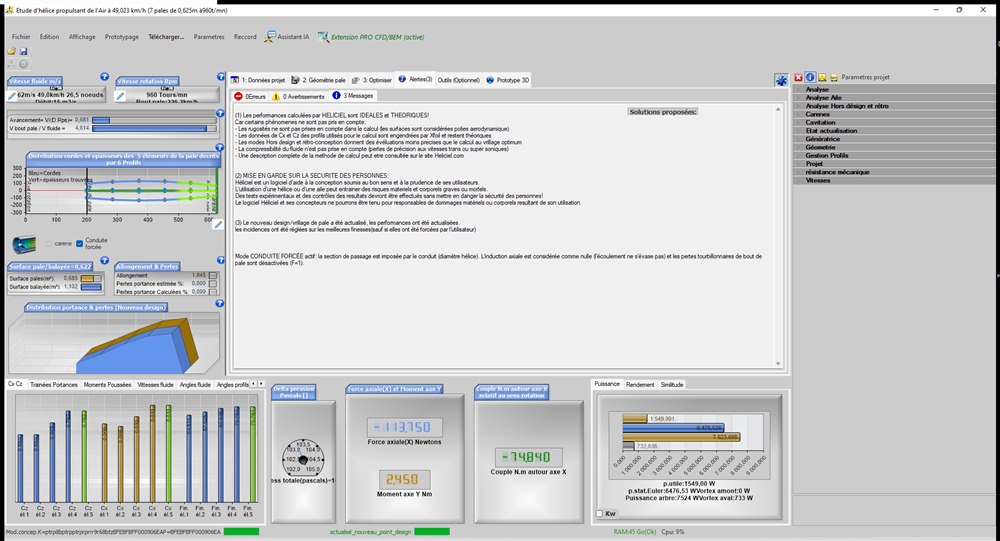
1: The fan model: when the model opens, note Heliciel's message: “PENSTOCK mode active: the flow section is imposed by the duct… axial induction is taken as zero and tip vortex losses are disabled”. A ducted impeller does not work like a free propeller: the tube imposes the air stream, and the tip clearance (ideally) removes the tip losses.
2: Translate the need: two conversions underlie every duct fan sizing:
- flow → axial velocity: Heliciel derives the flow section from the duct diameter (400 mm) and the hub (128 mm): S = 0.1128 m², so 3,000 m³/h = 0.833 m³/s → 7.39 m/s in the duct;
- pressure → thrust: the pressure supplied by the impeller is its thrust spread over the section: ΔP = T / S. Our 30 Pa therefore call for T = 30 × 0.1128 = 3.4 N of thrust. A modest pressure only needs a few newtons — but every pascal has to be earned.
3: Search for the rpm… and understand: at 960 rpm (the rpm inherited from the model), the 400 mm 5-blade impeller only supplies 16 Pa at the rated flow: not enough. We then asked for much more rpm, and discovered a lesson in air handling:
- at 1,850 rpm: 28.5 Pa; at 3,200 rpm: only 32 Pa, for 329 W absorbed — the extra power goes into swirl (the air leaves as a vortex with 7.4 m/s of tangential velocity) instead of becoming pressure;
- this is the physical limit of the duct fan without stator: past a certain point, turning faster no longer compresses, it screws the air. For high pressures (100 Pa and more), you need straightening vanes downstream, a contra-rotating stage… or a larger diameter;
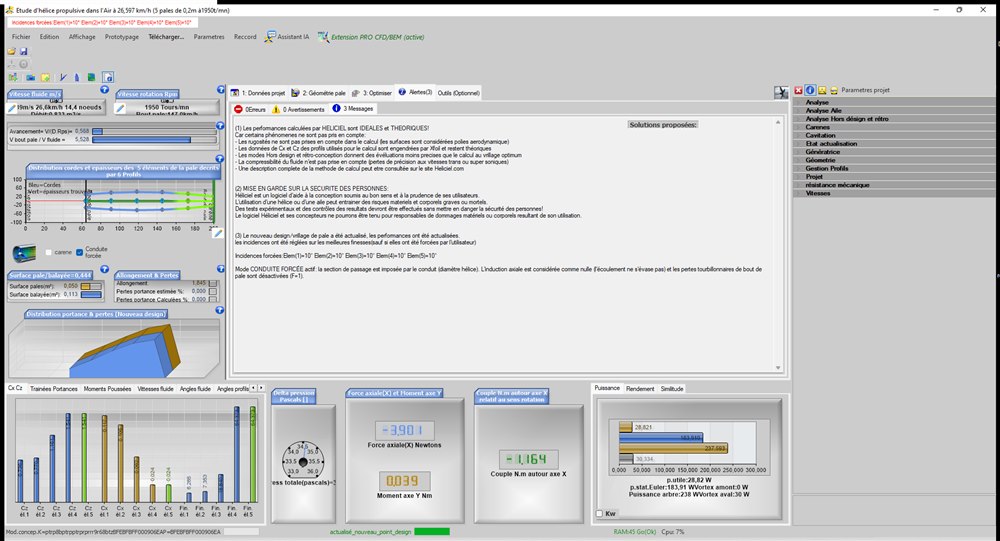
- our 30 Pa target, however, remains reachable: at 1,950 rpm, the rebuilt impeller supplies 32.9 Pa at the rated flow. We finally smooth the angles of attack (“smooth angles of attack” function: the whole blade at the angle of attack of the 0.75 R zone, here 10°) for a regular, easy-to-make blade: ΔP = 34.6 Pa, 238 W absorbed, torque 1.16 N·m. 15 % margin on the need: adopted.
4: The characteristic curve: a fan never lives alone: it settles in equilibrium with its network. The multi-point analysis sweeps the air speed in the duct (hence the flow) at 1,950 rpm, geometry frozen:
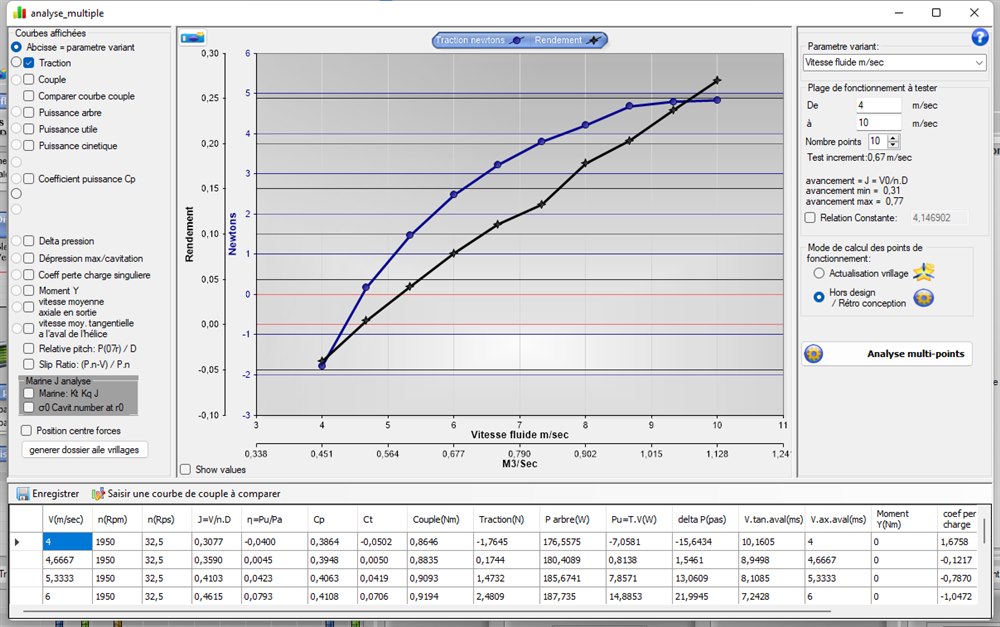
| Flow (m³/h) | Axial V (m/s) | ΔP (Pa) | Shaft P (W) |
| 1624 | 4.0 | -15.6 (windmilling!) | 177 |
| 2166 | 5.3 | 13.1 | 186 |
| 2436 | 6.0 | 22.0 | 188 |
| 2708 | 6.7 | 28.6 | 193 |
| 2977 | 7.3 | 33.7 | 210 |
| 3248 | 8.0 | 37.4 | 189 |
| 3790 | 9.3 | 42.6 | 189 |
Reading: below about 2,000 m³/h, our setting (10° angle of attack, deliberately loaded) stalls and the “pressure” becomes negative: if the network is more resistive than planned (clogged filter, obstructed grille), the flow drops and the fan leaves its working zone. The margin taken at step 3 is therefore not a luxury. This is the whole point of confronting the fan curve with the network curve — the approach is detailed on the fan and ventilation page.
- 5-blade duct impeller Ø 400 mm (hub 128 mm), angle of attack smoothed to 10°, pitch angle 27° at 0.7 R;
- rated point: 3,000 m³/h at 34.6 Pa at 1,950 rpm, 238 W at the shaft — a 4-pole motor with a variable-speed drive, or a brushless motor, will do;
- noise: blade passing frequency 162.5 Hz (harmonics 325 / 487.5 Hz), blade tip at 41 m/s;
- air-handling lesson: without a stator, the duct fan reaches a pressure ceiling — size the network BEFORE the fan.
The complete project can be downloaded here: ventilateur_gaine_400mm_3000m3h.hlc (open it with Heliciel). It is also included in the models supplied with the software.
I remain at your disposal for any remarks or further information at contact@heliciel.com
- JF Iglesias, Heliciel developer.
 Global site map
 Mecaflux
 Tutorials Mecaflux Pro3D
 Tutorials Heliciel
 Tutorials Heliciel PRO CFD
 Mecaflux Store
 Compare software functions
 Quotes, Orders, Payment Methods
 project technical studies