
Tutorial: designing a 10-inch quadcopter drone propeller with Heliciel
The builder of a camera quadcopter wants to size its propellers and predict its endurance BEFORE buying motors and battery. The data:
- Total mass in flight: 2,000 g (frame, camera and battery included), 4 motors;
- in hover each propeller must therefore carry 500 g, a target thrust of 4.905 N per motor;
- 10-inch (254 mm) propellers, 2 blades — the standard of 450-class frames;
- battery 4S 5,000 mAh (14.8 V), motor + controller efficiency estimated at 75 % (figure from the motor manufacturer);
- air at 20 °C at sea level.
- Organisation and design phases:
- Start from a model of the drone library
- Hover design: 500 g per motor
- Theoretical endurance on the battery
- The throttle curve: thrust and power against rpm
- Noise
- Summary and model to download
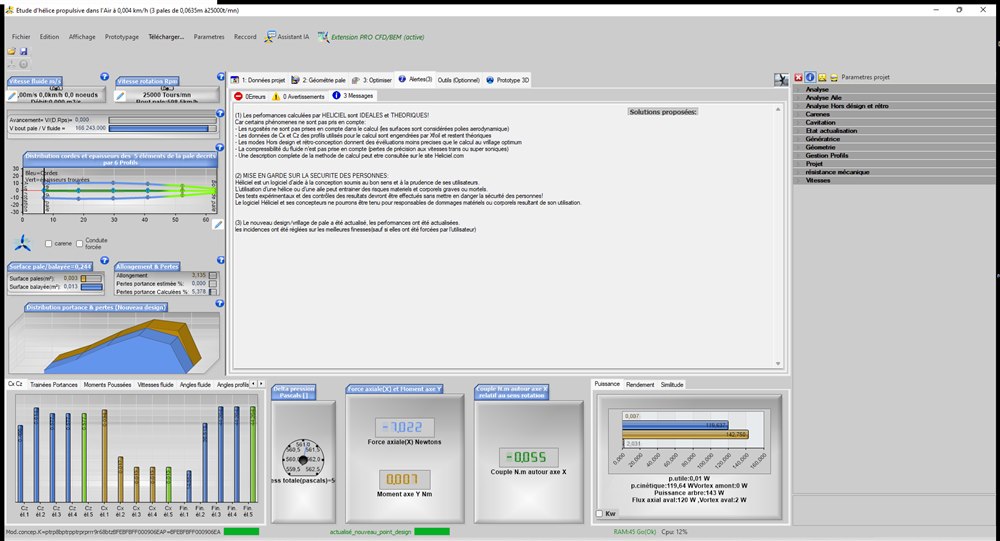
1: Start from a model: Heliciel ships with a library of drone propellers (1.2 to 6 inches, 2 to 9 blades). We load a 5-inch 3-blade racing propeller… which we are going to turn into a 10-inch two-blade lifter — once again, the model is only a starting point.
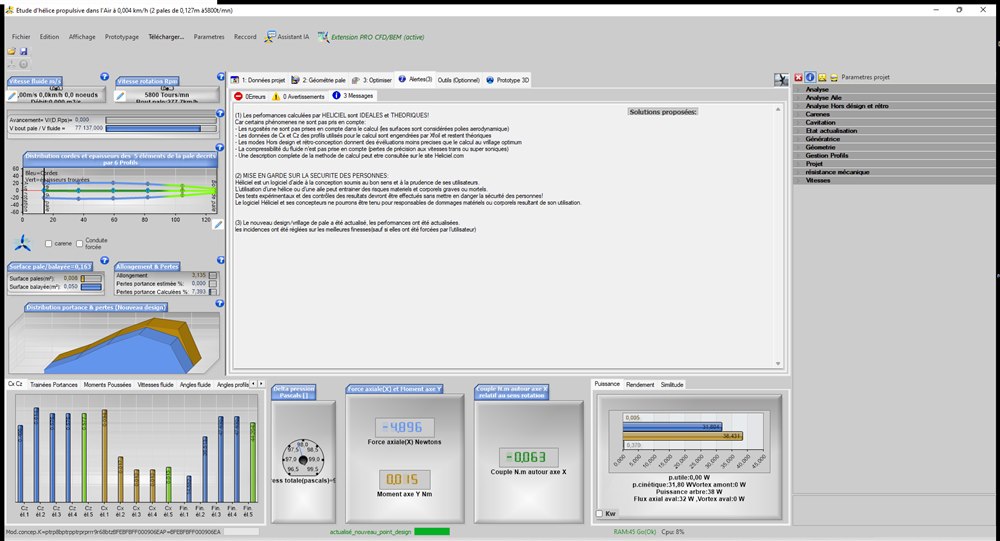
2: Hover design: hovering is THE design point of a multirotor (zero speed of advance — Heliciel brings it to 0.001 m/s for the BEM computation). We ask for: Ø 254 mm, 2 blades, air at 20 °C, thrust target 4.905 N. Heliciel searches for the rpm:
- hover rpm: 5,800 rpm;
- shaft power: 38.4 W per motor, torque 0.063 N·m;
- figure of merit: 0.80 — the quality indicator of a rotor in hover (ratio of the ideal Froude power to the actual power): 0.80 is a very good value, commercial drone propellers typically sit between 0.55 and 0.75;
- geometric pitch: 115 mm at 0.7 R — our computed propeller is the equivalent of a commercial “10 × 4.5”, but with an optimum twist instead of a constant pitch;
- tip Mach number: 0.23.
3: Theoretical endurance: Heliciel chains the BEM hover computation with the electrical balance using OUR assumptions (no hidden value):
- total electrical power: 206 W (4 × 38.6 W shaft / 0.75 motor + ESC efficiency);
- current drawn from the battery: 13.9 A (2.8 C on 5,000 mAh — very gentle);
- theoretical hover endurance: 21.5 minutes to full discharge. In practice a LiPo is only discharged to 80 %: count on ~17 minutes of hover — and less in windy forward flight.
4: The throttle curve: the flight controller modulates the rpm all the time. The multi-point analysis sweeps the rpm from 3,500 to 8,000 rpm with the geometry frozen:
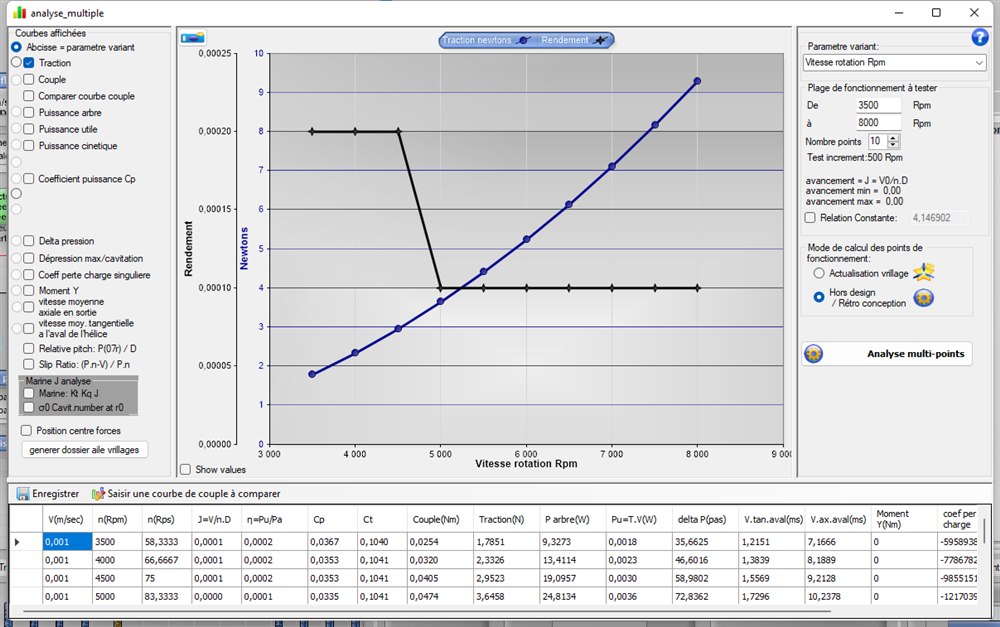
| Rpm | Thrust/motor (N) | (g) | Torque (N·m) | Shaft P (W) |
| 3500 | 1.79 | 182 | 0.025 | 9.3 |
| 4500 | 2.95 | 301 | 0.041 | 19.1 |
| 5000 | 3.65 | 372 | 0.047 | 24.8 |
| 5800 | 4.90 | 500 | 0.063 | 38.4 |
| 6500 | 6.14 | 626 | 0.079 | 53.6 |
| 7000 | 7.12 | 726 | 0.091 | 67.0 |
| 8000 | 9.30 | 948 | 0.119 | 100.0 |
Reading: at 8,000 rpm the 4 motors deliver 4 × 9.3 N = 37.2 N, a thrust-to-weight ratio of 1.9: enough to hold a hover in a steady wind and manoeuvre calmly (2 or more is recommended for a camera platform). The table also gives the torque at each rpm: the figure to check against the Kv/torque curve of your motors, to make sure they will hold 8,000 rpm under load.
5: Noise: blade passing frequency 193 Hz (harmonics 387 and 580 Hz) — the characteristic “hum” — and a blade tip at 77 m/s (Mach 0.23). Switching to 3 blades of smaller diameter would raise the BPF (a higher-pitched sound, often felt as more aggressive): the large, slow two-blade propeller is the choice of discretion and endurance.
6: Summary and model to download
- Two-blade propeller Ø 254 mm (10″), pitch 115 mm (~10×4.5), optimum twist;
- hover: 500 g/motor at 5,800 rpm, 38.4 W shaft, figure of merit 0.80;
- theoretical endurance: 21.5 min (100 % discharge) / ~17 min at 80 %;
- maximum thrust (8,000 rpm): thrust-to-weight ratio 1.9.
The complete project can be downloaded here: helice_drone_10pouces_hover.hlc (open it with Heliciel). It is also included in the models supplied with the software. For 3D printing your prototypes, export the STL from Heliciel — and balance carefully before the first flight.
I remain at your disposal for any remarks or further information at contact@heliciel.com
- JF Iglesias, Heliciel developer.
To see this propeller in the air it stirs, pressure on the blades and jet under the rotor, read the case study drone propeller CFD: six minutes of simulation on the 5-inch propeller supplied with Heliciel.
 Global site map
 Mecaflux
 Tutorials Mecaflux Pro3D
 Tutorials Heliciel
 Tutorials Heliciel PRO CFD
 Mecaflux Store
 Compare software functions
 Quotes, Orders, Payment Methods
 project technical studies