
One checkbox of the multiple analysis produces the open water coefficients of your propeller, and places them on the advance coefficient axis.
Kt, Kq and J: reading a marine propeller in open water
A marine propeller file is always read the same way: three curves against the advance coefficient. Heliciel produces them for your propeller, the one you have just designed — not for a stock propeller.
1: The definitions, and one warning
- J, the advance coefficient: it compares the speed of advance to the product of the rotation speed by the diameter. A low J means a heavily loaded propeller; a high J, a propeller that is "unscrewing";
- K_T, the thrust coefficient, and K_Q, the torque coefficient: thrust and torque made dimensionless;
- the open water efficiency follows from the three.
The warning: some publications use coefficients of the rotor kind, whose definition differs from that of the propeller kind. Heliciel uses the propeller definitions and says so in its displays. Mixing two sources without checking that convention is one of the most expensive mistakes in the propeller literature.
2: Turning the marine analysis on
Open the multiple analysis, tick Marine: Kt Kq J, then bound the range of J to be explored. The bounds are chosen around the operating point aimed at: there is no point sweeping up to values of J your boat will never reach.
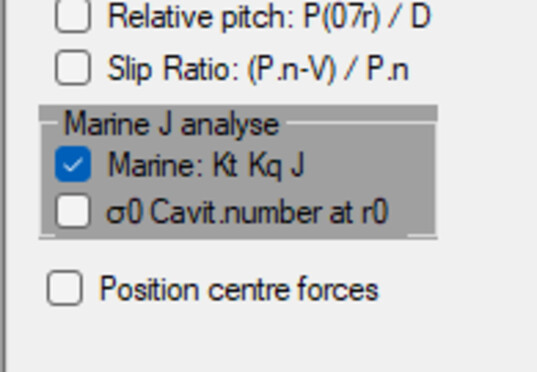
The option and its bounds
3: Reading the three curves
The classical reading: K_T decreases as J increases — the propeller pushes less as the boat moves faster; K_Q decreases too, but not at the same rate; and the efficiency goes through a maximum. That maximum is not necessarily your operating point, and this is the whole value of the curve: it shows the gap.
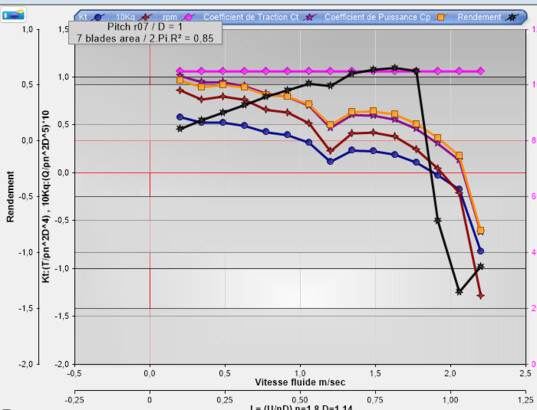
The three curves

Where your propeller works
4: Comparing with a reference propeller
The Wageningen B series provides the yardstick: at equal diameter and operating point, where does your propeller stand? A gap in your favour deserves an explanation — better suited sections, an optimised chord distribution; an unfavourable gap deserves one too.
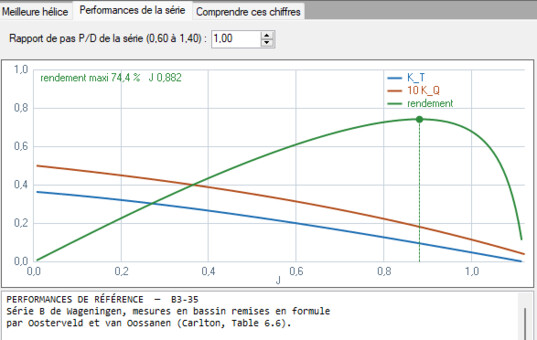
Your propeller, against the yardstick
Validation. Heliciel's BEM computation laid over the published curves of four propellers of the series, B4-70 at pitch ratios 0.60, 1.00 and 1.40 and B3-50 at unit pitch, over the whole J sweep: validating Heliciel against published data.
5: The torque of the propeller and that of the engine
The real matching criterion is not efficiency: it is where two torque curves meet. The multiple analysis lets you enter an engine torque curve and compare it with that of the propeller: their intersection gives the rotation speed at which the assembly will actually settle.
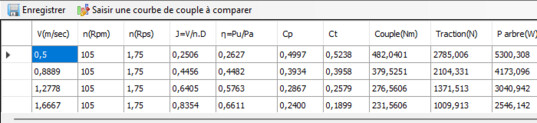
The table, for the file
Going further: the multiple analysis, propeller advance and the boat propeller.
 Global site map
 Mecaflux
 Tutorials Mecaflux Pro3D
 Tutorials Heliciel
 Tutorials Heliciel PRO CFD
 Mecaflux Store
 Compare software functions
 Quotes, Orders, Payment Methods
 project technical studies