
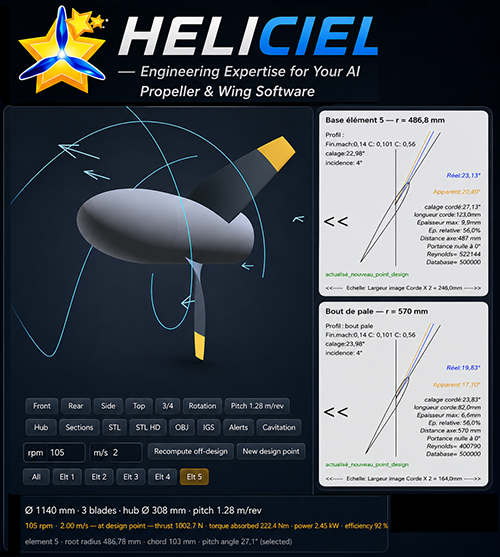
What you get: thrust, torque, power, efficiency, blade geometry element by element, cavitation check — computed by Heliciel.
→ About the Heliciel MCP connector
→ Install in Claude
→ Try it free: 1-day discovery pass
→ Get an MCP pass
→ Boat propeller (article)
→ Boat propeller design tutorial
→ Propeller cavitation
→ Version française
 Boat propeller design with an AI assistant
With the Heliciel MCP connector, ChatGPT or Claude size a marine propeller from the available diameter, the shaft rpm, the boat speed and the target power or thrust. Heliciel computes thrust, torque, efficiency and blade geometry with the BEM method (Blade Element Momentum), and checks cavitation element by element — the point that sets a boat propeller apart from an air propeller.
The problem: thrust, torque and cavitation are linked
A boat propeller must turn the engine torque into thrust at hull speed, without the depression on the suction side exceeding the vapour pressure of water — otherwise cavitation, erosion and loss of thrust. Diameter, pitch, blade area (number of blades, chords) and rpm are set together. Charts give a starting point; a language model on its own paraphrases them. Heliciel computes the operating point and the cavitation margin of each blade element.
Real session: Ø 1,140 mm, 3 blades, 105 rpm
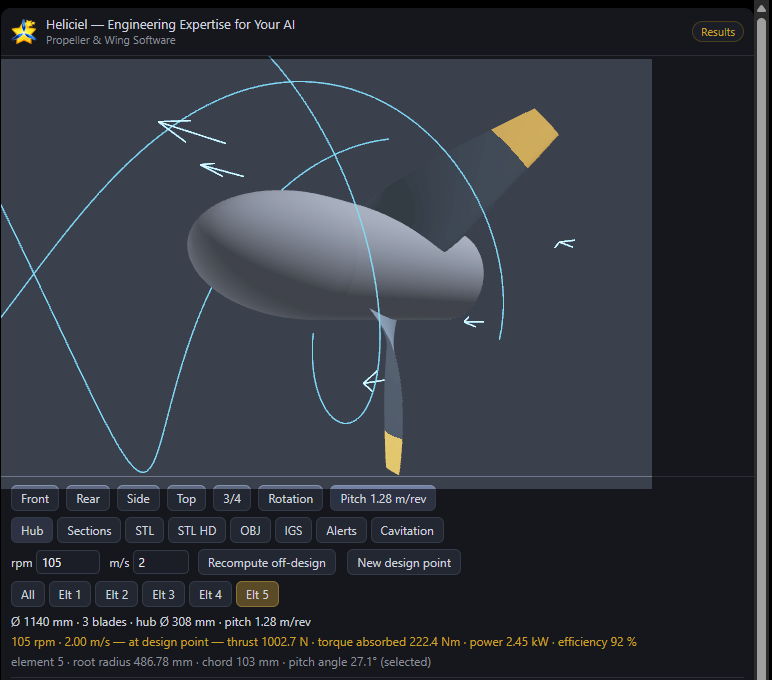 Heliciel 3D viewer during the conversation: element 5 selected, section diagrams at r = 486.8 mm and at the blade tip (r = 570 mm). The Cavitation button colours the elements at risk; the STL, OBJ and IGS buttons start the exports.
Element 5 (r = 486.8 mm): chord 103 mm, pitch angle 27.1°, Reynolds 522,144. Blade tip (r = 570 mm): chord 82 mm, pitch angle 23.98°, Reynolds 400,790.
What you can ask
“Size a boat propeller: 30 kW at the shaft, 1,000 rpm after the gearbox, 8 knots, maximum diameter 600 mm, 3 blades, sea water.”
- Design at an imposed rpm or automatic search for the rpm that absorbs the power.
- Cavitation check per blade element, at the immersion depth and temperature you give (vapour pressure).
- Compare 3 and 4 blades, or two diameters, to reduce the blade loading.
- Off-design: the same propeller at bollard pull (towing at zero speed) or at overspeed.
- Ducted propeller (nozzle) for workboats: ducted project in Heliciel (propeller duct).
- Export as STL (casting, prototyping), IGES (CAD), JSON sections (machining).
For the complete hull + propeller study, see the boat propeller design tutorial and the resistance to forward motion.
Limits specific to marine propellers
- BEM in uniform flow: the hull wake (reduced, non-uniform speed of advance) is not modelled; give the effective speed of advance rather than the boat speed if you know it.
- Cavitation is detected by a pressure criterion on each element, not simulated; erosion, noise and the vapour pocket are not.
- No blade structural computation and no propeller-rudder interaction.
Connecting
- Get a Heliciel MCP pass on mecaflux.com.
- In Claude: connector directory. Elsewhere: MCP connector at
https://mcp.heliciel.com/mcp(details per client). - Authorise with the pass key, then describe your boat and its engine.
Frequently asked questions
Fresh water or sea water?
Say which: density and vapour pressure change, hence thrust and cavitation margin. Heliciel does not assume the fluid.
Is the 92 % efficiency realistic?
It is the theoretical BEM efficiency of the isolated propeller, at low loading (105 rpm on 1,140 mm). Behind a hull, the overall propulsive efficiency will be lower. Heliciel states this in its limits.
Can I start from an existing propeller?
Yes: give its diameter, pitch and number of blades, Heliciel models it and computes its operating point (reverse-engineering mode, less accurate than a design with optimum twist — the connector says so).
Related pages: Heliciel MCP (overview) · drone propeller by AI · aircraft propeller by AI · wind turbine by AI
 Global site map
 Mecaflux
 Tutorials Mecaflux Pro3D
 Tutorials Heliciel
 Tutorials Heliciel PRO CFD
 Mecaflux Store
 Compare software functions
 Quotes, Orders, Payment Methods
 project technical studies