
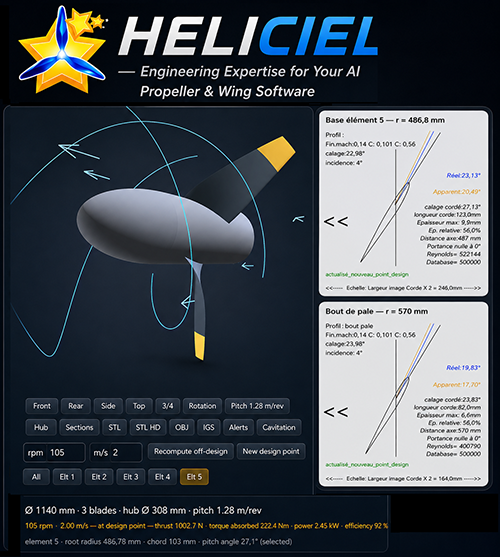
What you get: the RPM that absorbs your power, thrust, torque, efficiency, tip Mach, full geometry — computed by Heliciel.
→ About the Heliciel MCP connector
→ Install in Claude
→ Get an MCP pass
→ Aircraft propeller (article)
→ Aircraft propeller design tutorial
→ Version française
 Aircraft propeller design with an AI assistant
With the Heliciel MCP connector, ChatGPT or Claude design an aircraft or ultralight propeller from the engine power, the flight speed, the available diameter and the blade count. The design RPM is searched automatically by Heliciel to absorb the power, and the assistant returns thrust, torque, efficiency, tip Mach and blade geometry — with the software's design alerts.
The problem: absorbing the power at the right RPM
An aircraft propeller must absorb the engine power at the target flight speed, with a high propulsive efficiency and a tip speed that stays below compressibility effects. Diameter, pitch, blade count and RPM are coupled: changing one moves the others. A language model alone gives "typical values"; it does not solve the coupling. Heliciel solves it blade element by blade element, with the airfoil polars at the local Reynolds number.
Real dialogue: 50 kW, 120 km/h, 2 blades
Real session in ChatGPT web (from the demo video). This case was replayed six times on three different clients (ChatGPT, Claude, Le Chat) with the same results.
"Design an aircraft propeller: 50 kW, 120 km/h, max diameter 1.5 m, 2 blades."
propulsion_air project, speed 33.33 m/s):• Design RPM found: 2,862.5 rpm — shaft power 50.10 kW
• Thrust 1,121.4 N, absorbed torque 167.1 N·m
• Efficiency 92.8 % — tip Mach 0.679
• Geometry: Ø 1,500 mm, 2 blades, hub Ø 255 mm, pitch 0.85 m/rev
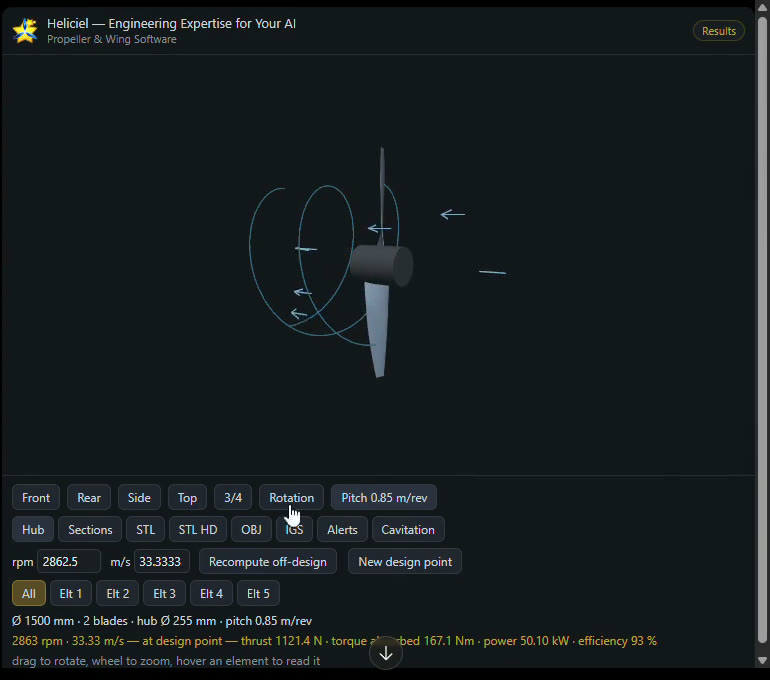 The Heliciel 3D viewer in ChatGPT: Front/Rear/Side/Top views, rotation, Hub, Sections, STL, STL HD, OBJ, IGS, Alerts, Cavitation buttons; rpm and m/s fields to recompute off-design; result line of the design point.
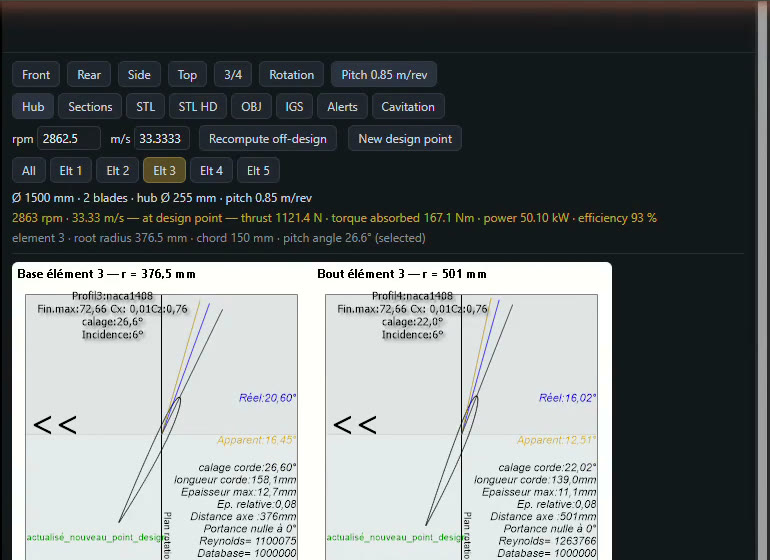 Element 5 selected (r = 625.5 mm): NACA 1408 profile, pitch angle 18.8°, incidence 6°, Reynolds 1,227,482. Blade tip (r = 750 mm): pitch angle 16.6°, Reynolds 918,049. The diagram is Heliciel's, not a generated image.
What you can ask next
- Reduce the tip Mach: ask for a smaller diameter or 3 blades — Heliciel recomputes RPM and efficiency. See blade count.
- Off-design: the same propeller at take-off (low speed, full RPM) or in fast cruise; RPM × speed map.
- Optimize RPM or chord law within your bounds.
- Variable-pitch propeller: recompute at several pitch settings (variable pitch propeller).
- Export as STL for prototyping, IGES for CAD, sections as JSON for machining.
Limits specific to aircraft propellers
- Compressibility is not modelled: Heliciel computes the tip Mach but the polars are not corrected in the transonic range. Above tip Mach ≈ 0.8, precision drops; the connector says so, it does not correct.
- Ideal performance: smooth surfaces, no fuselage wake or installation effect.
- No structural computation (bending, centrifugal) and no dB(A) acoustics.
- Designing a real aeronautical propeller is the job of engineers trained in safety rules: this computation is an aid, not a certification.
Connect
- Get a Heliciel MCP pass on mecaflux.com.
- In Claude: connectors directory. Elsewhere: MCP connector at
https://mcp.heliciel.com/mcp(per-client details). - Authorize with the pass key, then state your specification.
Frequently asked questions
Do I have to give the RPM?
Not if you give the power: Heliciel searches the RPM that absorbs it. If you impose the RPM (gearbox, electric motor), give it and Heliciel sizes at that RPM.
Which airfoil is used?
The one of the loaded model (here NACA 1408), chosen from Heliciel's airfoil database. You can ask for another airfoil from the database; the assistant tells you which one is in place, it does not invent it.
Is the 92.8 % efficiency realistic?
It is the theoretical BEM efficiency at the design point, smooth surfaces. A real installed propeller will be below; Heliciel writes it in its limits and the connector reports them.
Related pages: Heliciel MCP (overview) · drone propeller by AI · wind turbine by AI
 Global site map
 Mecaflux
 Tutorials Mecaflux Pro3D
 Tutorials Heliciel
 Tutorials Heliciel PRO CFD
 Mecaflux Store
 Compare software functions
 Quotes, Orders, Payment Methods
 project technical studies