
What you get: thrust per propeller, diameter, RPM, chord and pitch distribution, exportable 3D geometry — computed by Heliciel, not estimated by the model.
→ About the Heliciel MCP connector
→ Install in Claude
→ Get an MCP pass
→ Drone and multirotor propellers (article)
→ Version française
 Drone propeller design with ChatGPT or Claude
With the Heliciel MCP connector, your AI assistant sizes the propellers of a drone or multirotor from the mass, the number of motors and the thrust margin you want. It does not guess a "common" diameter and pitch: it sets the thrust target, asks you for the available diameter, then has the blade computed by the Heliciel software (BEM, Blade Element Momentum) at your motors' RPM.
The problem: a drone propeller is computed in hover
A multirotor propeller spends most of its time at zero or low forward speed: induced velocity dominates, root incidence angles are high and efficiency depends strongly on the twist law. Rules of thumb (pitch ≈ 0.4 × diameter, "this motor takes that prop") give neither the real thrust nor the absorbed power. A language model asked alone repeats those rules of thumb; it does not compute. The connector replaces the rule with the computation. Background: drone, VTOL and multirotor propellers.
Real dialogue: 8 kg drone, 4 motors
Real session in the ChatGPT iPhone app (from the demo video), Heliciel connector active.
"I have an 8 kg drone, 4 motors, 150 % thrust margin, motors at 5000 rpm. Size the propellers."
propulsion_air project in hover."Max diameter 400 mm."
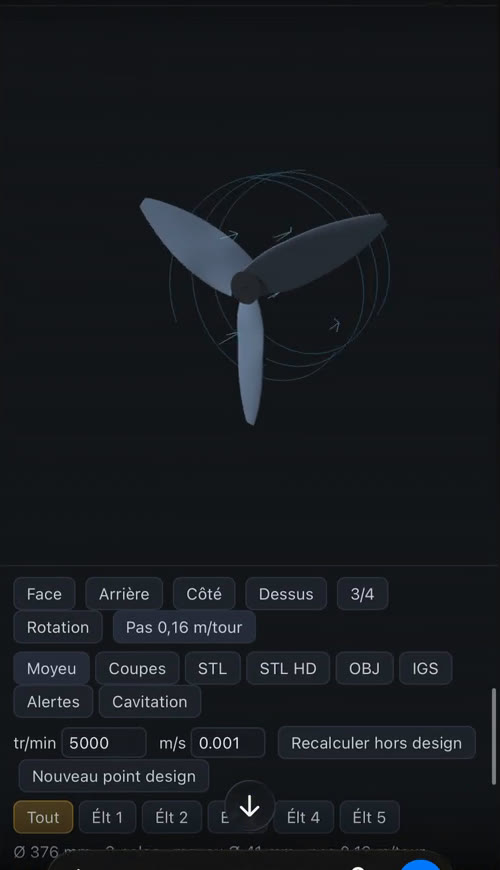 The Heliciel 3D viewer in ChatGPT iOS: the 3-blade propeller rotates under your finger; Hub, Sections, STL, OBJ, IGS, Alerts buttons within thumb reach. 5,000 rpm, forward speed ≈ 0 (hover). The Heliciel 3D viewer in ChatGPT iOS: the 3-blade propeller rotates under your finger; Hub, Sections, STL, OBJ, IGS, Alerts buttons within thumb reach. 5,000 rpm, forward speed ≈ 0 (hover). |
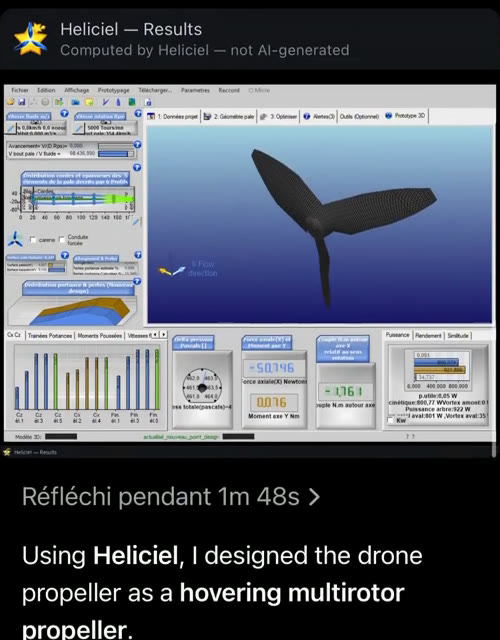 The The visualiser tool returns Heliciel's real screen ("Computed by Heliciel — not AI-generated"): tabs, 3D blade, Cl/Cd charts, thrust and power. |
What you can ask next
- Compare 2, 3 and 4 blades at the same diameter and RPM — Heliciel recomputes, the assistant tabulates thrust, absorbed power and efficiency. See propeller blade count.
- Sweep the RPM (e.g. 3,000 to 7,000 rpm) to plot thrust and power against RPM and pick the motor.
- Analyze an off-design point: the same propeller in forward flight at 10 m/s, or at reduced RPM in descent.
- Optimize the RPM or the chord law within bounds you set (iterative or genetic search).
- Read the blade-passing frequencies (noise indicator; Heliciel does not compute a dB(A) level and does not estimate one).
- Export as STL for 3D printing, or IGES for CAD. Links valid 60 minutes.
Limits specific to drone propellers
- The computation is a steady, ideal BEM: smooth surfaces, XFOIL polars, no interaction between neighbouring rotors, no ground effect.
- Very small diameters at low Reynolds numbers (< 100,000) leave the usual accuracy range of the polars: Heliciel reports the Reynolds number of each element, read them.
- Noise is not modelled beyond blade-passing frequencies and tip speed.
- The connector checks the strength of the printed blade in bending and in centrifugal tension (material, armature, safety factor); torsion, shear, buckling and fatigue are not computed, and this is not a finite element calculation.
Connect
- Get a Heliciel MCP pass (per day) on mecaflux.com.
- In Claude: install from the connectors directory. Elsewhere: add an MCP connector at
https://mcp.heliciel.com/mcp(per-client details). - Authorize with the pass key, then write your request as above.
Frequently asked questions
Can the assistant choose the diameter for me?
No. It can help you reason (clearance, frame size), but Heliciel does not accept a diameter you did not give.
Does the result hold in forward flight?
The design above is in hover. Then ask for an off-design analysis at the forward speed you want: same propeller, new operating point.
Can I reproduce these figures?
Yes: same prompt, same project type, same diameter and RPM give the same result. It is a deterministic computation, not a generation.
Related pages: Heliciel MCP (overview) · aircraft propeller by AI · wind turbine by AI
 Global site map
 Mecaflux
 Tutorials Mecaflux Pro3D
 Tutorials Heliciel
 Tutorials Heliciel PRO CFD
 Mecaflux Store
 Compare software functions
 Quotes, Orders, Payment Methods
 project technical studies