
Heliciel describes two main types of propellers:
1: propeller turbine for energy recovery, designed to capture the kinetic energy of a fluid, Exemples:
Wind turbines and windmills are equipped with propellers capturing energy from the wind.
The Kaplan turbine propellers type capture the kinetics energy of a stream of water .
the tidal turbines are submerged propellers that capture the energy of ocean curren
2:propellers intended to supply energy to the fluid . Exemples:
Fans and ventilators provides energy to the air by increasing its speed or pressure
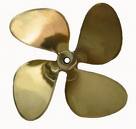
the propellers of the aircraft or ship propellers, accelerate the fluid in which they move, the change in the momentum of the air or water generates the propulsive force by reaction on the propeller.
The axial flow pumps or fan pump, supply energy by increasing the pressure or the flow velocity
 Heliciel.com, the propeller and wing website: calculation and design
Heliciel.com brings together the methods for calculating and designing propellers and wings, and the Heliciel software that applies them. Whether you are designing an aircraft, boat or drone propeller, a wind turbine, a tidal turbine, a fan or a foil, you will find here what you need to understand how it works, size it step by step and check its performance. The site is meant for amateur builders as much as for engineering offices: we want to be a useful link between your imagination and your project.

The propeller is a familiar object, but its design hides real calculation difficulties. A badly sized propeller or wing wastes energy and penalises the whole project. Yet a propeller is only a rotating wing: that is why this site and its software deal with propellers and wings together. Nature understood it before us, with the maple seed.

The maple seed, a natural propeller with a single blade.
On this page:
- Three ways in: understand, design, verify
- Propeller calculation by machine
- The Heliciel propeller design software
- Figures compared with measurements
1: Three ways in: understand, design, verify
The pages of this site work at two levels: formulas for those who want to master the theories, pictures and examples for those who mainly want to build their propeller. Choose your starting point:
- Understand. Propeller pitch, propeller geometry, blade and wing sections, then the theories of propeller and wing calculation. The propeller glossary defines every term, and the history of the propeller tells where they come from.
- Design. The Heliciel tutorials and videos take a propeller from specification to 3D model and detail each function of the software, and the propeller pitch calculator gives the pitch of a boat propeller online.
- Verify. With the PRO CFD extension, Heliciel simulates the flow around the propeller with OpenFOAM: the twenty numerical wind tunnel tutorials go from meshing to reading the results, and CFD simulation of a propeller shows what CFD adds to the classical calculation.
2: Propeller calculation by machine
Propellers fall into two families. Propulsive propellers give energy to the fluid to produce thrust or flow; energy-capturing propellers take energy from it. Each machine has its own entry page:
- propulsion: aircraft propeller, boat propeller, drone and multirotor propeller, fan, axial pump and waterjet;
- energy capture: wind turbine, tidal turbine, Kaplan hydraulic turbine;
- wings and hulls: wing, hydrofoil and sail, waves and drag of a ship hull.
A word of caution: the tools on this site remain within reach of non-specialists, but designing an aircraft or an air transport system requires skills far beyond their scope. It is the work of engineers trained in safety rules.
3: The Heliciel propeller design software
For those in a hurry, the Heliciel propeller and wing calculation software designs a propeller from a simple specification: power, speed, diameter, number of blades, fluid. Heliciel computes the blade element by element with the blade element momentum method (BEM, Blade Element Momentum), sets the pitch angle of each section, displays the performance and exports the 3D model for manufacturing.
It designs energy-capturing propellers (wind turbines, tidal turbines, Kaplan turbines) as well as propulsive ones (aircraft, boat, drone, fan), and also wings, foils and fins. Your AI assistant can even drive it: the Heliciel MCP connector lets you design a propeller in conversation with ChatGPT or Claude, with real calculations from the software.
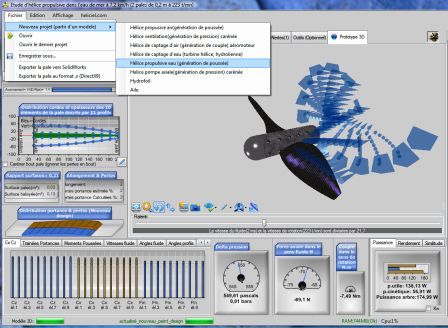
Heliciel: every project starts from a model (propulsive or energy-capturing propeller, fan, wing…) that you then adapt to your specification.
Download or buy Heliciel on mecaflux.com.
4: Figures compared with measurements
A calculation program is only worth the gap between its results and reality. We therefore publish our comparisons, gaps included:
- the validation against the Wageningen B-series compares Heliciel with towing-tank tests of four marine propellers: efficiency agrees, thrust and torque are overestimated by 15 to 27 %;
- the wind tunnel validation on the NR640 and DA4002 aircraft propellers compares thrust and power coefficients and efficiency with measurements from the University of Illinois (UIUC);
- the experimental CFD validation shows how to qualify your own simulation chain.
To go further, we can start with propeller calculation basics, or go straight to the tutorials closest to your project.
 Global site map
 Mecaflux
 Tutorials Mecaflux Pro3D
 Tutorials Heliciel
 Tutorials Heliciel PRO CFD
 Mecaflux Store
 Compare software functions
 Quotes, Orders, Payment Methods
 project technical studies